Silver Dollars & Trade Dollars of the United States - A Complete Encyclopedia
Q. David Bowers
Circulated grades: The 1878-57 TF (as are all) is common in worn grades, but not as common as the mintage indicates, for relatively few were released into circulation until well into the twentieth century. Most worn 1878-S dollars are in higher grades, from VF upward.
Mint State grades: The most often seen S-Mint dollars in high grades are those from 1879-S through 1882-S, of which this is the first in the lineup.
Quantities of 1879-S Morgans remain in all Mint State grades. Most are in the lower ranges of MS-60 through 62 or 63. MS-64 coins are much fewer, but still enough exist that on an absolute basis they are common. The same goes for MS-65. My population estimates follow: MS-60 to 62, 600,000 to 1,000,000; MS-63, 100,000 to 160,000; MS-64, 40,000 to 80,000; and MS-65 or better, 12,000 to 20,000. Most examples are well struck with excellent lustre. Many coins are very heavily bagmarked.
Prooflike coins: Prooflikes are common, and probably at least 15,000 to 30,000 exist, of which about 10% are better than MS-65 PL. Most have fairly low contrast between the fields and devices, and many are prooflike only on one side, DMPL coins are about five times rarer than regular prooflikes, with about 10% better than MS-65 DMPL.
Varieties
Business strikes:
ALL WITH 7 TF REVERSE:
1. Long nock (arrow shaft): Breen-5517, VAM-26, 27, and 56. Very rare. All seen are in low grades.
Discovered circa 1977. Struck beginning April 18, 1878, from the only two usable reverses; of 10 pairs of dies shipped April 8, 1878, three obverses and eight reverses were condemned by the coiner as unusable. This reverse has more significance than just another VAM variety. In time, it may have great value. Presently, only a few specialists seek it. As is true of many Morgan dollar varieties, when the 3rd edition of the Van Allen-Mallis book achieves wide distribution, collector desire for VAM-26, 26, and 56 will undoubtedly escalate sharply.
2. Short nock: Breen-5518. At least 53 varieties from at least 36 pairs of dies shipped in June. Gems and prooflikes are common, mostly one-sided; sliders more so, thanks to the Redfield hoard. Highfill estimates prooflikes as 20 times less often seen than regular Uncirculateds, and eight to 10 times more often seen than DMPLs.
1878-S Morgan: Market Values
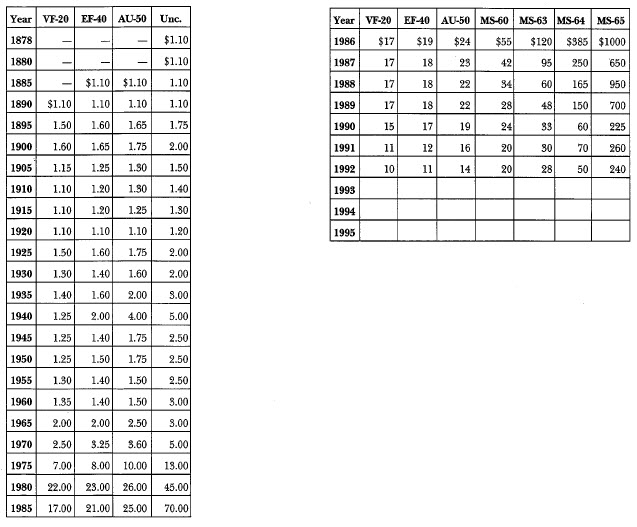
1878-S Morgan: Summary of Characteristics
Business Strikes:
Enabling legislation: As earlier, plus Act of February 2S, IS7S
Designer: George T. Morgan
Weight and composition: 412.5 grains; .900 silver, . 100 copper
Melt-down (silver value) in year minted: $0.89222 Dies prepared: Obverse: 46+; Reverse: 46+; 43+ obverse and 38+ reverse dies actually used.
Business strike mintage: 9,774,000
Estimated quantity melted: Unknown, but probably several million under terms of the 1915 Pittman Act.
Approximate population MS-65 or better: 12,000 to 20,000 (URS-15)
Approximate population MS-64: 40,000 to 80,000 (URS-17)
Approximate population MS-63: 100,000 to 160,000 (URS-18)
Approximate population MS-60 to 62: 600,000 to 1,000,0001(URS-21)
Approximate population G-4 to AU-58: 500,000 to 1,000,000 (URS-21)
Availability of prooflike coins: Prooflikes are common and usually have low contrast; DMPL coins are available but are scarcer.
Characteristics of striking: Usually well struck. Known hoards of Mint State coins: Very large quantities were released by the Treasury Department in the 1950s and, especially, in the 1962-1964 years.
Proofs:
None
Commentary
The 1878-S is a popular and plentiful early San Francisco Mint Morgan dollar. Alleged Proofs offered by B. Max Mehl in the Nygren and Griffith sales (11/30/14 and 2/29/16) and advertised by William & L. Pukall (Numismatist, 10/53) have hot been traced and were probably DMPLs.