Silver Dollars & Trade Dollars of the United States - A Complete Encyclopedia
Q. David Bowers
1880-CC SECOND REVERSE; REV. OF 1878; PAF
Second Reverse: Seven tail feathers, parallel arrow feathers, small cc. "Reverse of 1878." Probably about 10% to 20% of surviving 1880-CC Morgan dollars in Mint State are of this type. All are overdates, but on some coins the overdate feature is not visible. These are from an improperly basined 1878 reverse, struck after September 1880. When Coiner Levi Dague complained to the Philadelphia Mint, Engraver Barber in October ordered Dague to return all 1878 reverses. If Carson City Mint daily or weekly delivery records survive, we may be able to give ballpark mintage figures for this type, which forms a small minority of 1880-CCs. See details below.
A propos of their status and scarcity on the coin market in 1992, John V. Kamin wrote as follows concerning the 1880-CC with Second Reverse:'
This is a truly scarce coin. I have been searching for them for the better part of a quarter century, and have managed to buy only a few, which I passed on to good clients, keeping none. Maybe a couple hundred pieces exist, maybe not. But at prices starting around $150 each, 1880-CC 2nd reverse seems like a bargain for an Uncirculated scarce silver dollar. If I'm lucky enough to find three to six more pieces over the next year, I think I'll put them away for myself.
Circulated grades: As a class, 1880-CC dollars are quite scarce in worn grades. If Mint State ratios are applicable to worn coins also, then about 1,000 to 2,000 circulated 1880-CC Second Reverse dollars exist, as compared about 18,000 or 19,000 of the Third Reverse.
In the late nineteenth century, worn pieces (generically; no differentiation was made as to reverse types) did very well in coin auctions. Later, as Mint State pieces became available from Treasury releases, the desirability of circulated pieces declined.
Mint State grades: Probably, 10% to 20% of the known Mint State coins of this date are of the second reverse. This translates to 10,000 to 15,000 MS-60 to 62 coins, 7,000 to 10,000 MS-63 specimens, 3,000 to 5,000 MS-64 pieces, and only 1,500 to 2,500 in MS-65 or better grade. John V. Kamin's commentary, quoted a few paragraphs earlier, indicates a greater rarity than I suggest. As the 1880-CC Second Reverse has been virtually ignored by cataloguers to date, the jury is still out on this variety. It could well be a prime sleeper. Time will tell.
Prooflike coins: Prooflikes of the Second Reverse are very rare; DMPL coins rarer yet (those seen by Wayne Miller were of the VAM-4 variety). 85% or more of the PL and DMPL coins grade below MS-65. As of September 1992, 41 PL and 38 DMPL had been certified by NGC and PCGS.
1880-CC THIRD REVERSE; REV. OF 1879; SAF
Third Reverse: Seven tail feathers, slanting arrow feather. "Reverse of 1879." Probably about 80% to 90% of surviving Mint State 1880-CC dollars are of this type. Large and small CC mintmark varieties exist. See details below.
Circulated grades: As a class, 1880-CC dollars are quite scarce in worn grades. Probably about 10,000 to 20,000 remain, of which about 80% to 90% may be of the Third Reverse type. The demand forworn pieces is low, as Mint State coins are readily available.
Mint State grades: Probably close to half the original net mintage survives in various Mint State grades. Most Mint State coins are MS-60 through MS-63, although MS-64 and MS-65 coins are in good supply as well. I estimate that about 15,000 to 25,000 MS-65 or finer coins survive, the majority of which are the Third Reverse.
Many of these are lightly struck at the centers, a relatively unusual situation for a Carson City Mint Morgan dollar (but also see 1893-CC). Some have planchet striations caused by the drawing bench procedure. By cherrypicking you can avoid such coins.
Prooflike coins: Prooflikes of the Third Reverse are plentiful, and probably 7,500 to 15,000 exist. DMPL coins are rarer but still remain in large numbers, possibly 3,500 to 7,000 coins. Most PL and DMPL coins grade below MS-65.
Varieties
Business strikes:
SECOND REVERSE
1. Second Reverse: 1880/79-CC: Short nock (arrow shaft). Breen-5551, VAM-4. In date, 80 are almost parallel. Seldom prooflike, rarely DMPL; often weak. I consider this to be the most desirable variety of the 1880-CC. Presently a sleeper.
2. Second Reverse. 1880-CC (technically 8/7). Short nock. Breen-5552, VAM-2 (no traces of overdate) and VAM-7 (8/7 with tiny "ear" of 7 at top of 2nd 8; in date 0 leans left). Both obverses are technically 8/7, but this overdate cannot be seen on VAM-2 and may not show on late die states of VAM-7.
THIRD REVERSE
1. Third Reverse. 1880/7-CC. Small cc. "8/high 7," Breen-5553, VAM-5.
2. Third Reverse. 1880/7-CC. Small cc. "8/low. 7," Breen-5554, VAM-6. Slightly scarce. Alleged normal dates are late states of an 1880/ 7-: Breen-5555. See comments to 1880/79-CC 7 tail feathers PAF above. Gems are common, prooflikes and DMPLs less so.
3. Third Reverse. 1880/7-CC. Small cc. 8/ normal position 7. VAM-8 (later state of obv. die used on VAM-6), 9.
4. Third Reverse. 1880-CC. Large CC. Breen-5556, VAM-1 and 3 (dash under 8, for date logotype positioning). Unknown to A.G. Heaton he listed only the "very small" CC, currently called "small."
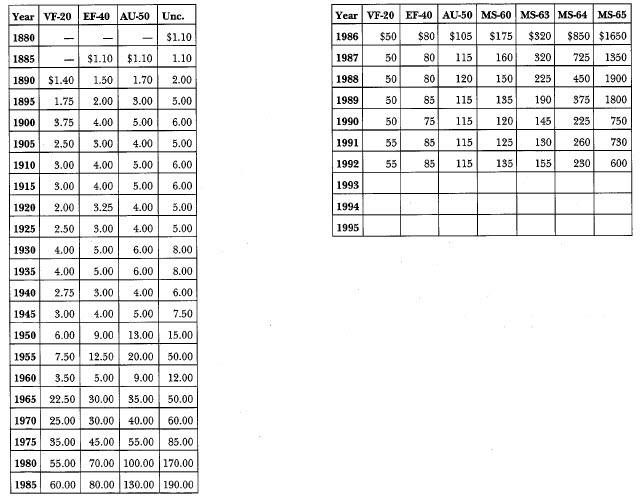
1880-CC Morgan: Market Values