Silver Dollars & Trade Dollars of the United States - A Complete Encyclopedia
Q. David Bowers
In the 1950s, anyone finding a $1,000 bag of 1886 dollars would "throw it back" to the bank, like a fisherman tossing back an undersized trout. Bags of these and most other early Philadelphia Mint Morgan dollars were not wanted, even for face value. If abuyer could be found-and I remember the situation well-a good wholesale price would be $1,100.
Circulated grades: 1886 dollars are very common in worn grades.
Mint State grades: Mint State 1886 dollars are very common. Examples are frequently encountered in all grades from MS-60 through MS-64, and even MS-65 coins are easy to find. Only the 1887 rivals the 1886 in availability among Philadelphia Mint dollars dated before 1921.
Many 1886 dollars are very well struck and have much lustre, although the lustre is often more satiny or "greasy" than deeply frosty. Other coins are poorly struck, particularly at the center of the reverse. Some coins have irregular "metal flow" granularity, especially in the fields and at the borders, and are not numismatically appealing. All in all, there is a very wide variation in quality among Mint Statedollars of this date. Careful buying is advised, especially if you are at all concerned with aesthetics. In the same technical numerical grade, a poorly struck coin with unattractive surfaces might not be worth half as much as a sharply struck, lustrous gem.
Prooflike coins: While semi-prooflike and prooflike coins are very common, high-grade cameo DMPL coins with good striking characteristics are rare. Hundreds in the latter category exist; as of September 1992, PCGS and NGC combined had certified 88 pieces as MS-65 DMPL, and this is just a fraction of the population.
Proofs: 886 Proofs were minted, most of which remain today. High level, unimpaired, uncleaned coins are rare.
Varieties
Business strikes:
1. Normal date: Probably all the 63 obverses and 60 reverses were used until they were worn out. The two distinct styles of date, Even 6, Breen-5586 and High 6, Breen-5588 (VAM-6, 8), apparently represent two different logotypes; which is scarcer has not been determined. The last two shown to Walter H. Breen as "1886/5" had high 6 punched over lower 6; apparently, this is more wishful thinking, than an overdate. High 6 normally has closed 6; Even 6 comes open (e.g., VAM-7) or closed. Some varieties have interesting die chips and gouges around the date and elsewhere.
Proofs:
1. Proof issue. Repunched 1: VAM-4. (Supposedly only one pair of Proof dies was furnished, but two obverse die varieties are known, both with even 6; see below for second variety.)
2. Proof issue. Double date: First date lower and slanting up to right, then corrected higher and level. Breen-5587, discovered in 1974 and still rare. VAM-15, with doubled 18 and 6 in date, dash under second 8, has only 179 edge reeds (use of an anachronistic collar from the early days of Morgan dollar production), as opposed to the usual 189 or 190.
1886 Morgan: Market Values
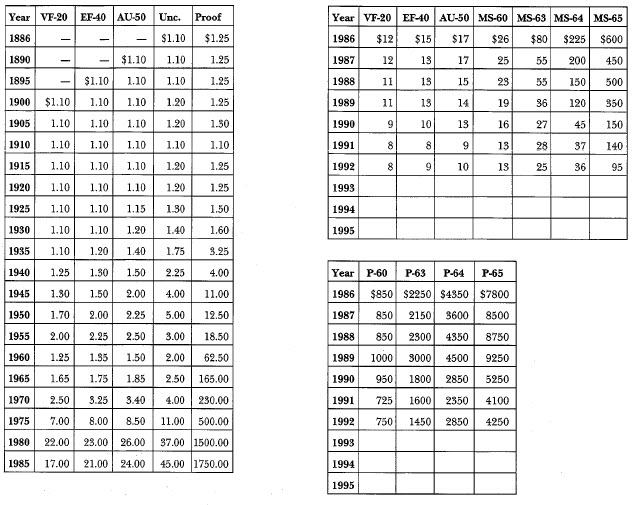
1886 Morgan: Summary of Characteristics
Business Strikes:
Enabling legislation: As earlier, plus Act of February 28, 1878
Designer: George T. Morgan
Weight and composition: 412.5 grains; .900 silver, . 100 copper
Melt-down (silver value) in year minted: $0.769
Dies prepared: Obverse: 63; Reverse: 60
Business strike mintage: 19,963,000; Delivery fig-ures by month: January: 1,700,000; February: 1,700,000; March: 1,700,000; April: 1,700,000; May: 1,700,000; June: 1,563,000; July: 1,600,000; August: 1,800,000; September: 1,900,000; October: 1,800,000; November: 1,400,000; December: 1,400,000.
Estimated quantity melted: Millions at various times, probably including under the 1918 Pittman Act and certainly during the run-up in silver prices in the late 1970s.
Approximate population MS-65 or better: 80,000 to 110,000 (URS-18)
Approximate population MS-64: 275,000 to 400,000 (URS-20)
Approximate population MS-63: 400,000 to 650,000 (URS-20)
Approximate population MS-60 to 62: 1,000,000 to 2,000,000 (URS-22)
Approximate population G-4 to AU-58: 1,500,000 to 3,000,000 (URS-22)
Availability of prooflike coins: Semi-prooflike and prooflike coins are common but usually have low contrast. High-grade cameo DMPL coins are elu-sive, but hundreds exist MS-65 DMPL or finer.
Characteristics of striking: Striking varies from weak to sharp, with most coins being average .
Known hoards of Mint State coins: Many bags were released in the 1930s, 1940s, December 1954, and 1962-1964.
Proofs:
Dies prepared: Obverse: 2; (One die pair according to Mint records, but two obverse die varieties exist.) Reverse: 1
Proof mintage: 886; Delivery figures by month:
January: none; February: none; March: 360; April: none; May: none; June: 165; July: none; August: none; September: 100; October: none; November: none; December: 26l.
Approximate population Proof-65 or better: 98+/- (URS-8)
Approximate population Proof-64: 92+/- (URS-8)
Approximate population Proof-63: 88+/- (URS-8)
Approximate population Proof-60 to 62: 215+/- (URS-9)
Commentary
The 1886 is one of the most common of all Morgan dollars and is readily available in all grades from worn through MS-65.