Silver Dollars & Trade Dollars of the United States - A Complete Encyclopedia
Q. David Bowers
1892-S Morgan Dollar
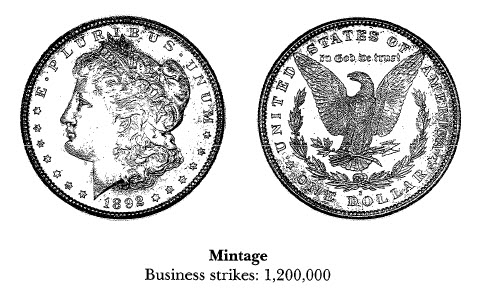
Numismatic Information
Commentary: The 1892-S dollar is one of those United States coins that is very common in worn grades but which is an extreme rarity at the MS-65 level. In 1992, a coin in VG-8 grade was worth about $10, while an MS-65 coin would have brought $50,000 or more at auction. In other words, an MS-65 coin is worth 5,000 times as much as a VG-8! The explanation is that many if not most 1892-S dollars were placed into circulation at or near the time of issue, and few were saved in Mint State.
However, in the days of long ago the 1892-S was not recognized as a rarity. No accolades were given to the issue whenever an Uncirculated coin crossed the auction block in the period extending up to 40 years after it was minted. In Ed. Frossard's sale of March 8, 1898, a Mint State 1892-S fetched $1.05; in the U.S. Coin Co. auction of May 19-21,1915, $1.50 was obtained for another; and in Thomas L. Elder's auction of April 13-14, 1917, $1.50 was again achieved. In fact, it was not until comparatively recent years that the rarity of the 1892-S has been recognized; this after the San Francisco Mint dispersals from storage in the 1940s and 1950s apparently yielded no bags of this date, nor were any among the untold millions of Morgan dollars paid out by the Treasury during the 1962-1964 emptying of government vaults. However, it is known that at least one bag of 1892-S dollars was paid out by the San Francisco Mint in 1925-1926. Few coins reached numismatic circles, as there was little collecting interest in Morgan dollar mintmarks at the time. Perhaps, some of the AU coins now known came from that release.
In higher circulated grades from EF-40 to AU-58 the 1892-S is readily available today. For a long period of time, such coins were overvalued in the market and were riding on the coattails of the truly rare Mint State coins. Stanley Apfelbaum, founder and president of First Coinvestors, of Albertson, New York, told me that in the 1970s his firm made a lot of money by selling AU 1892-S dollars to investors who did not know much about coins. His customers, for the most part, were not numismatists and were not part of the collecting fraternity. As they were much cheaper than Uncirculated coins, they appeared to be bargains, and selling them was easy to do.
Today, the 1892-S is known to be a rarity in higher grades, but for some unknown reason, the issue is not popular with collectors, dealers, or investors. It is almost as if a cloud is hanging over each 1892-S. Possibly, this commentary in Wayne Miller's widely-read Morgan and Peace Dollar Textbook turned potential buyers away:
The 1892-S has been denigrated as a poor investment by most advisory letters, to the effect that it is one of the few key date Morgans that is not instantly salable in fully gem condition .... Because of the enormous price which a fully BU piece commands, AU specimens are often advertised at clearly exorbitant prices. Beware of high-grade 1892-S dollars which are toned on both sides. Such toning is often artificial, and is intended to cover up wear, abrasions, carbon spots, etc., or to mask the discoloration which occurs when a mintmark is soldered onto a silver dollar.
However, Miller was not creating news-he was reporting it. The 1892-S was a silver dollar without honor in its own country long before Wayne Miller took pen to paper to write about it.
I suspect another root cause is that years ago nearly all coins that were called "Uncirculated" were, upon careful examination, what we would call AU today. Because of this, historical prices as reflected in advertisements and catalogues over the years are not a guide to availability. "What an understatement!" exclaimed dealer and market-watcher Maurice Rosen, upon reading the manuscript of this book. (Undated commentary received by the author, November 2, 1992) "The same is true for a host of other dates including 1883-S, 1884-S, 1903-S, 1904-S, and 1921-S," he continued.
Circulated grades: In lower worn grades the 1892-S dollar is very common. In EF and AU 1892-S dollars were common as recently as the 1960s and 1970s, but today they are somewhat scarce. Perhaps Stanley Apfelbaum cleaned out the market so well, and placed the coins so far away from the mainstream of numismatic activity, that they will stay off the market for a long time.
Mint State grades: In true Mint State the 1892-S is very rare. In 1982, Wayne Miller expressed the opinion that no more than 200 choice (MS-63 or better) specimens exist. Beware of AU coins being offered as Mint State. The advent of the certification services has been a boon to silver dollar collectors, and you can bet your bottom (Morgan) dollar that an 1892-S certified by NGC or PCGS as MS-63, MS-64, or MS-65 is a dandy coin worth owning. Curiously, population reports issued by certification services indicate that more MS-65 pieces have been graded than have coins at MS-63 or MS-64 levels. The reason for this is not known, but resubmission of the same coins may have occurred. Also, there is some truth to the situation, in that high-grade 1892- S dollars I have seen have usually been very, very nice-such as MS-64 or MS-65-or have been close to MS-60. There is no large middle ground for this date in Uncirculated grades.