Silver Dollars & Trade Dollars of the United States - A Complete Encyclopedia
Q. David Bowers
1882-O/S Morgan Dollar
Coinage Context
Die making. At the Philadelphia Mint in late 1881, when 1882-dated obverse dies were being made, apparently a number of reverse dies bearing S mintmarks were overpunched with 0 dies. The reason for this is not known, unless too many S dies were made in advance, and the decision was made to convert some of these for New Orleans Mint use.
Numismatic Information
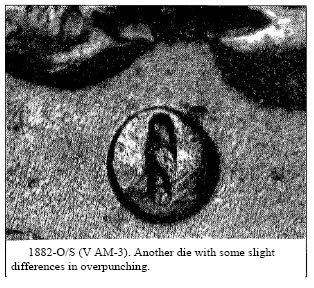
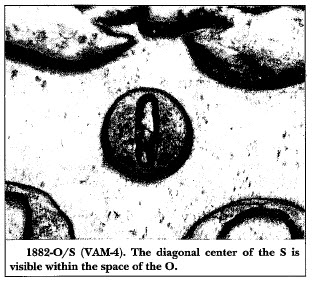
About the overmintmark: The 1882-O/S overmintmark is interesting, and apparently first came to light in the early 1960s when coins from the Treasury release were examined in detail, first by A. George Mallis, Leroy Van Allen, and their contemporaries, and later by a host of readers of the Van Allen-Mallis book. By the time that the Van Allen-Mallis book saw publication, four die varieties were known,to which a fifth was added in 1975 by Bill Fivaz and a sixth in 1976. On about half of the varieties the O/S feature is very weak; these coins are worth less in the marketplace. The new 3rd edition of the Van Allen-Mallis work eliminates certain numbers earlier considered to be O/S and consolidates the O/S listing to just three varieties: VAM-3, 4 and 5.
In his study, Die Varieties in the Morgan Dollar Series, Jeff G. Oxman discusses the 1882-O/S in detail, and the varying die states, listing the characteristics. He concluded that there were three distinct reverse dies, each of which occurs in two states, causing six varieties altogether, but really from just three dies, as noted. All are from rusted dies except the two or three known prooflikes. Taken as a group, the 1882-O/S overmintmark coins are manytimes rarer than regular 1882-O coins, however this rarity has not been appreciated as the variety has not been widely collected to this point. The only other highly publicized overmintmark in the silver dollar series is the 1900-O/CC, which has received fairly wide acceptance in recent years, much more so than the 1882-O/S.
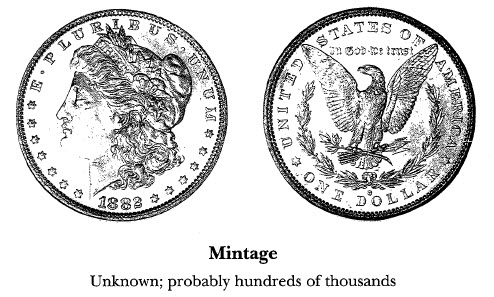
Circulated grades: The issue is readily available in worn grades, although the overmintmark feature is sometimes very weakly defined. Probably, 10,000 to 20,000 or more survive.
Mint State grades: The 1882-O/S is very scarce in lower Mint State grades, scarcest in MS-64, and very rare MS-65. The PCGS tour of silver dollars, which took place in 1990 and 1991 and which featured some of the finest certified coins, borrowed from various sources, assembled to make up an exhibit collection, had an 1882-O/S in just MS-64 grade, one of the very few coins in the exhibit to be less than MS-65. I suggest that approximate populations are as follows: MS-60 to 62, 500 to 1,000; MS-63, 200 to 400; MS-64, 100 to 200; and MS-65, none to 10.
PCGS had certified any PL or DMPL examples. Jeff Oxman reported that no two-sided prooflikes are known. (Ibid., November 29,1992.)
Varieties
Business strikes:
1. 1882-O/S overmintmark: Three varieties unequivocally displaying the 1882-O/S featurehave been found; Breen-5567, VAM 3-5. Some other varieties may have been overmintmarks, but the O/S is indistinct. (Use the 3rd edition of VAM when attributing this overmintmark.) All were struck from pitted dies. Usually the variety is seen softly struck. The entire situation of the 1882-O/S has been the subject of much discussion among specialists.