Silver Dollars & Trade Dollars of the United States - A Complete Encyclopedia
Q. David Bowers
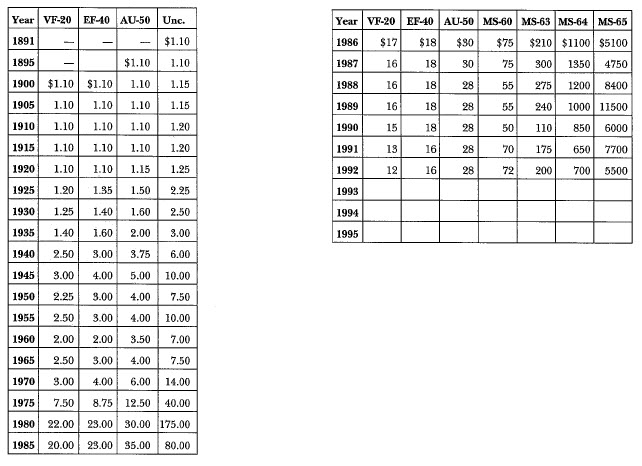
1891-0 Morgan: Market Values
1891-0 Morgan: Summary of Characteristics
Business Strikes:
Enabling legislation: Act of February 28, 1878, plus the Sherman Silver Purchase Act of July 14, 1890 and the Trade Dollar Recoinage Act of March 3, 1891
Designer: George T. Morgan
Weight and composition: 412.5 grains; .900 silver, .100 copper
Melt-down (silver value) in year minted: $0.76416
Dies prepared: Obverse: 30; Reverse: 29
Business strike mintage: 7,954,529; Delivery figures by month: January: 1,000,000(Under Act of February 28, 1878); February: 500,000(Under Act of February 28, 1878) + 500,000(Under Act of July 14, 1890.); March: 414,082 (Under Act of February 28,1878.) + 500,000(Under Act of July 14, 1890); April: 600,000(Under Act of July 14, 1890); May: 5,831(Under Act of February 28,1878.) + 400,000(Under Act of July 14, 1890.); June: 200,000(From trade dollar bullion under the Act of March 3, 1891. These cannot be distinguished )+ 500,000(Under Act of July 14, 1890.); July: 500,000(This and months through December from trade dollar bullion under the Trade Dollar Recoinage Act of March 3, 1891. These cannot be distinguished.); August: 560,000; September: 400,000; October: 500,000; November: 950,000; December: 424,616. Totals: 1,919,913 under the 1878 Act, 2,500,000 under the 1890 Act, 3,534,616 under the 1891 Act, dispersing of 3,471,488 Trades.
Estimated quantity melted: Probably a few million under the 1918 Pittman Act.
Approximate population MS-65 or better: 250 to 400 (URS-10)
Approximate population MS-64: 2,000 to 4,000 (URS-13)
Approximate population MS-63: 10,000 to 15,000 (URS-15)
Approximate population MS-60 to 62: 35,000 to 55,000 (URS-17)
Approximate population G-4 to AU-58: 200,000 to 400,000 (URS-19)
Availability of prooflike coins: Prooflikes exist to the extent of 200-400 (URS-9); DMPL coins are about twice as rare. Nearly all are below MS-65.
Characteristics of striking: The 1891-O is the worst struck of all Morgan dollars. Nearly all show weakness to one degree or another, and some are flat at the centers.
Known hoards of Mint State coins: Unspecified large quantities were in the Treasury releases of 1962-1964. Earlier, the Treasury released bags from time to time.
Proofs:
None
Commentary
The 1891-O dollar has the unique distinction of being the only issue in the Morgan series of which during the year specimens were struck under three different authorizations: the 1878 Bland-Allison Act, the 1890 Sherman Silver Purchase Act, and the 1891 Trade Dollar Recoinage Act. Although this fact has been nearly universally overlooked in texts describing the issue, I find it fascinating.
Additional Information
New Orleans Mint Operations
The Annual Report of the Director of the Mint, 1891, commented as follows:
"The operations of the coiner's department during the fiscal year were confined exclusively to the manufacture of silver dollars. This department operated upon 17,382,560 standard ounces of silver ingots and delivered to the superintendent 9,870,913 silver dollars, being 48.8% of finished coin produced from ingots operated upon. The mechanical wastage was 3,417.63 standard ounces, or about 19.63% of his legal allowance."
Distribution of Silver Dollars
The Annual Report of the Director of the Mint, 1891, told of the distribution of silver dollars at the New Orleans Mint: In mint July 1, 1890, $8,459,974; coinage of the fiscal year 9,870,913; in mint July 1, 1891, 10,884,500; distributed from mint: 7,446,387.