Silver Dollars & Trade Dollars of the United States - A Complete Encyclopedia
Q. David Bowers
1921 Morgan Dollar
Coinage Context
An unnecessary coinage: The coinage of Morgan silver dollars in 1921 was accomplished under the provision of the Pittman Act of April 23, 1918, which mandated that hundreds of millions of older silver dollars be melted down into bullion, and that the government should take the proceeds and buy new silver for a price of $1 per ounce, a considerable premium over current market levels. This was a sop to Western silver mining interests.
While the Bland-Allison Act of 1878 and the Sherman Silver Purchase Act of 1890 mandated thepurchase of unneeded, unwanted silver bullion at current market price, the Pittman Act dictated that the government pay considerably more than market. As usual, American taxpayers bore the brunt of the effect.
There was little interest at the Mint in the recoinage program, and it was deemed expedient to resurrect the old Morgan design for further use. The earlier hubs had been destroyed in 1910, when no-body expected any further coinage of Morgan dollars. Morgan (with help from J.R. Sinnock) made copy hubs based on an 1878 7 Tailfeathers PAF, but in shallower relief and much poorer quality. Apparently, the original hubs had been destroyed or were deemed unfit for use, so new transfer hubs were made, these being of shallower relief and much poorer quality that those used during the earlier era.
Numismatic Information
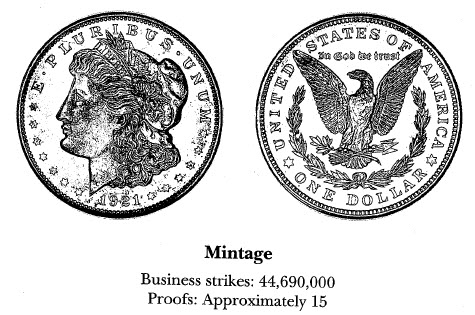
Commentary: In 1921, the Mint redesigned the Morgan dollar. The new coin was in shallow relief with many features less well defined than on earlier (1878-1904) issues. Comparison of a 1921Morgan dollar (from any of the three mints) with an issue from the early 1900s will show many differences.
On the obverse of the 1921, the portrait of Miss Liberty is very shallow, and the cheek is almost flat; the lines of her hair are bolder and better defined; and there is no crease above her chin, among other distinctions.
On the reverse of the 1921, the eagle is flat with virtually no breast feather detail, the arrow feathers are parallel (copied after an 1878 7 tail feathers, parallel arrow feathers, reverse), and the stars are slightly larger.
In 1910, six years after the last coinage, the Engraving Department at the Philadelphia Mint believed that the days of the Morgan dollar were gone forever, and old hubs were destroyed. When the order camein 1921 to rush production of more Morgan dollars, new hubs were made by George T. Morgan and John R. Sinnock, but in shallow relief in
order to facilitate quantity striking in a hurry. It was realized that one thing the world needed was not more silver dollars, and that most would simply go into storage (where countless millions of earlier dates already were in moldering bags). There was no need to consider aesthetic appeal.
The dollars of this year have an interesting distinction: a monograph, The 1921 Morgan Dollars: An In-Depth Study, by Mike Carter, was written about them. The author devoted over two dozen pages to the various aspects of dollars from the three mints. In his introduction, the author noted in part:
I love 1921 Morgan dollars! I am one of the very few numismatists who would ever say such a ridiculous thing .... They have been shunned by collectors and investors alike for various reasons from being poorly struck to being the most common of all the Morgan dollar dates. I believe that the 1921s have been treated unjustly, and in the ensuing text we will take a look at some interesting facts about these dollars that just may change the minds of more than a few of you.
Hoard coins: Many bags of coins were released over a long period of time. Eventually, they became so common that dealers' buying prices for Uncirculated bags and rolls of Morgan dollars often said "except 1921." As a result, most bags were broken up. Today, relatively few original mint-sealed bags exist. However, individual coins from these bags are exceedingly common.
Circulated grades: Worn 1921 dollars are extremely common. Probably, 10 to 15 million exist. Time was in the mid-1960s when the majority of dollars seen at Nevada gaming tables were 1921 dollars (Philadelphia coins primarily, but also Denver and San Francisco Morgan dollars). Many millions were melted in the run-up of silver bullion prices during the 1970s.
Mint State grades: Nearly all pieces are very poorly struck. This, added to the shallow relief of the dies, is responsible for the unsatisfactory appearance of nearly all specimens in existence today. Even coins certified as MS-65 are apt to be ugly in this re-gard. I have seen "MS-65" coins that would be graded no better than MS-61 or MS-62 if they were of earlier dates. If you want to see an amazing study in contrasts, simply compare a certified MS-65 1881-S dollar with a like certified 1921 Morgan; there is virtually no similarity whatsoever!
Most known specimens are in low grades such as MS-60, 61, or 62. The striking is so poor that the difference between an MS-60 and a lightly circulated AU-58 is often moot.