Silver Dollars & Trade Dollars of the United States - A Complete Encyclopedia
Q. David Bowers
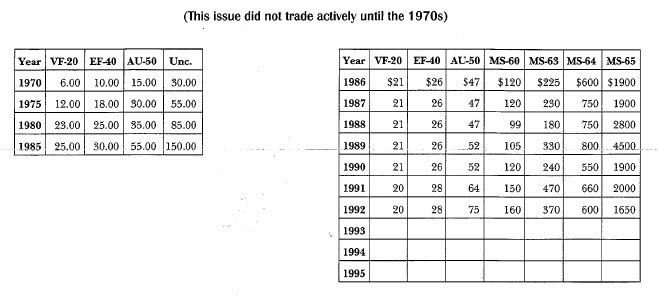
1900-0/CC Morgan: Market Values
1900-0/CC Morgan: Summary of Characteristics
Business Strikes:
Enabling legislation: Act of February 28, 1878, plus the Sherman Silver Purchase Act of July 14, 1890
Designer: George T. Morgan
Weight and composition: 412.5 grains; .900 silver, .100 copper
Melt-down (silver value) in year minted: $0.47958
Dies prepared: Obverse: Unknown; Reverse: 5 reverse dies were reshipped from Carson City (then used as an assay office) to Philadelphia in late 1899, where they were resurfaced and punched with 0 mintmarks, creating the 1900-O/CC.
Business strike mintage: Unknown; probably 10% to 20% of the 12,590,000 mintage of 1900-O; approximately 1,250,000 to 2,500,000 coins.
Estimated quantity melted: Unknown, but probably an equivalent percentage of 1900-O melts.
Approximate population MS-65 or better: 1,000 to 2,000 (URS-12)
Approximate population MS-64: 5,000 to 10,000 (URS-14)
Approximate population MS-63: 10,000 to 20,000 (URS-15)
Approximate population MS-60 to 62: 40,000 to 80,000 (URS-17)
Approximate population G-4 to AU-58: 100,000 to 200,000 (URS-18)
Availability of prooflike coins: None known.
Characteristics of striking: Average .
Known hoards of Mint State coins: Many bags were released by the Treasury 1962-1964. 1900-O/CC were mixed in with and formed a small percentage of some bags of 1900-0 coins (also see preceding listing).
Proofs:
None
Commentary
Discovered by Howard R. Newcomb and/or Will W.Neil (who published it in the 1920s), the 1900-O/ CC was the first "overmintmark" in any American numismatic series to be brought to light.
1900-S Morgan Dollar
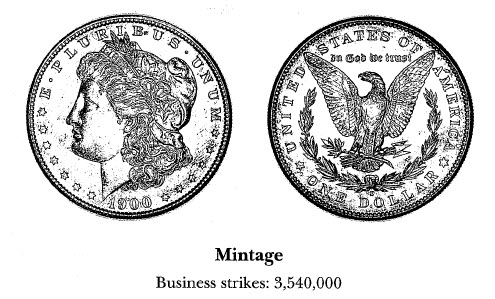
Coinage Context
Into storage: At the time of mintage, the demand for 1900-S dollars was minimal, and many went into government storage.
Numismatic Information
Two reverse hubs: In 1900, both C-3 and C-4 reverses (see description under 1900 Philadelphia dollars) were employed in San Francisco. The varieties are significantly different, but to this day only relatively few collectors have had both varieties in their holdings. The advent of the new third edition of the Van Allen and Mallis book, released in September 1992, will undoubtedly spur interest. This useful volume was out of print for a decade earlier, and virtually a new generation of collectors and investors has come into the market since that time, and have not had the book to use.
Hoard coins: Vast quantities of 1900-S dollars were stored at the San Francisco Mint. These were paid out over a period of years in the late 1930s, 1940s, and 1950s. Many went to Nevada casinos in the latter decade.
In the 1962-1964 period, many additional bags were released. By the time that the government stocks were exhausted, 1900-S was a plentiful coin in the hands of investors, dealers, and the public.
Circulated grades: In worn grades, the 1900-S is fairly scarce. AU coins turn up with some frequency, however, and are probably coins paid out in the West in the 1940s and 1950s.
Mint State grades: Specimens are readily available from the Treasury release. Most are in lower gradesfrom MS-60 through 62, at which level I estimate 20,000 to 30,000 are known, followed by 10,000 to 18,000 at the MS-63 stage. MS-64 coins are about twice as hard to find and number 5,000 to 10,000, while MS-65 or better pieces, of which 1,250 to 3,500 are estimated to survive, are scarcest of all.
Some coins show parallel striae or lines on the planchet, from the drawing bench step in the planchet preparation process. Strike on 1900-S dollars varies from flat to average to sharp. Most have attractive frosty lustre. Cherrypicking will reward the buyer. As noted, those from the C-4 reverse are not as sharply defined, as the hub was not as detailed as C-3. As such, a "weakly struck" C-4 may be normal C-4; make an inspection to tell the difference.
Prooflike coins: Prooflike coins remain to the extent of several thousand coins, most of which are unattractive in appearance. The Redfield estate (1976) is said to have had several hundred with subdued lustre and/or spotting, possibly from exploding cans of peach juice once stored near the dollar cache. DMPL specimens are about a dozen times harder to find than PLs. Most DMPLs are in lower grades. The "Proofs" offered by the Pukalls (The Numismatist 2/47,10/53) were probably DMPLs.
Varieties
OLD REVERSE HUB: NARROW WING/NECK SPACE, SMALL STARS
VAM C-3 REVERSE
Business strikes:
1. Narrow S. Breen-5674, VAM-1. Common from hoard coins. Probably most of the 35 pairs of dies were not used; certainly few old reverses were.
2. Wide S. Breen-5676. VAM-2, 4, latter with doubled 00. Much more often seen with new reverse over old reverse (below).
3. Narrow S mintmark over wide S. VAM-3A. A wide S mintmark was punched over a slightly doubled narrow S on a die that had already been used, indicating that the San Francisco Mint must have had its own supply of S punches (alternatively and less likely, the die was returned to Philadelphia for reprocessing, then sent back to San Francisco). Walter H. Breen suggested that all three S mintmarks are of the same size, and the mintmark is simply triple punched.(Thomas K. DeLorey also believes this is a triple-punched mintmark. Letter to the author, November 13, 1992.) Jeff Oxman stated the following: (Letter to the author, November 29, 1992.)
Society of Silver Dollar Collectors members have discussed this variety at length and have concluded it is a dual mintmark variety, that is a narrow S over a wide S. However, we believe that ALL mintmarks were applied in Philadelphia, never at the branch mints. The following scenario is likely:
1899 and 1900 represented transition years for San Francisco mintmarks, since prior to this, a narrow S punch was used exclusively, and beginning in 1901, a wide S punch became the principal mintmark for the rest of the dollar series. It is quite conceivable that an engraver inadvertently used a narrow S punch that had been the standard punch up to this time, and then corrected his mistake by repunching the die with the wide S punch. Although the narrow S may well have been properly effaced from the die, it became visible again when minute pieces of metal which had covered the old mintmark fell out as a result of the pounding incurred while striking coins. In the case of the narrow S mintmark over wide S, two states of the die areknown. One features only a repunched narrow S mintmark, whereas the later state shows the remains of the wide S as well.
NEW OVER OLD HUB: DOUBLE OLIVE AT CLAW
VAM C-4 OVER C-3 REVERSE
Business strikes:
1. C-4 reverse hub over C-3, "2 Olive Reverse" (VAM nomenclature). Large wide S: VAM-16. Breast feathers not well formed, as on all C-4 dies. Forms a small minority of this date.