Silver Dollars & Trade Dollars of the United States - A Complete Encyclopedia
Q. David Bowers
1902 Morgan: Market Values
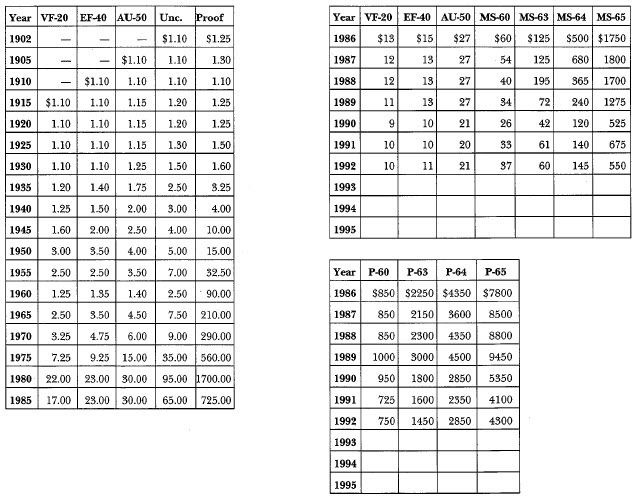
1902 Morgan: Summary of Characteristics
Business Strikes:
Enabling legislation: Act of February 28, 1878, plus the Sherman Silver Purchase Act of July 14, 1890
Designer: George T. Morgan
Weight and composition: 412.5 grains; .900 silver,.100 copper
Melt-down (silver value) in year minted: $0.40835
Dies prepared: Obverse: 80; Reverse: 67
Business strike mintage: 7,994,000; Delivery figures by month: January: 800,000; February: 786,000; March: 750,000; April: 1,000,000; May: 500,000; June: 586,000; July: 500,000; August: 778,000; September: 1,054,000; October: none; Novem-ber:726,000; December: 514,000.
Estimated quantity melted: Many under the Pittman Act and later authorizations, but the minorityprobably went into circulation.
Approximate population MS-65 or better: 5,000 to 10,000 (URS-14)
Approximate population MS-64: 15,000 to 30,000 (DRS-15)
Approximate population MS-63: 20,000 to 35,000 (URS-16)
Approximate population MS-60 to 62: 80,000 to 160,000 (URS-18)
Approximate population G-4 to AU-58: 750,000 to 1,500,000 (URS-21)
Availability of prooflike coins: Prooflike coins are very scarce. Most have unsatisfactory surfaces.
Characteristics of striking: Ranges from poor to sharp, but most are average or above average.
Known hoards of Mint State coins: Large quantities were released by the Treasury, especially in the late 1950s.
Proofs:
Dies prepared: Obverse: At least 1; Reverse: At least 1.
Proof mintage: 777; Delivery figures by month:
January: none; February: none; March: 312; April: 65; May: none; June: 60; July: none; August: none; September: 60; October: none; November: none; December: 280.
Approximate population Proof-65 or better: 46+/-(URS-7)
Approximate population Proof-64: 120+/- (URS-8)
Approximate population Proof-63: 88+/- (URS-8)
Approximate population Proof-60 to 62: 225+/-(URS-9)
Commentary
The 1902 is common in lower Mint State levels but is quite elusive MS-65.
Additional Information
Coinage Commences
The Numismatist, February 1902, printed this item:
"On January 13th the Philadelphia Mint began the first issue of our coins with the date of 1902. They werethe bright and shining silver dollars and were immediately placed in service in the commercial world through the banks."
Distribution of Dollars
The Annual Report of the Director of the Mint, 1902, told of the distribution of silver dollars during the fiscal year: Phila-delphia: In mint June 30,1901,86,075,954; transferred from Treasury for storage, 500,000; coinage, fiscal year 1902, 8,196,800; total, 94,772,754; in mint June 30, 1902, 94,352,954; distributed from mint, 419,800.
Storing Silver Dollars
The Annual Report of the Director of the Mint, 1902, gave details of the new Philadelphia Mint facilities, which replaced the old structure that had been in use since the 1830s. The coinage operations at Philadelphia were transferred from the old to the new Mint structure in October 1901. The capacity of the new facility was more than twice that of the old. Further:
"For the storage of bullion, coin, blanks, dies, etc., the Mint is provided with 20 steel-lined vaults, eight of which are located in the basement and are as follows: The silver dollar vault, which is 100 feet long, 52 feet wide, and 10-1/2 feet high, has a capacity for storing $112 million in silver dollars, packed in boxes.
"The cashier's working vault, measuring 80 feet long, 52 feet wide, and 10-1/2 feet high, is used for storing the various denominations of coin prior to shipment. The remaining six vaults in the basement are 122 feet long, 21 feet wide, and 10- 1/2 feet high, and are provided with four entrances, all opening into the main corridor. These are utilized for the storage of gold and silver bullion, bars, etc. These vaults are all of the most approved modern construction. The combined weight of steel used in their construction is approximately 3.25 million pounds
"The two largest vaults are divided into several compartments, which, after filling, are locked and sealed so as to avoid, as much as possible, the necessity of reweighing and recounting. The foundation of vaults is of concrete, the walls of hard bricks laid in cement 2-1/2 feet thick; the linings are from two to three inches thick, consisting of steel construction which has passed through a special purpose. the doors are six inches thick and there are three for each vault; the front door, weighing about eight tons, is mounted on ball bearings; the other two doors are arranged in one set and are somewhat lighter than the front door. Four combination locks are used, which can be adjusted to independent combination. The remaining vaults throughout the building are of lighter construction are used only for storage of metal in the process of coinage."