Silver Dollars & Trade Dollars of the United States - A Complete Encyclopedia
Q. David Bowers
1884-CC Morgan: Market Values
Business Strikes:
Enabling legislation: As earlier, plus Act of February 28, 1878
Designer: George T. Morgan
Weight and composition: 412.5 grains; .900 silver, .100 copper
Melt-down (silver value) in year minted: $0.85904
Dies prepared: Obverse: 10; Reverse: 10
Business strike mintage: 1,136,000; Coinage figures (by months; incomplete): January: June: not known; July: 75,000; August: 100,000; September: 100,000; October: 100,000; November: 100,000; December: 101,000.
Specimens sent to the Assay Commission: 71
Estimated quantity melted: Very few.
Approximate population MS-65 or better: 30,000 to 35,000 (URS-16)
Approximate population MS-64: 110,000 to 120,000 (URS-18)
Approximate population MS-63: 350,000 to 375,000 (URS-20)
Approximate population MS-60 to 62: 550,000 to 575,000 (URS-21)
Approximate population G-4 to AU-58: 5,000 to 10,000 (URS-14)
Availability of prooflike coins: Common in prooflike as well as DMPL. Most have cameo contrast and are in lower grade levels, although many high-grade coins exist as well. Tens of thousands survive totally. The second most common (after 1883-CC) Carson City dollar with PL or DMPL finish.
Characteristics of striking: Usually seen well struck. Known hoards of Mint State coins: Bags of 1,000 coins were released by the Treasury in 1938, the mid-1950s, and early in the 1960s; 962,638 were held back from 1962-1964 Treasury release and subsequently sold by the General Services Administration. Over 1,000,000 Mint State coins remain.
Proofs:
None
Commentary
Nearly all of the original mintage exists today in Mint State: over one million in all; the highest percentage of any Morgan dollar (91 % or more), and the largest surviving population of any Carson City dollar.
1884-0 Morgan Dollar
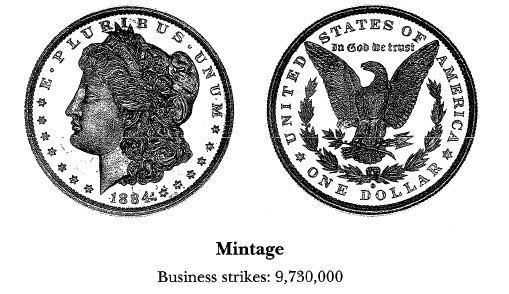
Coinage Context
At the mint: The coinage department of New Orleans Mint devoted all of its energy this year to the manufacture of silver dollars. No other silver coin denominations were minted, nor were any struck in other metals.
Numismatic Information
Hoard coins: Mint-sealed bags of 1884-O Morgan dollars were released in 1933·1934, 1938, and again in the 1950s, from storage in the Treasury Building in Washington, D.C. These dispersals were insignificant compared to the veritable deluge of 1884-O dollars that spewed forth from storage in the Philadelphia Mint beginning in October 1962. Some from the latter distribution later showed up in the memorable hoard owned by the Continental-Illinois Bank.
The 1883-O, 1884-O, and 1885-O constitute the bulk of approximately 10 million coins released from a long-sealed vault in the Philadelphia Mint, beginning in October 1962. While many went into the hands of investors, hoarders, and collectors, others-possibly amounting to millions of pieces totally-went into circulation. Many of these were melted in the 1970s during the run-up in silver bullion prices.
Circulated grades: The 1884-O is very common in worn grades.
Mint State grades: From an availability viewpoint, the 1884-O is closely related to the 1883-O and 1885-O. The 1884- is very common in Mint State, and millions exist. The issue is readily available at all levels from MS-60 through MS-65, although most are in the lower ranges. At the MS-60 to 62 level an estimated two to three million survive, followed by 750,000 to 1.25 million MS-63s, 350,000 to 500,000 MS-64s, and 60,000 to 100,000 MS-65 or better examples.
Many coins are seen with extensive bagmarks, the resultof storage, moving, and counting over the years. Although some coins are poorly defined at the center, most coins are of average to somewhat bold sharpness.
Prooflike coins: Prooflike coins are very common, especially in lower Mint State grades. The majority are heavily bagmarked and show little contrast between the devices and fields. Prooflike coins are often flatly struck, unlike the typical business strike. Most prooflikes are of the Oval 0 variety.
An estimated 15,000 or more PL and about the same number of DMPL exist. About 10% of these are MS-65 or better.
Proofs: A few Proofs were coined, but I have seen no original documentation stating the reason why. See No.1 under Proofs, below.
Varieties
Business strikes:
1. Oval O (slit opening): Breen-5577. In all 20 pairs of dies; if this figure is not in error, not onlywere all used, most must have been used until theywore out (many of the coins actually look that way).A far more likely figure is 40 pairs. Some obverses show partly repunched date; many reverses show repunched 0; see VAM. VAM-6 is the most dramatic of the numerous % repunchings of this year.
1884-O Round O (wide opening), Breen-5578, VAM-2, 18. Forms a small minority of the date, butstill many exist. Troy Thoreson showed Walter H.Breen one with solid mintmark: compare VAM-5.
Note: 1884-O represents a transition from the Medium Oval O mintmark (1879-1884) to the Round O mintmark (1884-1904).
Proofs:
1. Proof issue: A very few Proofs were struck, one of which was in the collection of Ambassador and Mrs. R. Henry Norweb, at $20,900, ex Robert Brock, University of Pennsylvania, Rovensky:99. The earli-est records were in S.H. & H. Chapman's sale of the Ferguson Haines Collection (Oct. 17-18, 1888), at a then high $3.50 (over double what Philadelphia Proofs brought), and in their June 16-17, 1889 sale at $4, with the claimthat only one other was known. Wayne Miller, who did not see the Norweb coin prior to the publication of his 1882 book, was not aware of Proofs of this date. Probably, most catalogued as "Proof' over the years are, in fact, prooflike business strikes. However, I considered the Norweb coin, which I personally catalogued, to be an unequivocal Proof, a status that was not questioned by any of the bidders at the sale.