Silver Dollars & Trade Dollars of the United States - A Complete Encyclopedia
Q. David Bowers
My population estimates follow: MS-60 to 62, 75 to 150 coins exist; MS-63, 25 to 50; MS-64, 10 to 20; and MS-65 or better, 25 to 50.
Most Mint State 1892-S dollars are well struck and have good mint lustre and a minimum of bagmarks. High-grade examples are usually a joy to behold.
Prooflike coins: Prooflike coins exist among the few surviving Mint State coins. DMPL coins are exceedingly rare; As of September 1992, just one had been certified.
Caveat emptor: It has been said that forgeries exist of the 1892-S dollar, and that most are 1892 Philadelphia Mint coins with an S mintmark added. However, Thomas K. DeLorey, who for a long time was director of the American Numismatic Association Certification Service, stated this: "I never saw an added S."2 Nevertheless, any high-grade 1892-S should be authenticated before purchase. Further, because of the wide difference in price vs. grade of authentic 1892-S dollars, it is important to have a coin graded carefully. In fact, caveat emptor with regard to an 1892-S dollar refers mainly to any purchase transaction in which you might engage. A slight difference in grade can mean a huge difference in price. Be careful!
Varieties
Business strikes:
1. Normal date: Breen-5627. Besides the VAM varieties, Walter H. Breen reports another: date well to right, traces of repunching on bases of 89; mintmark completely filled.
2. Doubled Date. Breen-5628. VAM-2. Usually seen in low grades. Rare.
1892-S Morgan: Market Values
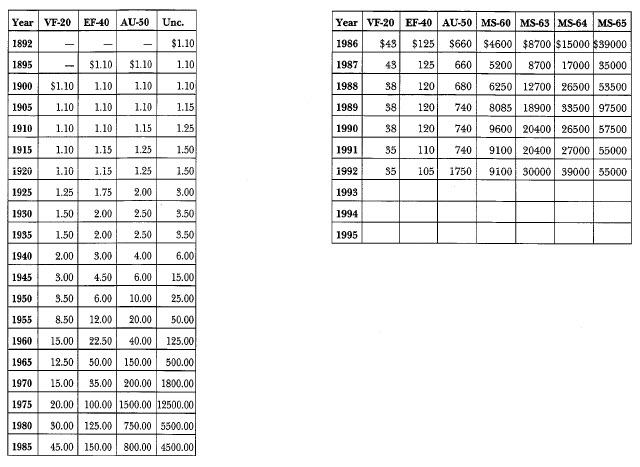
Business Strikes:
Designer: George T. Morgan
Weight and composition: 412.5 grains; .900 silver, .100 copper
Enabling legislation: Act of February 28, 1878, plus –the Sherman Silver Purchase Act of July 14, 1890
Melt-down (silver value) in year minted: $0.67401 Dies prepared: Obverse: Unknown; Reverse: Unknown.
Business strike mintage: 1,200,000; Delivery figures by month: January: 100,000; February: 100,000; March: 100,000; April: 100,000; May: 100,000; June: 100,000; July: 100,000; August: 100,000; September: 100,000; October: 100,000; November: 100,000; December: 100,000. (The uniform delivery rate of 100,000 coins per month in San Francisco during the year 1892 is remarkable in the annals of mint operations.)
Estimated quantity melted: Very few Mint State coins were melted. Most were released into circulation; hundreds of thousands of worn coins were part of general melts 1918 and later.
Approximate population MS-65 or better: 25 to 50 (URS-6)
Approximate population MS-64: 10 to 20 (URS-5)
Approximate population MS-63: 25 to 50 (URS-6)
Approximate population MS-60 to 62: 75 to 150 (URS-8)
Approximate population G-4 to AU-58: 30,000 to 60,000 (URS-16)
Availability of prooflike coins: A few surviving Mint State coins are prooflike (and included in the above population estimates). DMPL coins are exceedingly rare.
Characteristics of striking: Usually sharply struck. Known hoards of Mint State coins: None since the dispersal of a bag in 1925-1926, most coins from which went into circulation.
Proofs:
None
Commentary
Many if not most were placed into circulation within a decade or two of striking. The 1892-S is common in worn grades but is very rare in true Mint State.