Silver Dollars & Trade Dollars of the United States - A Complete Encyclopedia
Q. David Bowers
1904-0 Morgan Dollar
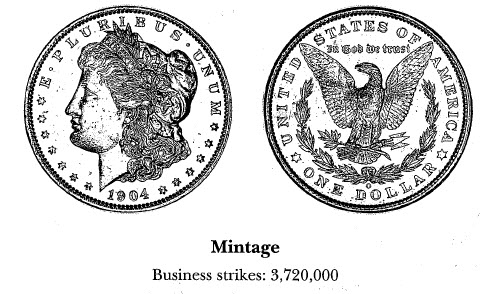
Coinage Context
The New Orleans Mint: The 1904 dollar coinage represents the last production of this denomination at the New Orleans Mint. After perhaps a few hundred thousand (if indeed that many) were released, the rest went into storage. The mint continued to operate, striking $10 gold coins through 1906 and silver through 1909, after which coinage ceased. Silver dollars remained in bulk storage at the mint until 1929, when about 10 million of various dates were transferred to a sealed vault in the Philadelphia Mint.
Numismatic Information
Hoard coins: In October 1962, vast quantities well over one million coins-of 1904-O dollars were released from long-term storage at the Philadelphia Mint. Previously, the 1904-O in Mint State had been considered one of the prime rarities in the Morgan series. Additional bags were released from storage in the Treasury Building in Washington, D.C., from which location some coins had dribbled out in small numbers since the 1930s. Today, there are more 1904-O Mint State dollars in existence than there are of any other New Orleans dollar after 1885-O.
Circulated grades: Worn 1904-O dollars are fairly scarce, but the price is low as Mint State coins are so plentiful. Probably only about 4,000 to 8,000 circulated examples survive.
Mint State grades: Uncirculated 1904-O dollars are plentiful in all levels, with more at the lower grades of MS-60, 61, 62, etc., than at MS-65 or higher, but there are more than enough to fill collector demand.
At the MS-60 to 62 level, 600,000 to 1,200,000 are believed to exist, followed by 350,000 to 700,000 in MS-63, 250,000 to 500,000 in MS-64, and 40,000 to 70,000 in MS-65 or better grades.
The strike is usually of average quality, but most coins are lustrous and frosty.
Prooflike coins: Prooflike coins are very plentiful. Striking is often weak at the centers and/or with low contrast. Wayne Miller related that in 1978 a bag of DMPL coins appeared on the market, and he was able to secure 300 pieces from the group. Probably 15,000 to 30,000 PL coins exist, and about 25% as many DMPLs. About a fifth of the DMPLs are MS-65 or better.
Die rotation: VAM-2 is known with the reverse die rotated 108° counterclockwise from normal.
VAM-13 exists with the reverse rotated 28° to 70° counterclockwise from normal. Both varieties are known in Mint State.
Varieties
NEW REVERSE HUB: WIDE NECK/WING SPACE, LARGE STARS VAM C-4 REVERSE
Business strikes:
1. Breen-5701. Varieties are mostly positional or have light doubling.
2. Doubled Date: VAM-4 has the date numerals doubled.
1904-0 Morgan: Summary of Characteristics
Business Strikes:
Enabling legislation: Act of February 28, 1878, plus the Sherman Silver Purchase Act of July 14, 1890
Designer: George T. Morgan
Weight and composition: 412.5 grains; .900 silver, .100 copper
Melt-down (silver value) in year minted: $0.44763
Dies prepared: Obverse: Unknown; Reverse: Unknown.
Business strike mintage: 3,720,000; Delivery figures by month: January: 1,000,000; February: 1,000,000; March: 1,200,000; April: 520,000; MayDecember: none.
Estimated quantity melted: Possibly 2,500,000 or so were melted, mostly under the 1918 Pittman Act.
Approximate population MS-65 or better: 40,000 to 70,000 (URS-17)
Approximate population MS-64: 250,000 to 500,000 (URS-20)
Approximate population MS-63: 350,000 to 700,000 (URS-20)
Approximate population MS-60 to 62: 600,000 to 1,200,000 (URS-21)
Approximate population G-4 to AU-58: 4,000 to 8,000 (URS-14)
Availability of prooflike coins: Common, but often with weak strike and/or low contrast. 15,000 to 30,000 PL exist (URS-15) and 25% as many DMPLs.
Characteristics of striking: Striking quality varies from weak to sharp, but most are average.
Known hoards of Mint State coins: Many bags, possibly amounting to over one million coins, were distributed 1962-1964; earlier the issue was very rare in numismatic circles in Mint State.
Proofs:
None
Commentary
Prior to October 1962, numismatists considered the 1904-O to be one of the rarest of all Morgan dollars in Mint State. After the 1962 Treasury release, it became one of the most common.
Additional Information
Distribution of Dollars
The Annual Report of the Director of the Mint, 1904, told of the distribution of silver dollars: New Orleans. In the mint June 30, 1903, $25,518,725; coinage, fiscal year 1904, 4,070,000; total, 29,588,725; in mint June 30, 1904, 29,588,725; total, 29,588,725.
The New Orleans Mint in 1905
The Numismatist, May 1905, printed a note from Farran Zerbe, who at the time traveled extensively around the United States and who in 1904 had the numismatic concession at the Louisiana Purchase Exposition in St. Louis:
"A visit to the mint at New Orleans, found it, the now oldest buildingused for coining purposes in this country, not operating. It has not been in operation since November 1904. Those in charge expected it would resume operation July 1, 1905. Of the $32 million in coin stored in its vaults $29 million is in silver dollars, and the anticipated work is the recoinage of the stock of dollars into subsidiary coins .... "