Silver Dollars & Trade Dollars of the United States - A Complete Encyclopedia
Q. David Bowers
Business Strikes;
Enabling legislation: As earlier, plus Act of February 28, 1878
Designer: George T. Morgan
Weight and composition: 412.5 grains; .900 silver, .100 copper
Melt-down (silver value) in year minted: $0.758
Dies prepared: Obverse: At least 1; Reverse: At least 1.
Business strike mintage: Unknown part of 1887 mintage
Estimated quantity melted: Unknown
Approximate population. MS-65 or better: 100 to 200 (URS-8)
Approximate population MS-64: 400 to 800 (URS- 10)
Approximate population MS-63: 1,750 to 3,500 (URS-12)
Approximate population MS-60 to 62: 3,000 to 6,000 (URS-13)
Approximate population G-4 to AU-58: 10,000 to 20,000 (URS-15)
Availability of prooflike coins: Available but rare in lower grade ranges; very rare in high-grade DMPL.
Characteristics of striking: Average
Known hoards of Mint State coins: None specifically of 1887/6, except as a part of Treasury releases of 1887, a common date.
Commentary
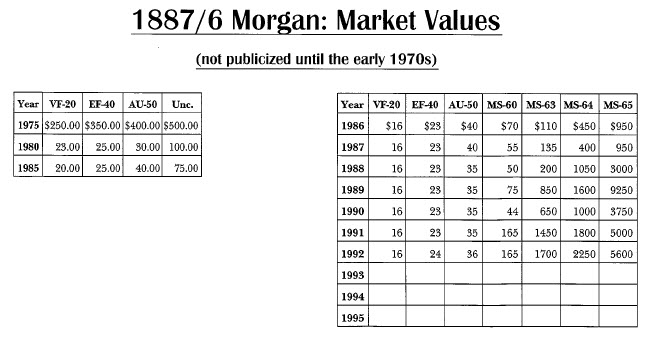
This variety was generally unknown to collectors until 1971.
1887 Morgan Dollar
Coinage Context
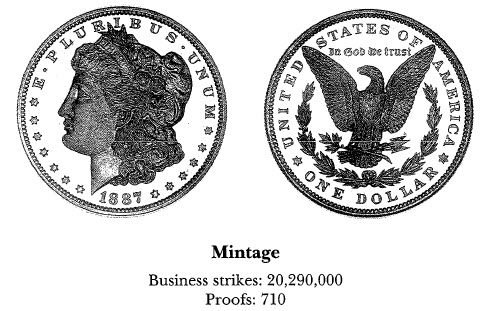
Another record: The mintage record in the Morgan series set in 1886 by Philadelphia didn't last long, and the 20,290,000 production figure for 1887 eclipsed it, if only by a narrow margin. The new record would stand until 1921.
Numismatic Information
Common issue: The record high mintage of 1887 Morgan dollars translates neatly today into the issue being the most plentiful of all Morgan issues of the early period from 1878 to 1904. Specimens are easily available in just about every business strike grade imaginable, from well worn through MS-65. Those who like higher numbers, buyers mainly from the investment (rather than the numismatic) sector, will have no trouble loading themselves down with MS-66, MS-67, etc., coins.
The 1887 dollar was plentiful years ago, and additional Treasury releases, from coins stored at the Philadelphia Mint, took place in 1938, the 1940s, the 1950s (particularly in December 1954), and the early 1960s. The number of Mint State coins surviving today is believed to run into seven figures.
One lot of 100 bags existed as late as 1978. The Continental-Illinois Bank hoard, which was estimated to contain as many as 1,000 original bags of brilliant Uncirculated dollars plus an estimated 500 bags of circulated coins (1.5 million coins totally), included quantities of Mint State 1887 Morgans. The 1887 may, as Wayne Miller has written, be the most plentiful Morgan dollar in terms of 1,000-coin bags still in existence.
Circulated grades: Worn 1887 dollars are plentiful, and because Mint State coins are so common, circulated pieces are not of much interest to numismatists. However, they make interesting presents to children.
Circulated grades: Worn 1887 dollars are plentiful, and because Mint State coins are so common, circulated pieces are not of much interest to numismatists. However, they make interesting presents to children.
Mint State grades: It is probably redundant at this point to state that the 1887 is very common in Mint State. Most coins are average strikes, but individual specimens may vary either way, from quite flat to quite sharp. Cherrypicking for quality is advised and is not hard to accomplish. The lustre is apt to be a bit satiny or "greasy," on the dull side, rather than deeply lustrous and frosty. Perhaps some now unemployed coiner from the Carson City Mint, which produced superb quality coins, should have visited Philadelphia to show them how to do things right. In actuality, few if any people at the Philadelphia Mint cared about the quality of silver dollars. They were being produced to conform with a piece of legislation promoted by distant western interests, the 1878 Bland-Allison Act, and most pieces were destined to be sewn into mint bags and dumped into dark storage.
Prooflike coins: There are many prooflike 1887 dollars in existence, but nearly all have little contrast between the fields and the devices. Many are one-sided. A hoard of cameo DMPL coins came to light in California in 1977, Wayne Miller related, and today this group is recognized as the mother lode for extant pieces of this calibre. Probably, several thousand coins remain in MS-64 DMPL or finer grade.
Die rotation: VAM-1 exists with the reverse die rotated from 700 to 1420 clockwise from the normal orientation, and also with rotation from 800 to 1400counterclockwise. Van Allen and Mallis report that these have been seen only in circulated grades.
Proofs: Most of the 710 Proofs minted still exist, although most are in lower grades such as Proof-60 to 63. Many have been cleaned.
Varieties
Business strikes:
1. Normal date: Breen-5592. This huge mintage probably took all 55 obverses and 54 reverses. All dies must have been used until they wore out. Even so, the 368,909 coins per obverse is extremely high. Perhaps there is an error in Mint records.
2. Doubled Date: Breen-5594, VAM-5. Scarce.The most desirable of the many repunched dates of this year.
3. Other variations: Four doubled dies are known, three on the obverse (VAM-12, 13, 15) and one on the reverse (VAM-16).
Proofs:
1. Proof issue: Proofs have top of 7 doubled (not the same as VAM-3).