Silver Dollars & Trade Dollars of the United States - A Complete Encyclopedia
Q. David Bowers
Varieties
Business strikes.(Descriptions augmented by comments received from Jeff Oxman, letter to the author, November 29, 1992.)
1. 1880/79.S Medium S: Breen-5544, VAM-8.
Same comments about position of zero as to 1880/ 7-above. Common 1880-S overdate with easily identifiable remains of underlying 7 within top loop of the second 8 in the date.
2. 1880/79-S Largest S: Breen-5545, VAM-9.
Shares same obverse with VAM-8, but reverse exhibits large S, tilted to the left with the top serif doubled. The VAM-9 is much scarcer than its VAM-8 counterpart.
3. 1880/9-S Medium S: Breen-5546, VAM-11. Often ignored except in its earliest die state. Evidence of the underlying 9 is visible within the 0 of the date. The VAM-11 is considered the most common of the five 1880-S overdates. The 0/9 feature on the VAM-11 is unusual in that it is the only overdate of 1880 with this configuration. All others are 8/7 or 80/79 varieties.
4. 1880/7-S Largest S: Breen-5547. VAM-10.This is the key issue among 1880-S overdates, and is rare in all grades. However, when found, specimens are usually Mint State.
5. 1880-S Medium S: Breen-5548. There are 70 1880-S die varieties in the new 3rd edition of VAM, and many have the medium S mintmark. Plentiful even in gem state and/or prooflike; available in DMPL. Second commonest Uncirculated S mint Morgan thanks to the Treasury hoards. V AM-18 has repunched mintmark, VAM-19 triple-punched S; many obverses have partly or wholly repunched dates, usually faint. See VAM for details.
6. 1880-S Largest S: Breen-5549, VAM-2, 3, 6, 17, 22-24, 29, 31, 33, 35, others. Common in Mint State from hoards, but not as common as Medium S. Many obverses show traces of repunching on one to all four digits of date, usually faint.
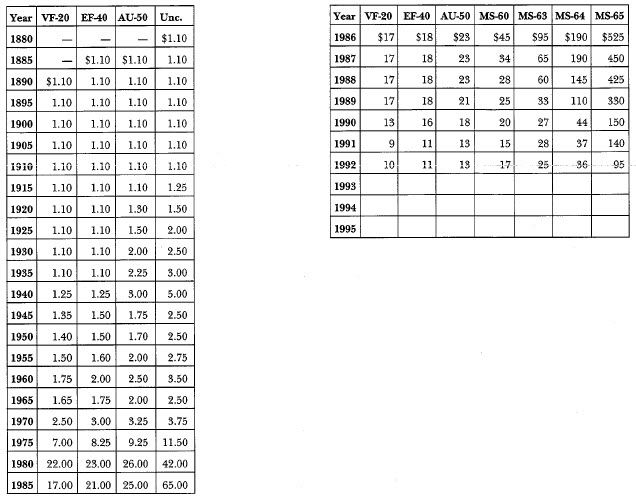
1880-S Morgan: Summary of Characteristics
Business Strikes:
Enabling legislation: As earlier, plus Act of Febru-ary 28, 1878
Designer: George T. Morgan
Weight and composition: 412.5 grains; .900 silver, .100 copper
Melt-down (silver value) in year minted: $0.88564
Dies prepared: Obverse: Unknown; Reverse: Unknown.
Business strike mintage: 8,900,000
Estimated quantity melted: Unknown
Approximate population MS-65 or better: 125,000 to 175,000 (URS·19)
Approximate population MS-64: 200,000 to 300,000 (URS-19)
Approximate population MS-63: 400,000 to 600,000 (URS-20)
Approximate population MS-60 to 62: 750,000 to 1,250,000 (URS-21)
Approximate population G-4 to AU-58: 400,000 to 800,000 (URS-20)
Availability of prooflike coins: Common, including DMPL; indeed, the commonest issue of the Morgan series.
Characteristics of striking: Nearly always sharply struck.
Known hoards of Mint State coins: Millions were released by the Treasury in the 1950s and, espe-cially, 1962-1964.
Proofs:
None
Commentary
The 1880-S is one of the most plentiful of all early Morgan dollars, and is second only to the 1881-S in availability. Most known Mint State specimens are sharp and attractive.
Additional Information
1880-S $1 Rare in 1894
The Numismatist, October 1894, p. 236, included this com-mentary on the 1880-8 dollar, which at the time was considered to be a rare issue:
"Alden J. Bennett (ANA member No. 65) of the firm of Hall & Bennett, Bankers, Virginia, Montana, wrote us as follows. In August No. of The Numismatist, p. 172, he notes an 1880 dollar "S" mint brought $3.30 at the Friesner sale:
'The communication of Mr. Bennett in the October Numismatist (With the Editor) regarding 1880-8 mint dollars shows the opportunities bankers sometimes have for gaining desirable coins-especially in the dollar series, as such pieces are apt to remain for years in bank or mint vaults until a chance demand brings them into circulation. But large pieces often undergo several transfers without the bags being opened, while collectors are hunting in vain for desirable specimens.
"Could numismatists delve into Treasury and bank reserves there would at times be great discoveries, not only in mintmarks but in Philadelphia coinage and prices of some dates would have the bottom knocked out. This has occurred and will again, by the grace of our banker collectors, but the under bags earliest put in vault are seldom reached and export and recoinage add to the doubt that gives coin hunting a fascinating uncertainty."