Silver Dollars & Trade Dollars of the United States - A Complete Encyclopedia
Q. David Bowers
As is the case with many Uncirculated silver dollars; large quantities were purchased .by collectors and investors in the 1950s and 1960s. As Ruth Bauer found in her re-contacting buyers from that period, most quantities have simply disappeared from the regular coin market. This is true also of the G.S.A. sales of 1878-CC and other CC dollars; only a tiny fraction have ever been run through the certification services, nor are quantities of even a few dozen 1878-CC dollars often seen in one place.
Prooflike coins: Many prooflikes are one-sided. This issue is very common in semi-prooflike finish, many of which are now called PL. I estimate that under new interpretations, 10,000 to 20,000 or more PL pieces exist, of which only 5% to 10% are better than MS-65. OMPL examples are about-twice as rare as PLs, with about 10% being MS-65 DMPL or finer. The market for DMPL coins of the Carson City Mint has always been stronger. than for pieces from Philadelphia (especially), New Orleans, or San Francisco, due no doubt to the strong following that CC dollars have in general.
Die rotation: Specimens of VAM-5 are occasionally seen with the reverse misaligned from 26° to 90° clockwise. from normal. Examples are known in Mint State. According to the 3rd edition of the Van Allen-Mallis text, 1878-CC the only Carson City dollar issue known struck from a rotated die.
Varieties
ALL WITH 7 TF REVERSE:
Business strikes:
1. Longnock (arrow shaft). Close CC. Normal obverse: Breen-5519. Doubled obverse die, Breen- 5520, VAM-18. Scarce. VAM-24 has obverse with doubledcotton leaves and. bolls, and doubled eyelash.
2. Long nock. Wide CC: Breen-5521. V AM-3, 16, 17; doubled obverse die, repunched date..Breen-5522, VAM-6. Scarce.
3. Short nock, close CC. Normal obverse: Breen- 5523; doubled obverse die; Breen"5524, V AM-13.
4. Short nock, wide CC: Breen-5525, VAM-12.
1878-CC Morgan: Market Values
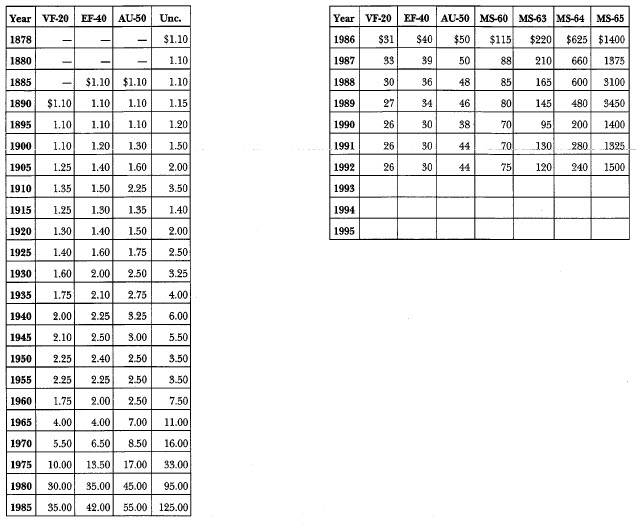
Business Strikes:
Enabling legislation: As earlier, plus Act of February 28, 1878
Designer: George T. Morgan
Weight and composition: 412.5 grains; .900 silver, .100 copper
Melt-down (silver value) in year minted: $0.89222
Dies prepared: Obverse: 30; Reverse: 30.
Business strike mintage: 2,212,000
Estimated quantity melted: Estimated 1,000,000 or more, mostly under the provisions of the 1915 Pittman Act.
Approximate population MS-65 or better: 3,000 to 6,000 (URS-13)
Approximate population MS-64: 10,000 to 20,000 (URS-15)
Approximate population MS-63: 30,000 to 60,000 (URS-16)
Approximate population MS-60 to 62: 120,000 to 160,000 (URS-18)
Approximate population G-4 to AU-58: 75,000 to 125,000 (URS-18)
Availability of prooflike coins: Fairly common semiprooflike; DMPL coinsare scarce, cameo DMPL more so.
Characteristics of striking: Usually very well struck Known hoards of Mint State coins: 60,993 were held back from 1962-1964 Treasury release and subsequentIysold by the General Services Administration. An estimated 100,000 to 125,000 or more additional coins were released by the Treasury during the 1940s, 1950s, and early 1960s.
Proofs:
None
Commentary
1878-CC dollars w.ere released in quantity at the time of striking, unlike most later issues from this mint. Alleged Proofs advertised by B.M. Douglas and William & L. Pukall (Numismatist, 12/51 and 10/53) have not been traced and were probably DMPLs.