Silver Dollars & Trade Dollars of the United States - A Complete Encyclopedia
Q. David Bowers
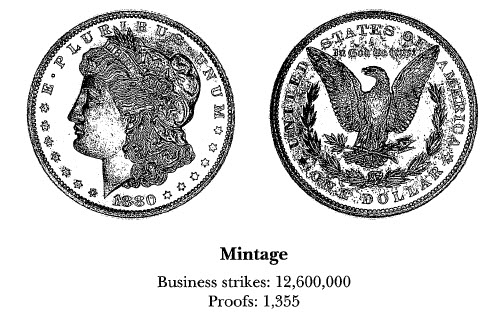
1880 Morgan Dollar
Coinage Context
Dollars piling up: President Rutherford B. Hayes said in 1880, "We have minted 72 million silver dollars and we have spent a lot of dough trying to keep them in circulation, but they keep coming back. The people don't want them. I think we should melt 700 of them and make an Aztec Calendar for General John W. Foster."!
Overdates: In the Morgan dollar series the year 1880 contains many overdates. Apparently, the Philadelphia Mint produced many obverse dies for 1879, and rather than waste them when it became evident that the excess supply would not be used, they were overdated with 1880. Over two dozen overdate varieties have been identified in coins from all four mints: Philadelphia, Carson City, New Orleans, and San Francisco.
Numismatic Information
Hoard coins: Bags of 1880 dollars probably came on the market over a long period of time, but I have been able to find no documentation of mass releases prior to the 1940s-although they may have occurred. Certainly, no attention was paid to Mint State coins before then, as collectors were content with readily available Proofs.
In the early 1940s, bags came on the market from storage in Philadelphia Mint vaults. Most dealers who handled dollars stocked up on a few rolls or so; stocking bags, especially of Philadelphia Mint coins, was not a popular practice. Dollars of this date remained plentiful throughout the 1950s, with a particularly large release occurring in 1955.
In the 1950s, Mint State coins were commonly found in bags of mixed dollars, and, occasionally, a full bag of just this one date would turn up. Prices remained cheap ($26 per roll, W.E. Johnson, September 1950; and $25 per roll, Klondyke Coin Exchange, April 1955, are examples), and there was little call for them. It was probably the case that most original bags paid out in the 1950s slipped into circulation, and by the early 1960 were "sliders." In terms of mint-sealed bags still around today, few remain.
Just one reverse type: All known 1880 Philadelphia Mint coins have the Third Reverse (slanting top arrow feather, convex breast on eagle).
Logotypes and overdates: Note that on both Philadelphia and branch mint coins the digits 80 come about parallel (see illustrations of Breen-5535, 5544, 5553 in the Breen Encyclopedia) or, more often, with 0 leaning more noticeably to left (5534, 5538, 5546, 5547, 5551, 5554). These must be re-examined to ascertain if they represent two different four-digit logotypes, or (as Walter H. Breen suspects) one three-digit logotype with final digit entered by hand.
Walter H. Breen asks these questions: If the former, which came first? If the latter, was it also used in 1881-1883? If so, look for final digit higher or lower, and/or wider and closer spacing between 80, 81, 82, 83. Similar problems recur in other dates: in 1880-O, VAM-13 has low zero; in 1881, VAM-4 and 9-10 have final I low, while VAM-8 (Proof) has final I in line; in 1883, VAM-6 has low 3; in 1889-O, VAM-10 shows wide spacing between 89; in 1886, 1886-O, 1889-S, 1889-CC, 1890-O, 1896, and probably others, final digit comes normal or high. Were the 1879s also made with three-digit logotypes? If so, this may explain 1880 with 8/7.
1880 with 8/7: Among Philadelphia Mint coins, most overdates have traces of a 7 beneath the second 8 in the date. It has been conjectured that in the late 1870s, dies were made with just the first three digits, 187, with the last space awaiting filling in later. This would account for the 8/7 issues without traces of a 9 under the O. However, conventional wisdom is that the entire date, such as 1879, was punched in at one time. Whether there were exceptions is a situation that remains to be explored.
This variety is identifiable only under magnification. The best of several varieties have, per Van Allen and Mallis, tiny spikes or "ears" visible at the upper left and right of the 8. Various other repunched numerals are less distinct. It has been conjectured that many 1880 dollars that appear to be "perfect" (non-overdated) dates are, in fact, are from overdated dies in which the under-date is no longer visible.
The 1880 with 8/7 is usually very sharply struck. Leroy C. Van Allen suggested in 1992 that fewer than a dozen Mint State coins are known.
This variety has attracted much attention among specialist collectors, but to date investors have largely ignored it. The same can be said to a degree for the branch mint overdates of this year.
Fivaz and Stanton on the 8/7: Bill Fivaz and J. T. Stanton, in The Cherrypicker's Guide, 2nd edition, 1991, devoted extensive coverage to the 8/7 issues. For the 8/7, VAM-6, they stated this:
The upper serifs of the 7 appear as "horns" or "spikes" on the upper left and right of the second 8. There is also metal fill from the 7's crossbar in the top half of that 8's upper loop. . . Fewer than three Mint State specimens are known, but you may be able to cherrypick this one in the lower circulated grades, even up to EF.2
For the 8/7, VAM-7, they noted the following:
The horizontal bar of the 7 canbe seen in the top half of the upper loop of the second 8 .... To our knowledge no Mint State specimens are known of this variety. Even highgrade (EF-AU) circulated pieces are extremely rare.
For the 8/7, VAM-8, they wrote this:
There are two very small (short) remnants of the 7's top left and right serifs atop the second 8's top loop .... Rather difficult to see on lower gradc circulated coins, this variety is also unknown (to our knowledge) in Mint State. Extremely rare in any grade.