Silver Dollars & Trade Dollars of the United States - A Complete Encyclopedia
Q. David Bowers
1893-CC Morgan Dollar
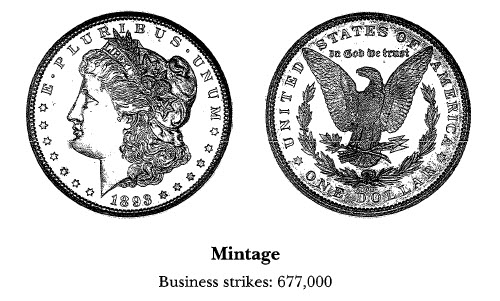
Coinage Context
End of an era: In 1893, the Carson City Mint was closed to further coinage, although it remained in business as an assay office and refinery. Thus ended an era in American coinage and numismatic history. The Carson City Mint had produced coins from 1870 to 1885 and again from 1889 to 1893. Silver dollars were produced from 1870 through 1873, from 1878 through 1885, and from 1889 through 1893. Trade dollars were minted there from 1873 through 1878. Today the Carson City Mint building still stands and since 1942 has been operated as the Nevada State Museum.
Numismatic Information
Commentary: The 1893-CC dollar has always been a collectors' favorite, due to its scarcity and its position as the last Carson City Mint coin of its denomination. In terms of availability in Mint State, it is third rarest after 1889-CC (rarest) and 1879-CC.
Hoard coins: Mint bags of 1893-CC dollars came on the market as early as 1920 at face value through the Cash Room at the Treasury in Washington and, in particular, from storage at the San Francisco Mint. However, the quantity was small in comparison to certain other Carson City dates, particularly those of the early and mid-1880s. The supply seems to have been exhausted by the late 1950s, and there are no records of any quantities being paid out after that time. However, during the 1950s the 1893-CC was sufficiently plentiful that Harry J. Forman handled at least 10 bags (10,000 coins), and other quantities were bought and sold by other dollar specialists.
One solitary coin turned up in the General Services Administration's holding held back in March 1964. The Redfield estate contained several thousand coins, most of which were severely damaged (see "An unfortunate situation" below). These probably came from storage at the San Francisco Mint and were probably paid out in the 1950s.
In the modern market, groups of 1893-CC dollars are seldom seen. John V. Kamin observed this:(Letter to the author, October 29, 1992.)
A BU roll of these appeared at the October 1992 Long Beach Coin Show, the first roll that I have seen on the market in five years. Our clients bought five coins out of that BU roll. It is typical for 1893-CC to appear by the roll only once or twice every five years. Most 1893-CCs trade by the single coin. A "hoard" today would be four rolls.
A 1955 release: As noted, in the 1950s, quantities of Carson City Mint dollars came on the market. In the December 1955 issue of The Numismatist, the following appeared under the title "More Silver Dollars Escape:"
It is reported by the Great Falls, Mont., Tribune that one thousand U.S. silver dollars, minted in Carson City, Nev., in 1893, were placed in circulation there during the last week of October. The Montana Bank received the coins in a routine shipment from the Minneapolis Federal Reserve Bank. Most of the dollars were distributed in regular banking operations before their value to collectors was realized. As only 677,000 were minted, the pieces catalog at $9 Very Fine and $65 Uncirculated.
Circulated grades: In worn grades the 1893-CC is one of the scarcer Morgan dollar varieties. Most circulated dollars are in lower grade levels such as VG-8 and F-12, indicating that such coins were used in commerce for a long time.
Mint State grades: Most Mint State coins are very lustrous. Of all Carson City Mint Morgan dollars, the 1893-CC is notorious for being very heavily bagmarked. The vast majority of extant Mint State coins are in lower levels and have extensive marking. High-grade, mark-free coins are very rare. In fact, although 1893-CC dollars were plentiful a generation ago, Mint State coins are decidedly rare at any level today. Even MS-60 to 62 coins, heavily bagmarked, are apt to show up just one at a time. It has been a long time since I have been offered a roll of 20 pieces.
The striking of 1893-CC dollars varies. The typical piece is apt to have some flatness at the obverse center and, on the reverse, weak breast feathers on the eagle. Sharply struck coins do exist and are in the distinct minority. Once again, cherrypicking is the order of the day for the discriminating buyer. Leave the weak coins to unknowing, uncaring investors.
Most 1893-CC dollars grade from MS-60 to 62 and, as noted, are heavily bagmarked. At this level, probably 15,000 to 30,000 coins exist. MS-63 coins are scarce; an estimated 2,000 to 4,000 survive. MS-64 coins are rare, and it is likely that no more than 1,000 to 2,000 survive. In MS-65 or better grade only 50 to 100 are known. MS-65 specimens are sufficiently elusive that even the most seasoned dealer in dollars will get excited if one is offered.
As is the case with all other CC dollars, only a small percentage of extant 1893-CC dollars have been certified.
Incompetence: In his Morgan and Peace Dollar Textbook, Wayne Miller related the following:
One of the most amazing acts of incompetence in the history of numismatics occurred during the dispersal of the Redfield hoard. Apparently the company which was engaged to inventory and appraise the hoard ran several thousand Mint State dollars through a coin counter! The damage was most evident with the 1893-CC dollars, many of which evidented a large, very noticeable scrape on Liberty's cheek or the eagle's breast. Although most of these dollars are well struck, with good lustre, they are virtually unsaleable.
Prooflike coins: Prooflike coins are usually lightly struck at the centers. Prooflike pieces are fairly scarce, and well struck they are rare. DMPL coins are about 10 times rarer than PL and are especially rare if well struck. Of the 11 DMPL coins certified by NGC and PCGS as of September 1992, none was better than MS-64.