Silver Dollars & Trade Dollars of the United States - A Complete Encyclopedia
Q. David Bowers
1883-0 Morgan Dollar
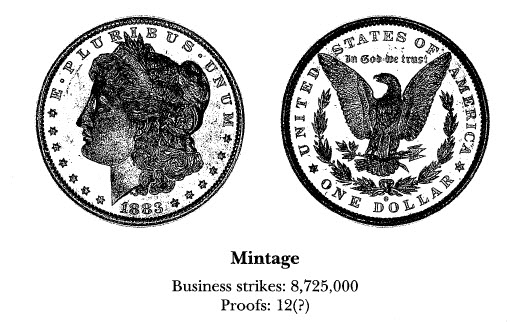
Coinage Context
Mint affairs: There is not much significant to report in the silver dollar category about activities at the New Orleans Mint in 1883, except that many were made, and among the mintage were a few Proofs.
Numismatic Information
Hoard coins: The 1883-O, minted in large quantities, was never rare in Mint State on the numismatic market. This date was released in bags of 1,000 coins as long ago as 1938, from the Treasury Building in Washington, D.C., which, earlier, had paid out small quantities of this date. Dealer John Zug was among those who obtained these for face value in the early 1930s. Bags were distributed at later intervals as well, including a major release in 1952, followed by occasional bags until about 1957. From a sealed vault in the Philadelphia Mint many more bags were released beginning in October 1962, and continuing well into 1963. Some of the latter found their way to the Continental-Illinois Bank and were sold on the coin market about 15 years later. As a result, today the 1883-O is very common in Mint State.
In general, the availability in Mint State over the years and the price structure of 1883-O has been quite similar to 1884-O and 1885-O.
The 1883-O, 1884-O, and 1885-O constitute the bulk of approximately 10 million coins released from a long-sealed vault in the Philadelphia Mint, beginning in October 1962. My estimate isthat the breakdown of these three dates is about as follows: 1883-O: 1.5 to 2,500,000 coins; 1884-O: 2.5 to four million coins; and 1885-O: two to 3.5 million coins. Of course, these coins are in addition to hoard coins released from other vaults earlier.While many were saved by the public, investors, and collectors, other coins-possibly amounting to millions of pieces totally-went into circulation. Many of these were melted in the late 1970s and early 1980s during the sharp increase in silver bullion prices, which on January 21, 1980, hit $52.35 per ounce.
Circulated grades: The 1883-O is very common in worn grades.
Mint State grades: Mint State coins are very common. Many of these have semi-prooflike or full prooflike surfaces. Most Uncirculated 1883-O dollars are in the ranges of MS-60 through MS-63 or even MS-64, although many MS·65 coins are on the market as well. I believe the following estimates to be meaningful: MS-60 to 62, 1.5 to 2.5 million survive; MS-63, 500,000 to one million; MS-64, 200,000 to 350,000; and MS-65 or better, 35,000 to 60,000.
Some coins were struck from improperly spaced dies and/or dies that were worn around the borders, with the result that such coins show metal flow marks around the borders and are weakly struck up at the centers. Striking is a problem for many 1883-O dollars, due to die spacing. Workmanship at the New Orleans Mint was often shoddy. However, cherrypicking can yield sharp specimens.
Prooflike coins: The 1883-O dollar is plentiful in prooflike condition, especially in lower grade levels from MS-60 through MS-64, often with many bagmarks, although MS-65 coins are encountered with regularity. In other words, there are enough prooflike coins around in varying grades and qualities of strike that the astute buyer can find what he or she wants. Most prooflike examples have little contrast between the devices and the fields. True DMPL coins with cameo contrast are considerably scarcer.
I believe that 5,000 to 10,000 PL and about 60% as many DMPL pieces survive.
Die rotation: Specimens of VAM-1 are sometimes seen with the reverse die rotated from 35° to 75° counterclockwise from the normal alignment. Examples of this oddity, known in Mint State, are usually quite well struck.
Proofs: It is believed that some Proofs (Walter H. Breen, following S.H. & H. Chapman's sale of the Ferguson Haines Collection (October 21, 1888) sug-gests a mintage of 12) were struck at the New Or-leans Mint in 1883, perhaps for some long-forgotten event such as the establishment of Tulane as a state university in Louisiana in that year. The same "12 struck" claim recurs in the Chapmans' June 17-18, 1889 auction. Wayne Miller's coin brought $14,300,January, 1986. The existence of Proofs was called to the attention of numismatists in a contribution to the AmericanJournal of Numismatics in 1884 by A.W. Smyth, the superintendent of the New Orleans Mint. Various specimens called "Proofs" have appeared in sales over the years, but as of 1989, Walter H. Breen had seen only one incontrovertible Proof coin, that authenticated for Harry J. Forman circa 1964 (later reappearing in Harmer Rooke's sale of November 1969, Lot 1136 for $1,600). Wayne Miller mentioned a specimen described as gem prooflike (not Proof) in a Superior Stamp & Coin Co. sale in 1979, a coin formerly owned by Herbert Bergen, which may be a candidate for being a full Proof.(The Morgan and Peace Dollar Textbook, pp. 222-223. Herbert Bergen, of Fullerton, California, was at one time a president of the American Numismatic Association.)It was bid up to $6,500 by Julian Leidman and was later resold for $15,000. As of 1991, Walter H. Breen believed that the number of unquestioned Proofs had increased to three.
Varieties
Business strikes:
1. Normal date: Breen-5572. Some of the 40 ob-verse and 36 reverse dies probably remained unused. The VAM book lists 15 varieties with one or more date numerals repunched, and multiple varieties with repunched O mintmark on the reverse. VAM -4 is the second most dramatic repunching (after 1882-O VAM-7) in the Morgan dollar series. VAM-15 has the digits 83 high and out of alignment; does this indicate a two-digit logotype punch was used?
Proofs:
1. Proof issue: It is believed that a small number, possibly 12 (per Breen), were coined for presentation purposes. In correspondence with the author in 1991, Walter H. Breen stated that three authentic specimens are known.