Silver Dollars & Trade Dollars of the United States - A Complete Encyclopedia
Q. David Bowers
1868 Liberty Seated Dollar
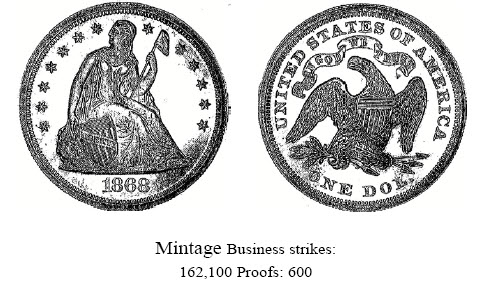
Coinage Context
Distribution: Many if not most 1868 dollars were exported, accounting for the relative rarity of business strikes today.
In China, merchants accepted Liberty Seated dollars by weight, and at a discount compared to the heavier Mexican dollar, an old story which was repeated in Mint and commercial reports for many years (and which eventually led to the production of the heavier U.S. trade dollar in 1873).
In the Annual Report of the Director of the Mint, 1868, Dr. Henry Richard Linderman observed the following: (Linderman's information concerning dollars in China probably represented the situation in 1867, due to the length of time needed to communicate with that remote location.)
Our silver dollar is not received by the Chinese except at a discount. This is owing to the fact that while it is of equal fineness with the Spanish or Mexican dollar, it is about 1 % less in weight. This rejection seems to take away the last plea for continuing to coin this piece.
Numismatic Information
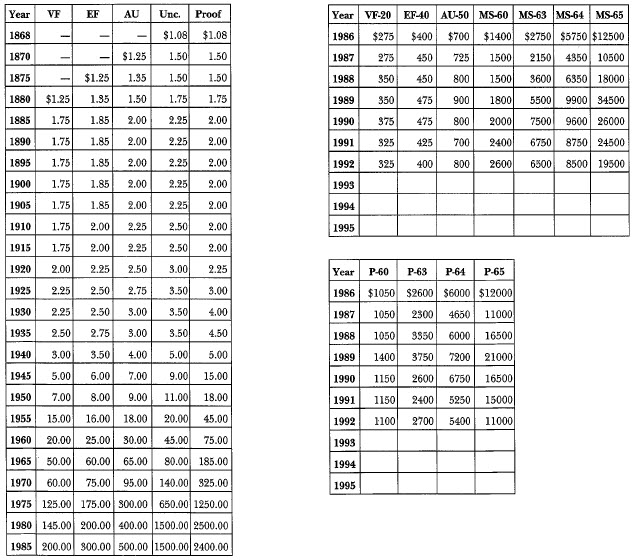
Circulated grades: Circulated Liberty Seated dollars dated 1868 are quite scarce, but because of the high mintage figure for this date they are nearly universally overlooked by the numismatic fraternity. Exceptions, of course, are Liberty Seated specialists who know full well that a nice VF, EF, or AU 1868 is an object of beauty and rarity.
Mint State grades: The year 1868 does not come to mind immediately when one thinks of rare coins in the Liberty Seated series, but a perusal of the data, including certification service population reports, indicates that it is indeed very rare, even if it is unappreciated and overlooked. Dealer specialist Chris Napolitano stated that an MS-61 coin was the finest business strike he could locate in six years of searching. (Conversation with the author, Central States Convention, April 30, 1992.)
Some high-grade pieces show unfinished areas within the lower right area of the shield. Most high-grade coins are prooflike.
Proofs: 600 Proof dollars were struck this year and were distributed with the silver Proof sets.
In terms of specimens appearing on the market today, high-grade Proof dollars of the late 1860s and early 1870s are considerably more available than those of earlier decades. Still, in absolute terms they are rare.
Varieties
Business strikes:
1. Normal Date: Breen-5479. Obverse: Date impressed to medium depth in the die.
2. Heavy Date: Breen-5479. Obverse: Date impressed deeply in die.
Proofs:
1. Proof issue: Breen-5479. Obverse: Date slightly high and slanting slightly down to the right. Shield point slightly to the right of the tip of the peak (above the left serif) of 1 in date. Reverse: Die first used in 1867 (No.3 of 1867 above), with spine joining arrowhead and inner angle of L in DOL. Most 1868 Proof dollars are from this die combination. This reverse die was also used to coin Proof dollars dated 1869.
2. Proof issue: Breen-5480. Obverse: Date slightly high and slanting slightly down to the right. Double punching is evident on early strikes, fading on later impressions. The more obvious the repunching, the rarer. Shield point over left upright of 1 in date. The discovery coin was in Stack's Anderson-Dupont sale, 1954.
1869 Liberty Seated: Market Values