Silver Dollars & Trade Dollars of the United States - A Complete Encyclopedia
Q. David Bowers
1866 Liberty Seated Dollar
WITHOUT MOTTO
Coinage Context
Unauthorized issue: This particular issue was omitted from the Mint records and, apparently, was unofficially made. No specific historical information exists.
Numismatic Information
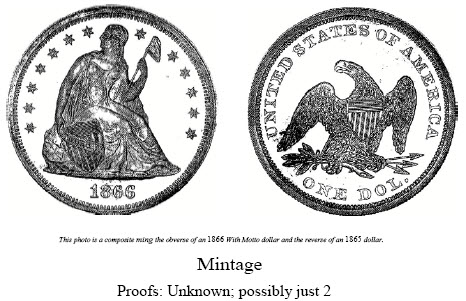
Proofs: Breen-5472. Both of the extant coins of this variety are Proof made at an unknown date, probably later than 1866 but before the end of the term of Mint Director Dr. Henry Richard Linderman in December 1878. R.W. Julian suggests 1867-1868 as a likely time. No Mint records exist concerning the variety, and its origin is shrouded in mystery.
Called restrikes by Walter H. Breen, (Walter Breen's Encyclopedia of u.s. and Colonial Proof Coins, 1722-1989, p. 264.) the two known 1866 Liberty Seated dollars without the motto IN GOD WE TRUST apparently were produced as novodels for collectors. Both specimens were handled by Philadelphia dealer Stephen K. Nagy early in the twentieth century. The issue is listed as No. 540 in Dr.J. Hewitt Judd's United States Pattern, Trial and Experimental Pieces.
Registry of 1866 No-Motto Dollars
The following roster of known specimens of the 1866 No-Motto silver dollar is by Q. David Bowers, Walter H. Breen, and P. Scott Rubin. The pedigree chain is tentative, and there may be some confusion between the two specimens.
1. Davis Specimen (part of set)
• Mint official. A set containing the quarter, half dollar, and dollar without motto went from a Mint official to Robert Coulton Davis, a nineteenth-century numismatist who was among the first to specialize in pattern coins, and who compiled the first published list of them. An avid collector, Davis developed friendships with several Mint officials. It was Davis who informed Director James Ross Snowden in 1858 about the plain-edged 1804 restrike dollars." Apparently, the set was broken up, for the quarter and half dollar were offered in the 1890 sale of the Davis Collection; the dollar was absent. The quarter reappeared in the May 1915 U.S. Coin Company sale of the Henry O. Granberg Collection.
• Stephen K. Nagy.
• Henry O. Granberg.
• William H. Woodin (well-known numismatist, industrialist, and for a short time, secretary of the Treasury under Franklin D. Roosevelt).
• Waldo C. Newcomer (Baltimore collector who sold his material on consignment through B. Max Mehl).
• Wayte Raymond (creator of coin albums, publisher of The Standard Catalogue, numismatic sponsor of young Walter
H. Breen's research in the National Archives, 1951).
• Frederick C.C. Boyd (head of Union News Company in New York City, who lived in New Jersey; owner of the so-called "The World's Greatest Collection," the silver and gold parts of which were auctioned by the Numismatic Gallery (Abe Kosoff and Abner Kreisberg) in 1945 and 1946.
• Col. E.H.R. Green in the 1930s; as part of the three-piece
set, by now reconstructed.
• F.C.C. Boyd (again). Set of three denominations.
• Numismatic Gallery. Set of three denominations.
•King Farouk of Egypt. At the 1954 sale of Farouk's collecting possessions, the partnership of Sol Kaplan and Abe Kosoff acquired the set. It was offered to the present writer circa 1956. Set of three denominations.
• Kaplan-Kosoff joint inventory. Set of three denominations. Apparently, Abe Kosoff sold the quarter and half dollar to Edwin Hydeman (numismatist who owned Wiest's Department Store in York, Pennsylvania). The dollar was sold privately to the following.
• Lammot du Pont, Willis du Pont (coin stolen October 1967 and since unlocated). Illustrated in Walter Breen's Complete Encyclopedia oj U.S. and Colonial Coins, from an American Numismatic Society negative made in the 1940s for Wayte Raymond.
• Unknown location.
No.2. Chapman Specimen
• Stephen K, Nagy, Philadelphia numismatist and dealer.
Handled by Stephen K. Nagy early in the twentieth century, apparently not as part of a set. How it fits into the following is not certain.
• S.H. and Henry Chapman, sold April 2, 1899 to Brand for $100.
• Virgil M. Brand.
• Brand Estate
• Fairbanks Collection (Ben Koenig), Stack's, December 1960, $13,000.
• Samuel Wolfson Collection, Stack's, 1962, Lot 1425, $18,000.
• Charles Jay Collection, Stack's, 1967, Lot 182, $15,000.
• Winner Delp Collection,Stack's, Lot 91, $32,000.
• A-Mark (California dealership owned by Steve Markoff).
• New England Rare Coin Galleries.
• Texas Collection (still there, 1993).
Publicity
A news release from New England Rare Coin Galleries concerning this coin was reproduced in the November 1979 issue of the Gobrecht Journal, and noted in part:
These coins are currently thought of as "fantasy coins," pieces whose origins have no official explanation. Often, such novodels were struck clandestinely-and illegally-by Mint employees to satisfy wealthy collectors' whims. Other famous fantasies include the 1913 Liberty Head nickel (5 known) and the 1804 silver dollar (15 known). New England's specimen of the 1866 No Motto silver dollar is far rarer than either of these other famous fantasy coins. And these figures do not reflect the fact that only New England's specimen of the 1866 No Motto silver dollar now freely exists in the numismatic world. [The other specimen] was stolen from the du Pont family collection over a decade ago [and has never been recovered].
Varieties
Proofs:
1. Proof issue: Obverse: Liberty Seated die dated 1866. No further description on hand. Reverse:
Type of 1840-1865 without motto IN GOD WE TRUST.
1866:Without Motto: Summary of Characteristics
Proofs:
Enabling legislation: Act of January 18, 1837
Business strike mintage: None
Dies prepared: Obverse: 1; Reverse: 1.
Proof mintage: At least 2
Approximate population Proof-64 or better: Two pieces are known; one stolen from the du Pont
Collection, now unlocated; the other in a Texas collection, ex New England Rare Coin Galleries, et al. (URS-2)
Commentary
This issue is believed to have been made later than the date on the coins, as novodels for sale to collectors.