Silver Dollars & Trade Dollars of the United States - A Complete Encyclopedia
Q. David Bowers
1862 Liberty Seated Dollar
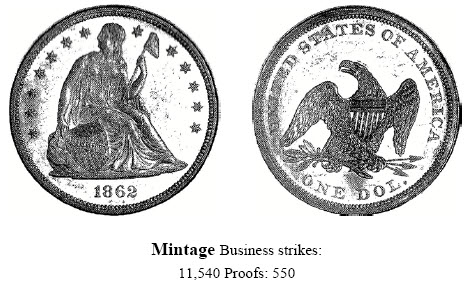
Coinage Context
Silver dollars accumulate: Walter H. Breen in his Encyclopedia notes that by 1861-1862 many earlier silver dollars had accumulated in the New York Sub-Treasury and were shipped to the Philadelphia Mint for melting and conversion into subsidiary coinage. "This explains both the undue rarity of many dated 1848-1859" and a bullion source of much Philadelphia coinage 1862-1865, according to the same source.
These coins were issues which had coin back from overseas, or which had not been sold for a premium (coins 1853 and later were not distributed for face value and were held until buyers were found who were willing to pay premiums for them).
Three different dollars: In 1862, dollars had three different values in the eastern United States. Most valuable was the silver dollar, which at the time of issue was not available at par and which had a melt-down value of over $1.04 in terms of gold. Next most valuable was the gold dollar, which served as the standard against which the other dollars were measured. The gold dollar was worth $1.00 in December 1861 and by early 1862 had risen slightly due to hoarding by the public and speculators. Worth the smallest amount was the paper dollar, which soon traded at a sharp discount from both the silver and gold coins. As the Civil War progressed, the value of the paper "greenback" dollar, as it was called from the color of its reverse side, would drop below 50¢ in terms of gold and silver. It was not until December 1878 on the market, and not officially by law until January 1, 1879, that the silver dollar, gold dollar, and greenback dollar were fill freely interchangeable at the same value on the open market.
Specie payments suspended: In late 1861 the American citizenry became very jittery. In December 1861, banks suspended the payment of gold coins (specie, in government lingo). In 1862 the situation worsened. Confederate victories had caused uncertainty, it was not known which side would be the victor in the Civil War, and all kinds of coins began to be hoarded. By the second week of July, scarcely a dime, quarter, or any other coin was to be seen, a situation which caused great consternation among tradesmen and vendors. Small cardboard chits and other coin substitutes sprang up and were widely used, as were a later spate of encased postage stamps, bronze tokens (called Civil War tokens by collectors today), scrip, and other paper currency notes. The Treasury suspended the payment of silver coins.
From the summer of 1862 onward, the Philadelphia and San Francisco mints turned out a steady but small quantity of silver coins which were not used in the eastern part of the United States. However, many of these went to Canada, where they circulated as fractional silver pieces and were literally as good as gold. An estimated $30 million worth of earlier silver coins found their way to Latin America, where in some instances United States coins traded at a premium. The West Indies, the East Indies, and the Orient provided additional markets. Curiously, all throughout the Civil War, gold and silver coins circulated readily on the West Coast. The explanation is that the West Coast had abundant supplies of gold and silver, and transportation with the East was such that monetary differences could not be adjusted quickly (the transcontinental rail link was not completed until years later, in 1869).
Concerning the withdrawal of silver and gold coins from circulation, Hepburn (p. 204) states that there was an estimated $250 million in specie in circulation in 1861, but only $25 million at the close of 1862, that "only the amount estimated in use on the Pacific slope."!
As they were worth more than face value even before the suspension of specie payments, Liberty Seated dollars did not circulate in the United States at any time during 1862. Over a decade later, in autumn 1876, following the acts of January 14, 1875 and April 17, 1876, specie payments were resumed, and the Treasury released quantities of coins of earlier dates. By this time the value of silver had fallen on world markets, due to the actions of Germany in Europe and the immense outpouring of silver from the Comstock Lode in the United States, and Liberty Seated dollars were no longer worth more as bullion than his coins. Thus, for the first time since early 1853, Liberty Seated coins of the dollar denomination were seen in general circulation.