Silver Dollars & Trade Dollars of the United States - A Complete Encyclopedia
Q. David Bowers
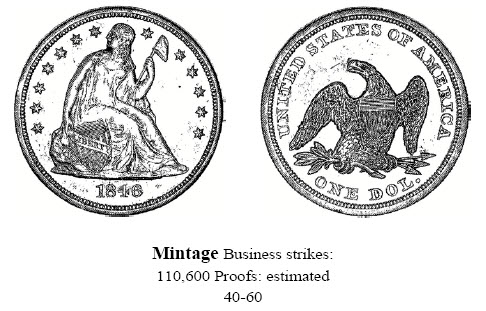
1846 Liberty Seated Dollar
Coinage Context
Many Proofs: The year 1846 was an average one in the annals of business strike silver dollar production. However, more Proofs than normal appear to have been made. The reason for this is unknown. Were they government gifts to diplomats or high-ranking military officers in connection with the War with Mexico? Robert Julian suggests that "it is more likely that extras were made for sale in other years, or someone simply bought several." (Letter to the author, March 10, 1992.)
The Assay Commission found that Philadelphia Mint silver (of all denominations, as a class) coined this year was .9013 fine, significantly above the statutory .900 (but still within the legal variation of .897 to .903), a very rare situation (see also 1846-O).
During the first six months of 1847, deposits of silver at all the mints amounted to $8,906,544.21, a greater amount than in any other entire year, with the exception of 1843. (The American Almanac and Repository of Useful Knowledge for the Year 1848, Boston, James Munroe & Co., 1847, pp. 114-115.)
Numismatic Information Circulated grades: In circulated grades the 1846 is one of the more available silver dollars of the 1840s, as its high mintage would indicate.
Mint State grades: Echoing the situation of 1843, the 1846 dollar is common in worn grades but is rare in Mint State, and is exceedingly rare in grades of MS-64 or higher. In 1982, Bruce Amspacher suggested that a really nice Uncirculated coin turned up at the rate of one coin every five to 10 years. (Article, "Liberty Seated Dollars," in the Monthly Summary, Coin Dealer Newsletter, July-August, 1982.)
Proofs: For some unexplained reason, more Proof dollars of this date seem to have been struck than of any other single issue from the inception of the Liberty Seated design in 1840 to this point. It is my experience that this is the most available of all Proof Liberty Seated dollars of the 1840s, but this statement has to be qualified by the notice that compared to many other coins in the later silver dollar series, it still is a great rarity. By December 1991 the PCGS and NGC certification services combined had examined four Proofs. (Which may include resubmission of the same coin(s). This figure is smaller than what I would expect for this date.)
Most Proof 1846 dollars are from an obverse die with noticeably repunched numerals, formerly called 1846/1845 (Lorin G. Parmelee Collection sale, 1890) and, more often, 1846/1844 (1945 F.C.C. Boyd "World's Greatest Collection" sale and others). The error is very noticeable; as Walter H. Breen remarks, it is "surprising that this die would have been approved for use on Proofs. (Walter Breen's Encyclopedia of u.s. and Colonial Proof Coins, 1722-1989, p. 83.)
The same writer suggests that at least 20 Proofs (of both varieties; see below) existed by the time he did his study, which was in the 1970s. Accounting for others in collections and other holdings, it is probable that the total population of 1846 Proof dollars exceeds 30 coins and may even be in the range of 40 or more.
Proof sets: A number of copper and silver proof sets have appeared in sales over the years and are known to exist today, most of these being sets of the copper and silver coins only. Years ago such sets were candidates for being broken up due to the highly prized status of the low (business strike) mintage of the half dime and dime. I handled a set in the 1970s, acquired from Robert Hughes.
Varieties
Business strikes:
1-6. Normal Date: Breen-5435. At least six minor obverse varieties are known, all having slightly different positional relationships to the base of Liberty and denticles. Some have repunching at 18.
Proofs:
1. Proof issue: Breen-5435. Obverse: Normal date without repunching. Reverse of 1840-1850 (described under 1840). About a half dozen specimens, including the National Coin Collection coin, are known to Walter H. Breen.
2. Proof issue: Double Punched Date: Breen-5436. Obverse: Noticeably double punched date, sometimes misdescribed as an overdate, 1846/1844. Date first punched far too low on the die, then partly polished away and repunched in its proper location. Parts of the upper halves of the earlier 846 numerals can be seen in the bottom part of the final digits. Reverse of 1840-1850 (described under 1840). This is the variety usually seen. Walter H. Breen knew of at least 15 appearances in sales or collections.