Silver Dollars & Trade Dollars of the United States - A Complete Encyclopedia
Q. David Bowers
1870 Liberty Seated Dollar
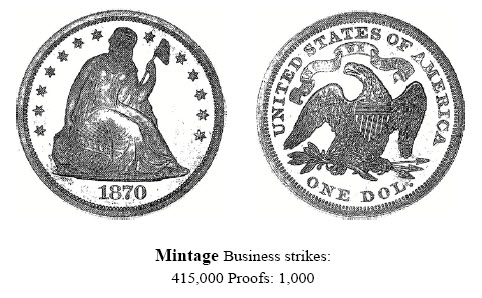
Coinage Context
Distribution: For the first time since the late 1840s, quantities of a Philadelphia Mint dollar remained within the borders of the United States. However, many 1870 silver dollars were also exported to China. All coins were paid out to depositors at the time of coining. Any 1870 dollars found in Treasury vaults in later years were coins returned to the government, possibly in the mid-1870s.
Dollars of the 1870s, particularly Philadelphia issues, appear to have circulated extensively domestically, judging from the availability of Very Fine and Extremely Fine coins today, many of which came to light in bags of circulated coins released through the Federal Reserve System in the early 1960s.
Numismatic Information
Circulated grades: Liberty Seated dollars of 1870 are relatively easy to acquire in circulated grades. Numerous worn specimens came to light in the Treasury release of 1962-1964, and before that they were also easy to find.
Availability of Mint State grades: Although the 1870 dollar is relatively plentiful in circulated grades, true Mint State coins are elusive. Few were saved at the time of release by those who owned them, which probably began domestically after 1873 when silver dollars were no longer worth more in bullion value than face value.
Proofs: The year 1870 was the first since 1861 in which the mintage of Proof dollars touched the 1,000 mark. It is one of those little anomalies of numismatics, and a spur to numismatic research and inquisitiveness, to note that today 1870 Proof dollars are slightly scarcer than are, for example, those dated 1867 (which has a considerably lower mintage).
Apparently, most 1870 Proof dollars were distributed with minor and silver Proof sets. The scarcity of survivors suggests that quantities may have remained unsold at the end of the year and were melted, many after July 10, 1873. However, as Proofs were produced in small numbers at multiple intervals throughout the 1870 year, this would seem to indicate a continuing demand.
Varieties
Business strikes:
1-2. Normal Date: Breen-5482. Obverse: Normal date. At least two varieties of obverses exist, differentiated by slight positional differences in the date.
3-5. Normal Date: Breen-5483. Obverse: Normal date. Reverse: At least three varieties show doubling on the reverse, plainest either on feathers at the left or on the lowest edges of leaves, claws, and arrows.
Proofs:
1. Proof issue: Breen-5482. Obverse: High date. Tiny rust marks in drapery and at crook of elbow of
shield arm. Reverse: The die used to coin Nos. 2 and 3 of 1869.
2. Proof issue: Breen-5483. Obverse: As preceding. Reverse: Doubling seen either on feathers at left or on lowest edges of leaves, claws, and arrows.
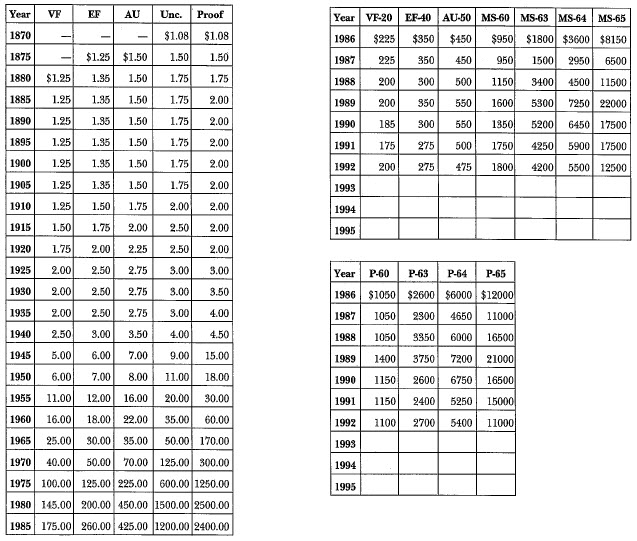
1870 Liberty Seated: Market Values