Silver Dollars & Trade Dollars of the United States - A Complete Encyclopedia
Q. David Bowers
1858 Liberty Seated: Market Values
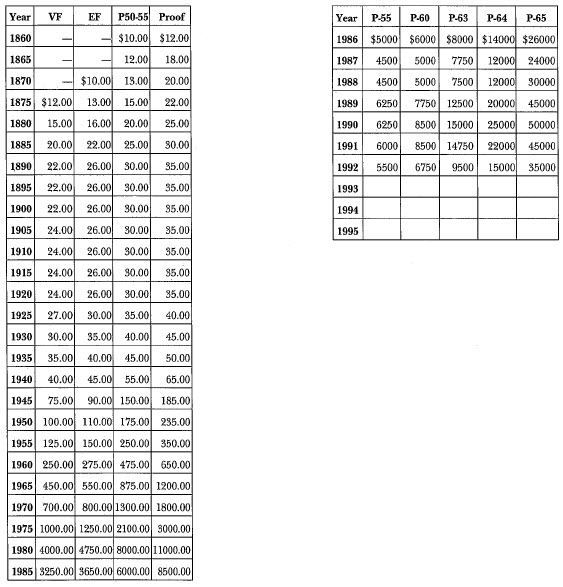
1858 Liberty Seated: Summary of Characteristics
Proofs:
Enabling legislation: Act of January 18, 1837 Business strike mintage: None
Designer of obverse: Robert Ball Hughes (after Gobrecht)
Designer of reverse: Robert Ball Hughes (after Reich)
Weight and composition: 412.5 grains; .900 silver, .100 copper
Melt-down (silver value) in year minted: $1.039 (value in 1858; some coins may be restrikes from a later date)
Dies prepared: Obverse: 2; (Two obverse dies were made, but only one obverse die variety is known today.)Reverse: 2
Proof mintage: 225 to 300+ estimated
Approximate population Proof-65 or better: 4+/- (URS-3) (Weimar W. White suggests a surviving population of 103+/- 1858 dollars in all Proof grades, a figure somewhat lower than the total of the estimates I give. (Ref.: Letter to the author, May 17, 1992.) Approximate population Proof-64: 10+/- (URS-5)
Approximate population Proof-63: 37+/- (URS-7)
Approximate population Proof-60 to 62: 95+/- (URS-8)
Approximate population Impaired Proof: 10 to 20 (URS-5)
Commentary
The 1858 is the only Proof-only date in the Liberty Seated silver dollar series.
Additional Information
A View of the 1858 Dollar
The Coin and Stamp Journal, April 1876, printed the following brief price history as part of an article titled "Rare American Coins": "1858.
"[William A.] Fewsmith's sale, Oct. 1870 [conducted by Ebenezer Locke Mason]; $10. Described: '1858; brilliant Proof; one of the sharpest impressions we have ever seen.'
"[ E. Harrison] Sanford's sale, May, 1874 [conducted by Edward Cogan]; $15. 'Fine Proof very rare. But few dollars of this date are sold out side of Proof sets. '"
The Year 1858 in History
In Illinois, Abraham Lincoln accepted the nomination as Republican candidate for senator, stating that: "A house divided against itself cannot stand." Defeated by Stephen A. Douglas, Lincoln would go on to greater things. Slavery continued to be the main topic of discussion in Congress and in numerous state and local debates. Minnesota was admitted to the Union.
George M. Pullman finished the first practical upscale sleeping car for the Chicago & Alton Railroad. Soon the name Pullman would be synonymous with luxury. The American Bank Note Company was founded in New York City by a consolidation of seven engraving firms. The ABNCo. (as its credit line appeared on currency) would print federal bank notes until 1879 and postage stamps until 1894, after which it would continue to do a thriving business printing stock certificates, travelers' checks, currency for foreign countries (including Hawaii), and other security documents. On October 27, 1858, the R.H. Macy Company opened its doors in New York City, and eventually would become one of America's most famous retailers. The glass Mason jar was patented making it possible for farm families and others to preserve food without refrigeration or drying.
Henry Gray's text, Anatomy of the Human Body, was published in its first edition, and would go on to be a worldwide classic, still in print. The Courtship of Miles Standish, by Henry Wadsworth Longfellow, was published and added to the lustre of America's most celebrated poet. In America, The Yellow Rose of Texas was a popular song, one of many "Texas songs" to be written over the years, more than for any other single state. In Paris, Jacques Offenbach's music for the opera Orpheus in the Underworld featured the Can-Can. News from Europe became instantaneous after the first undersea cable was completed to England. The mint julep was mixed for the first time, at a Virginia spa, Old White Springs. Brigham Young, in an interview published in the New York Times on July 3rd, stated that complaints against polygamy were nonsense, and the Mormons treated their women with dignity, while Easterners treated them like whores.
In the Kansas Territory the town of Denver was established, named after territorial governor James W. Denver. Placer gold was discovered at Cherry Creek, near Denver, setting off a gold rush which would see the flourishing of such mountain towns as Central City and Black Hawk. "Pikes Peak or Bust" became a popular slogan for Easterners who headed west for easy riches, although the Denver district was not particularly near Pikes Peak (which was 75 miles to the south). In years to follow, rich silver deposits would be discovered in the area as well. However the largest gold strikes did not occur until the early 1890s in Cripple Creek, distant from Denver, on the western side of Pikes Peak. Reports of gold discoveries in Arizona were published, with some accounts of silver finds as well, but not enough silver was produced to cause any excitement at the Mint.
In March 1858 a Mr. Balfeur of Boston classified paper money in circulation in the United States as follows (per The Bankers'Magazine). All was in the form of notes issued by private banks:
$1 notes amounting in face value to $7 million (7 million notes)
$2 notes to the amount of $4 million (2 million notes)
$3 notes to the amount of $3 million (1 million notes)
$5 notes to the amount of $15 million (3 million notes) $10 notes to the amount of $5 million (500,000 notes $20 notes to the amount of $13 million (650,000 notes) $50 notes to the amount of $12 million (240,000 notes) $100 notes to the amount of $8 million (80,000 notes) $500 notes to the amount of $35 million (70,000 notes) $1,000 notes to the amount of $30 million (30,000 notes) $5,000 notes to the amount of $2 million (400 notes) However, I disagree with these figures, especially for val
ues over $20. Notes of face value in excess of $20 were rarely seen in circulation, and denominations of $500, $1,000, and $5,000 were virtually unheard of. Presumably, these larger values were held by banks or transferred among major financial institutions, Even so, I cannot imagine any quantity like 30,000 $1,000 notes being in existence in 1858.
At the Mint, Proof sets were offered for sale to the general public for the first time. In addition, sets of 12 different varieties of pattern copper-nickel cents were made available to collectors. Restriking got 'underway, and (per Walter H. Breen) the "Midnight Minters," George and Theodore Eckfeldt, kept busy turning out delicacies for collectors, probably including Proof 1856 Flying Eagle cents by the hundreds. In 1861, using data gathered in 1860, W.C.Prime found the 1856 Flying Eagle cent to be very rare; later, its rarity dropped sharply as new coins were minted. Among denominations issued for regular circulation, only 2,521 $10 gold coins were made; in later years numismatists would recognize it as a rarity.
In Albany, New York, J.H. Hickcox published An Historical Account of American Coinage, the first general information guide of value to coin collectors, although the 1842 Eckfeldt DuBois volume (see 1842 earlier) contained some information. Coin collecting was beginning to catch on in a big way, and Edward Cogan hung out his shingle as America's first full-time professional numismatist. Still, bullion dealers and banks remained collectors' prime sources for desired rarities in the silver and gold series.
The year 1858 saw a burgeoning interest in numismatics brought about by the passing of the large cent (in early 1857) and the consequent publicity that certain large cents, even those which might be found in pocket change, were rare. While few people found a prized 1793, 1799, or 1804 cent (by 1858 any such coins in circulation were apt to be worn to the point of virtual smoothness anyway), quite a few armchair enthusiasts set about acquiring one of each date they could find. There developed a brisk trade in such coins, and Edward Cogan, for one, gained new customers nearly every day. The American Numismatic and Archaeological Society was formed. Later known as the American Numismatic Society, the organization began publishing the American Journal of Numismatics in 1866. Today, the A.N.S. is located in New York City at 155th Street and Broadway, in a building financed by Archer M. Huntington, and opened in 1908.
Archer, the son of Arabella Duval (Yarrington) Worsham, of Alabama, took the surname Huntington when his mother married Collis P. Huntington. As was true of Collis' cronies-Leland Stanford, Charles Crocker, Mark Hopkins-his fortune was largely based upon the monopolistic exploitation of farmers and other rail customers, upon immense grants given to the railroads by the government, and by the bribing of politicians; it was a sorry chapter in American history. Today, the family names are somewhat sanitized by the monuments left by these men-including Stanford University, Huntington Gardens (Henry Huntington's home in San Marino, California), etc. Notwithstanding all of this, Archer M. Huntington's financial contribution to numismatics was immense; and today the American Numismatic Society stands as a bastion of scholarship and learning. Its museum collection is spectacular, and while it emphasizes ancient coins, the American cabinet displays a spectacular selection of colonial and other early issues. In fact, the A.N.S. Library was a prime source for much information in the present book.