Silver Dollars & Trade Dollars of the United States - A Complete Encyclopedia
Q. David Bowers
1872 Liberty Seated Dollar
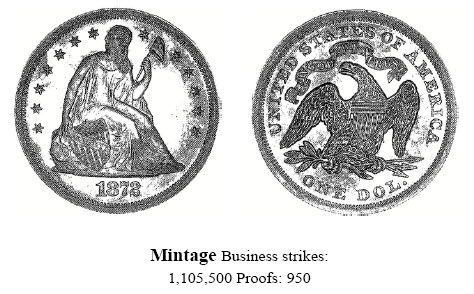
Coinage Context
Distribution: Despite the record mintage of 1,105,500 business strikes, 1872 Liberty Seated dollars are slightly scarcer today than are those dated 1871 (which has the next highest mintage). I believe that more were exported of this date than of 1871. All were paid out to depositors of silver. However, some returned to the Treasury in later years. Probably, most 1872 Liberty Seated dollars were used domestically and were seen in the channels of commerce after 1873, when their intrinsic value dropped below their face value.
Numismatic Information
Circulated grades: The 1872 is a plentiful dollar in all circulated grades, due no doubt to the combination of high mintage plus the use of this issue in domestic commerce, although specimens were not released at par in the United States until a few years after they were minted. In 1872, at the time of striking, these coins had a melt-down value of $1.03 and were available from the Mint only by paying a premium.
Mint State grades: The 1872 Liberty Seated dollar is very rare in MS-64 or higher, but in MS-60 to MS-63 it is one of the more available issues of the series. Walter H. Breen in his Encyclopedia notes that 1872 is "common in nicked Uncirculated, from at least one Treasury bag (1,000) released 1962-1964." Apparently, this information is not correct, for Walter H. Breen informed me that it came from Harry Forman, probably indirectly, who could not confirm it. Instead, Forman stated that he handled only a few dozen Mint State 1872 dollars during the time of the 1962-64 Treasury releases. Further, John W. Dannreuther has commented as follows: "There is still doubt that at least one bag of 1,000 coins was disbursed by the Treasury in the early 1960s. I say doubt, for the population data does not seem to confirm this." (Harry Forman was and is well known for having handled many dollars in quantity, and many unconfirmed rumors have circulated as to what he actually did handle. The truth is given in the detailed interviews with Forman reprinted in the present book. The Dannreuther comment is from his study, "Liberty Seated Dollars," in The Comprehensive U.S. Silver Dollar Encyclopedia)
The number of known Mint State 1872 dollars is probably on the order of several hundred coins, most of which are in lower grades. Apparently, some were mixed in with dollars of other dates during the Treasury release of 1962-1964, but no partial or full bag quantities have been confirmed. In 1982, Bruce Amspacher stated that a gem of this date came on the market once every year or two. (Article, "Liberty Seated Dollars," in the Monthly Summary, Coin Dealer Newsletter, July-August, 1982.)
Proofs: The 950 Proof Liberty Seated silver dollars of this date mostly were sold with minor and silver Proof sets, for which there seems to have been a fairly steady demand throughout the year (see Summary of Characteristics below). However, some Proofs probably remained unsold at the end of the year and were melted in 1873.
Among surviving Proof Liberty Seated silver dollars of all dates, those of the late 1860s and early 1870s are the most often seen today. However, in proportion to their original mintages, these later dollars do not survive in amounts 'equal to Proofs of certain Civil War years, for reasons noted earlier.
Pattern note: In 1870, John Jay Knox, Deputy Comptroller of the Currency, proposed a "commercial dollar" for the China trade, in place of the standard dollar. In 1872, the Mint made various patterns with reverse reading COMMERCIAL DOLLAR. Later patterns read TRADE DOLLAR. Further details are given under trade dollars in the present work.
Varieties
Business strikes:
1. Normal Date: Breen-5490. Obverse with date lightly impressed in die; 1 and 8 in date clear of each other. Several positional varieties. (Cf. "1872 Seated Dollars," by John W. McCloskey. The Gobrecht Joumal, November 1979).
2. High Date. Date high and very close to the rocky base; distant from denticles. 1 and 8 in date clear of each other. Rarity unknown but probably common; specimen (AU-50 grade) first seen by the author in an auction consignment, August 21, 1992. Later, a perusal of various catalogues showed several others.
3. Heavy Date: Breen-5490. Obverse with date heavily impressed in die; 1 and 8 touching at bases.
4. Blundered Date: Breen-5491. Obverse with part of extra 1 digit embedded in the rocky base below shield, just above the edge of base; parts of the bases of two 2s above and just below edge of rocky base, above 2 of date. Apparently, a four digit 1872 logotype was inadvertently lightly impressed into the working die at this point. The first specimen reported appeared in the 1974 Great Eastern Numismatic Association sale, Lot 1093, and was described as Uncirculated. Numerous others have shown up since, in various grades, some in later die states with the blunder less obvious. Dealer specialist Larry Briggs estimated that about a third of the known business strike 1872 dollars are of this variety. (Conversation with the author, April 6, 1992.)
Proofs:
1. Proof issue: Breen-5490. Obverse: Date slightly high. Shield point midway between tip and upright of 1. 1 and 8 in date nearly touch. Reverse: With die file marks at claw and stem. This reverse die was also used to coin Proof 1873 Liberty Seated dollars.
2. Doubled Reverse Die: Reverse (first used in 1871 and also used in 1873) with portions of motto sharply doubled through IN GOD WE, with IN GO particularly so. For example, the letter I has two sets of serifs at top and bottom. Cf. Bowers and Merena Galleries Spring Quartette sale, March 1992, Lot 2591; Stack's Floyd T. Starr Collection, October 1992, Lot 603.