Silver Dollars & Trade Dollars of the United States - A Complete Encyclopedia
Q. David Bowers
1846-O Liberty Seated Dollar
Coinage Context
New Orleans issue: After construction commencing in 1835 and the setting up of equipment in 1837, the New Orleans Mint opened for business in 1838. However, it struck no silver dollars until 1846. This was the first of only four dates of Liberty Seated dollars from this mint: 1846-O, 1850-O, 1859-O, and 1860-O.
Although some 1846-O dollars may have been exported, and most likely many were melted, many also circulated within the confines of the United States, probably in the Mississippi Valley.
The Assay Commission found that silver coins (of all denominations, taken as a class) from the New Orleans Mint produced in 1846 assayed a remarkably high. 9011 fine, which was above the legal standard (but still within the legal tolerance of .987 to .903); This was far out of the range of normal variation from the .900 standard, as reflected in Assay Commission reports.
Numismatic Information
Circulated grades: The 1846-O has always been relatively easy to find in circulated grades below Extremely Fine (but EF or better pieces are quite rare). I suspect that this issue circulated widely and saw use in the channels of commerce up and down the Mississippi River Valley, especially riverboats (which numbered in the hundreds) and casinos. Relatively few must have been melted or exported. As the first branch mint silver dollar and as an issue of the New Orleans Mint, the 1846-O has always occupied a place of affection in collectors' hearts.
Mint State grades: In Mint State the 1846-O is very rare; just how rare is not known with certainty. Some of the specimens seen by me have been so deeply toned that it is impossible for anyone (including a certification service) to determine, for example, whether they are AU-58 or Mint State. (In reviewing this particular section of the book, in which this sentence originally ended as "AU-58 or MS-60," Bill Fivaz made this comment (letter to the author, February 13,1992): "I have always felt that if a coin is being considered as either an AU-58 or Mint State, it would jump right over the MS-60 to 62 categories and be an MS-63 or better if determined to be Mint State. I feel (and teach thusly at the ANA Summer Conference) that an AU-58 coin is really an MS-63 (or better) coin with just a tad of wear. If an MS-60 coin had the same trace of wear, it should then be graded AU-50, because an MS-60 coin is not an attractive coin, due to contact marks, poor lustre, etc. It is a minor point, but one I feel has a good deal of merit." Fivaz's comment illustrates that numerical grading is not a science but a subjective value judgment. "How many points to take off for problems" translates to "How much to discount the price?") Notwithstanding this, a top grade 1846-O is an object of desirability. In MS-63 or better grade it is a prime rarity.
Varieties
Business strikes: Breen-5437:
1. Obverse: Normal. Reverse: With heavy O mintmark.
2. Obverse: Normal. Reverse: With "normal" O mintmark.
3. Obverse: Normal. Reverse: With very weak and thin O mintmark.
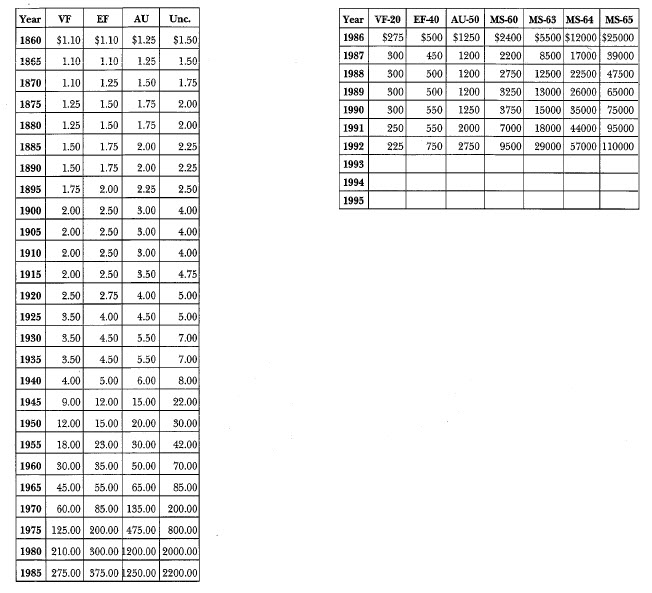
1846-O Liberty Seated: Market Values