Silver Dollars & Trade Dollars of the United States - A Complete Encyclopedia
Q. David Bowers
1854 Liberty Seated Dollar
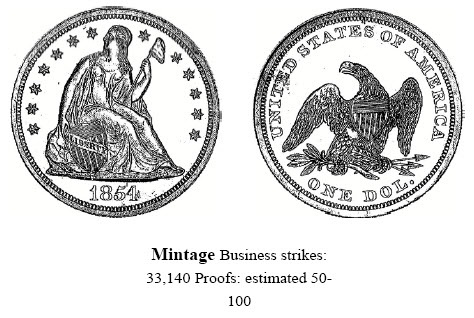
Coinage Context
Subsidiary silver coins pile up: At the Philadelphia Mint so many subsidiary silver coins (half dimes through half dollars) were minted that storage became a problem. Mint Director James Ross Snowden "stimulated their issue by shipping large amounts to various Treasury offices for distribution in government operation. He offered them in exchange for Spanish fractions, paid them out for silver bullion, and sold the remainder for gold coins to the general public .... In the city silver coins became a nuisance. Some creditors refused payments above the $5 amount for silver required by law." (Carothers, Fractional Money, p. 133)
Status of the silver dollar uncertain: Made primarily from bullion obtained from Mexico, U.S. silver dollars did not circulate domestically, and nearly all were immediately exported to China or South America. (Carothers, Fractional Money, p. 149.) When the San Francisco branch mint was set up in 1854, no provision was made to include machinery to mint silver dollars, although it was the case that the press intended to strike $20 gold coins could serve the purpose of dollar coinage. The status of the silver dollar was not defined during this era; from the standpoint of domestic utility it was virtually non-existent.
A "trade dollar": 1854 may represent the year in which Liberty Seated dollars were first used in quantity for trade overseas, particularly China. Merchants and others desiring goods from the Orient (particularly tea and silk from China) had to pay for them in silver, for American currency (privately issued at the time; banks accepted them at discounts or not at all; federal notes did not appear until after the issue of 1861) was not wanted, and gold was not in favor, as Chinese merchants preferred silver. The typical San Francisco merchant in the export trade had to pay a premium for Mexican silver pesos or else ship United States silver dollars. These dollars were not available at face value, for their silver content was worth more than that, and they could only be bought from brokers on the West Coast, who charged a 10% to 15% premium for them. China, which had been opened to Westerners in 1842, was by 1854 trading extensively with England, America (primarily via clipper ships through the ports of New York City, Boston, and San Francisco), and other countries.
Although most of the coinage of 1854 dollars was exported, some could have circulated in northern California, where the newspapers were constantly referring to the need for small-denomination silver coins for change, in a market where nearly all privately minted gold coins were of denominations from $5 upward. (Small denomination California gold coins, minted by San Francisco jewelers and others in the denominations of 25¢, 50¢, and $1 (relatively few of the $1, however), first made their appearance in summer 1852, supplementing the scanty supplies of domestic and foreign silver for small change. Curiously, little mention of California gold coins of these small denominations appeared in San Francisco newspapers of the decade of the 1850s.) The San Francisco Mint began business in 1854 but coined no silver until 1855, nor silver dollars until 1859, and then only in limited quantity. The Comstock Lode, which would make the United States silver-rich, would not be discovered until 1859, and silver was not in plentiful supply in San Francisco until after that time.
Walter H. Breen comments (Encyclopedia of U.S. and Colonial Coins, p. 439) that 10,000 silver dollars dated 1854 were shipped from Philadelphia to San Francisco on November 11.
Numismatic Information
Circulated grades: Just as the 1853 has an unexplained availability for a Liberty Seated dollar of the decade of the 1850s, the 1854 has kept the secret of its rarity well. Although 33,140 were struck, or a mintage just below that of 1850-O and double that of 1848, circulated 1854 dollars are few and far between today. This may be the rarest Philadelphia Mint Liberty Seated dollar after 1851-1852. In fact, dollars of this date were considered rare by Montroville W. Dickeson (in his American Numismatical Manual) in 1859, just five years after they were minted! Writing in 1880, Ebenezer Locke Mason considered the 1854 to be the rarest business strike silver dollar dated after 1852 (Mason did not consider mintmarks, as these were not collected at the time).
Why are they rare? As noted, the most logical explanation is that most were exported and melted. Possibly, many dollars of the 1850s were among the 40,000 melted at the Mint in 1861 to provide bullion for subsidiary silver (see R.W. Julian's accounts at 1859 and 1861).
Availability of Mint State grades: This silver dollar date is very rare, and I have seen only a few. However, PCGS and NGC data indicate an unusually high number certified at the MS-64 and MS-65 levels. Bruce Amspacher, a founder and owner of the Professional Coin Grading Service (PCGS), related the following: (Letter to the author, June 24, 1992.) "You are familiar with the problem of tracking the rarity of some dates due to resubmission of the same coin over and over again. A classic example: How can there possibly be six 1854 Seated dollars in MS-65 on the PCGS Population Report? I asked the owner of the one coin. He said he had sent it in six times. I mentioned that he could send in the old printed inserts and the duplications would be erased from the report. 'I threw 'em away,' he said."