Silver Dollars & Trade Dollars of the United States - A Complete Encyclopedia
Q. David Bowers
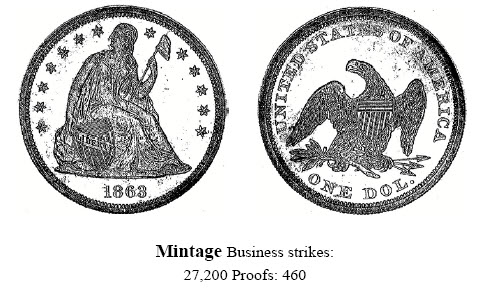
1863 Liberty Seated Dollar
Coinage Context
Coins exported: Walter H. Breen states that most Philadelphia Mint silver dollars 1862-1865 were "exported to Latin American and East Indian ports."!
It is certain that the Treasury paid none out at face value, for they were worth a premium and, further, specie payments were still in suspension. Such coins would have been available in exchange for bullion deposits, less a handling and coinage charge, and were eventually purchased at a premium by banks, bullion dealers, and others needing them for the export trade.
Because most Liberty Seated dollars were struck on private account and paid out to depositors of bullion, the mintage of a given issue would not have returned to a Treasury vault until some years later, if at all. The dispersal of such dollars at later times does not indicate how they were obtained in the first place. Records were not kept of such matters."
To suggest that most of the mintage of silver dollars remained in Treasury vaults awaiting the resumption of specie payments (which did not take place on a large scale until 1876) would not seem to be correct. Further, if this had been done, then thousands of coins would have circulated domestically after the mid-1870s, and business strikes in grades such as VF and EF would be much more available today than they actually are.
However, it is possible that the Treasury retained various quantities of certain issues. Apparently, there was no single hard and fast rule that applied to silver dollar distribution during this period.
Numismatic Information
Circulated grades: Circulated examples of 1863 have much the same story as 1862. Low mintage, export, etc., combined to make this a rare date in all business strike grades. The desirability of coins of this era, while long known to numismatists, has been accentuated by the activities and camaraderie among members of the Liberty Seated Collectors Club-which is great, for fellowship is one thing that coin collecting is all about.
As a class, business strikes (in all grades from well worn to Mint State) appear in auctions far less often than do Proofs. This observation is not completely objective, for by far the largest number of circulated silver dollars that change hands numismatically do so by private sale, not by auction. On the other hand, I believe that a fairly large number of transactions involving Proofs are consummated via auctions.
Mint State grades: As might be expected from the production figure, Mint State examples of 1863 are rare today. However, enough survive that the patient numismatist can sooner or later acquire a top level example. In the meantime, he will have had the opportunity to consider several Proofs, for as a class these are more frequently encountered. High grade Mint State coins usually have heavy die striae evident, especially on the reverse.
1863 Proofs: Only 460 Proof dollars were struck this year, most of which were probably sold, although the Mint's pricing and ordering policies during this difficult Civil War year made it anything but easy to acquire sets and individual coins (see note on this under 1862).
Proof dollars of various dates that were purchased circa 1862-1865 may have had a proportionately higher survival rate than Proofs before the Civil War, as silver coins of all kinds (Proof and otherwise) were especially prized after the suspension of specie payments in July 1862. Had it not been for the difficulties involved in ordering sets, and the likelihood that some percentage of buyers were in Confederate territory and inactive at the time, the quantities made of Civil War year Proof dollars (and other denominations) would have been higher. In the North, especially in Philadelphia, New York City, and Boston, numismatics was growing rapidly, and each month saw new devotees join the hobby. Few collectors were then known to be in the South.
Varieties
Business strikes:
1.Normal Date: Breen-5469. Obverse: Centered date. Business strikes are believed to have been struck from only one obverse die.
Proofs:
1. Proof issue: Breen-5469. Obverse: Date slightly low on the coin and slightly right of center. Shield point is left of the tip of 1; left base of lover space between border denticles. Reverse: Two arrows joined by a defect; unpolished area joins upper and center leaves, including a curved line.
2. Proof issue: Breen-5469. Obverse: Low date, as above, but from a different die. Reverse: Different from preceding. More information is needed in the form of a description of the dies and the number of coins known.
Note: Circa 1867-1868 a new 1863-dated obverse die was made up and used to strike patterns in copper, aluminum, and silver with IN GOD WE TRUST on the reverse. (These were probably made as delicacies, circa 1867-1868 or even 1869, for Mint Director Dr. Henry Richard Linderman. For many years (at least since the R. Coulton Davis list of patterns in the 1880s) collectors believed them to be transitional patterns, first made in 1863 to test the idea of having IN GOD WE TRUST on the reverse of Liberty Seated coins (25¢, 5M, and $1), with subsequent similar patterns made in 1864 and 1865. This belief died hard. Only in recent years Walter H. Breen examined a complete nine-piece set (1863- 4-5 of all denominations), with additional single examples, and established by die states that all nine followed 1866-1867 Proofs. Further, those dated 1863 and 1864 were made after those dated 1865. After they were struck, specimens were not openly sold, but were filtered out to the Mint to certain buyers. A number of specimens went to William Idler, then to John Haseltine and Stephen K. Nagy, who marketed them circa] 908-1915 when there was a great expansion of interest in patterns (spurred by the anticipation of and the publication by the American Numismatic Society of the Adams-Woodin book on the subject in 1913). This motto reverse first appeared on the last Proofs of 1866 (nos. 2 and 3) and the first two of 1867.