Silver Dollars & Trade Dollars of the United States - A Complete Encyclopedia
Q. David Bowers
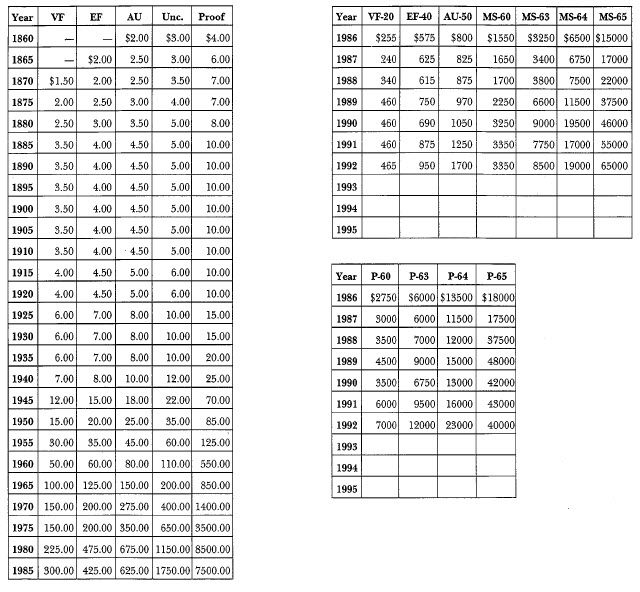
1857 Liberty Seated: Market Values
1857 Liberty Seated: Summary of Characteristic
Business Strikes:
Enabling legislation: Act of January 18, 1837
Designer of obverse: Robert Ball Hughes (after Gobrecht)
Designer of reverse: Robert Ball Hughes (after Reich)
Weight and composition: 412.5 grains; .900 silver, .100 copper
Melt-down (silver value) in year minted: $1.046
Dies prepared: Obverse: Unknown; Reverse: Unknown
Business strike mintage: 94,490; (The May 29th delivery of 490 pieces was omitted in error from both the 1857 Annual Report and calendar year statistics published by the Mint in the 1880s. It is possible that this small number of coins represents a special striking for unknown purposes. Reference: R.W. Julian, "Philadelphia Coinage Statistics: 1853-1873. The Silver Dollar," Numismatic Scrapbook Magazine, August 1964.)
Delivery figures by day: May 29: 490; June 6: 10,000; June 13: 20,000; June 16: 25,000;June 27: 31,000;June 30: 8,000.
Estimated quantity melted: Unknown
Approximate population MS-65 or better: 2 to 4 (URS-2)
Approximate population MS-64: 15 to 25 (URS-5)
Approximate population MS-63: 20 to 30 (URS-6)
Approximate population MS-60 to 62: 30 to 60 (URS-6)
Approximate population VF-20 to AU-58: 175 to 00 (URS-8)
Characteristics of striking: Nearly always weakly struck at top of the obverse (Miss Liberty's head and stars 5 through 10). Some coins are almost flat in this area. Other coins are weak on the obverse but quite well struck on the reverse. Most coins were made with prooflike surfaces.
Known hoards of Mint State coins: None
Proofs:
Dies prepared: Obverse: Apparently 2; Reverse: 1, plus 1 held over from 1856.
Proof mintage: 50 to 100 estimated
Approximate population Proof-64 or better: 5 to 12 (URS-4)
Approximate population Proof-60 to 63: 25 to 40 (URS-6)
Commentary
Like its immediate predecessors in the series, the 1857 Liberty Seated dollar was used primarily in the China trade. Business strike coins were made with prooflike surfaces. This date is much rarer than generally known.
Additional Information
Prices Paid at the Mint
In a letter dated February 6, 1857, to Hon. James Guthrie, secretary of the Treasury, Director of the Mint James Ross Snowden noted that although earlier laws had made Spanish and other dollars legal tender at the Mint, the same was not true of fractional denominations. Notwithstanding this, the minor coins have "held a far larger place in our currency than any or all others [Mexican dollars, etc.] named in those acts." Snowden said that many fractional coins had been received at the Mint for recoining into U.S. silver denominations.
The average buying price for coins at the Mint was as follows: Spanish [i.e., Spanish American, mostly Mexican] pillar dollars $1.053.
But: "There is a class of dollars which is generally mistaken for the true Spanish pillar dollar, but is decidedly inferior, being worth only $1.01 on the average, and withal very irregular. They were coined by the royal party in the revolutionary times of Mexico, and may be known by their defaced appearance, which is not due to wear, but to blows of the hammer, by which they were coined, whence they are called hammered dollars."
Dollars of Mexico, mixed $1.063.
Dollars of Peru, prior to recent changes $1.065. Dollars of Bolivia $1.065.
Dollars of Central America $1.027. Five francs of France, mixed $0.99.
Worn Spanish quarters $0.235. (Spanish halves, or 4-real pieces, circulated but were few in number. Judging from coins surviving today (in the 1990s), the most popular fractional denomination was the 2-real or quarter piece.)
Worn Spanish eighths $0.109.
Worn Spanish sixteenths $.052.
An Early Numismatic Society
In 1857, steps were taken to form a coin collectors' society in Philadelphia. The Proceedings of the Numismatic and Antiquarian Society of Philadelphia, January 4, 1866, gave a capsule history of the organization:
"The preliminary meeting to take into consideration the propriety of forming a Numismatic Society was held on the 28th of December 1857, on which occasion seven gentlemen were present. It was then resolved to form such a Society; a meeting was called for January 1, 1858, and organized regularly. At this meeting eight gentlemen were present; one of those present at the former meeting not being present at this or any subsequent meeting of this Society, although he became a member, and remained one until December 1859, when he resigned.
"During the year 1858 there were elected 16 members, making the total January 1, 1859, 25. During 1859 there were elected 13, and one resigned, making on January 1, 186037. During 1860 there were five elected, and two resigned, making the number 40 on the first of January 1861. During this year there were four elected, one died, one resigned, making 42 on January 1, 1862."
By early 1866 the number of members stood at 55. In addition, the director of the Mint James Pollock, was an ex officio or honorary member of the Society. It is probably accurate to say that the most serious collectors in the Philadelphia area belonged to the Society. This gives an indication of those who may have been doing some "business" with the Mint during the 1860s, buying restrikes, etc. James Ross Snowden, was a member ex officio, and after his Mint directorship ended in April 1861, he requested to retain (or renew?) his honorary membership, which was printed in April 1866 by the Society. This indicates that Snowden maintained an active interest in numismatics and personally interfaced with collectors in the Philadelphia area.
The following founded the Society in 1857-1858: John Bohlen, Arthur G. Coffin, Mark Wilkes Collet, M.D., Samuel H. Fulton, Montgomery L. Frederick, J. Ludger Hodge, Joseph J Mickley, Alfred Bates Taylor, and William S. Vaux. At one time Gulian C. Verplanck, of Hard Times token fame, was an honorary member, as was erstwhile 1848 presidential candidate Lewis Cass, who was well known as an amateur historian.