Silver Dollars & Trade Dollars of the United States - A Complete Encyclopedia
Q. David Bowers
1851 Proof Restrike Dollar
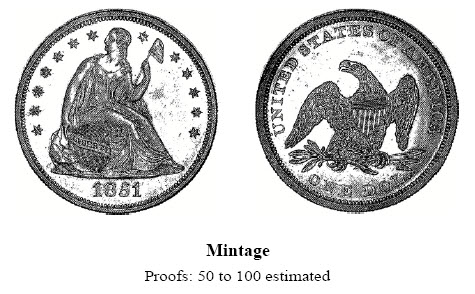
Numismatic Information
Tradition: The coins described here, with centered date, are traditionally called restrikes. However, in my opinion there may be more information to be learned. Could some be originals?
Proofs: This issue, made only with Proof finish, is believed to have been struck at the Philadelphia Mint on at least two occasions, one being circa 1858-1860 and the other probably later, possibly circa 1867-1868, perhaps employing unused obverse dies on hand from 1851. Two die pairs are known for restrikes.
Restrikes are distinguished by having the date lower and better centered than on the originals. Alternatively, new dies dated 1851 could have been made up at a later date, the first circa 1858-1860. (The date logotype is identical to that of the original obverse; Mint regulations did not even mention old logotypes, let alone mandate their destruction.)! Some copper impressions were also made from the Proof dies, for sale to collectors.
Such restrikes were not sold in Proof sets, nor, for that matter, openly sold at all. Most likely, they were privately sold by insiders at the Mint. During the time of issue, circa 1858-1860 (and possibly again 1867-1868), absolutely no one studied minute die varieties of silver dollars, and the difference between original 1851 silver dollars and restrikes, so obvious today, was not a subject of discussion then. The knowledge of two die pairs for 1851 restrikes represents a new discovery, first confirmed by James C. Gray, Thomas K. DeLorey, and the author, during the examination of a group of 1851 restrike dollars assembled for study at the 1992 ANA convention."
"Midnight Minters": Walter H. Breen relates that the "Midnight Minters" (George and Theodore Eckfeldt) produced coins from 1858 through the summer of 1860, when Director James Ross Snowden seized various old dies and sealed them in a carton, which he kept in his vault under a watchful eye." Further:
If Mint Director Linderman ordered any after opening the carton in which Snowden had sealed them, this must have been in 1867-1868. The "Midnight Minters" must have eased their task by using old dies wherever possible; making new dies was time-consuming and risky, though they likely did so on occasion, mostly after 1860. Probable examples include 1863-1864 restrikes of the trime and half dime, and possibly 1865 $3 and various patterns. Clearly, Snowden didn't find all the dies they had; obvious exceptions include the no-motto reverses of the silver $1 and gold $5.
On the other hand, R.W. Julian writes:
(Letter to the author, March 10, 1992; at the time it was not known that restrikes exist from two die pairs, thus indicating restriking on at least two different occasions.)
"I think James Ross Snowden made the 1851 restrike. Much too much has been made of the clandestine competitors in the Mint; they probably concentrated on a few high-profit pieces."
Director Linderman: Further from Walter H. Breen:
Director Snowden confiscated the [1851 restrike dollar] dies and sealed them in a carton which went into the director's office vault, with an inventory. The carton remained sealed until 1867, when H.R. Linderman opened it for replacing the lost inventory. He was a collector of coins, especially patterns and off-metal strikings, and he probably ordered impressions struck from the old dies. The Linderman strikings are not identified; if the copper strikings [of the 1851 restrike dollar] are from the latest die states, they may have been among those ordered by Linderman.
Eric P. Newman and Kenneth E. Bressett wrote this: (From Eric P. Newman and Kenneth E. Bressett, The Fantastic 1804 Dollar, pp. 84-85.)
On July 30, 1860, the director of the Mint, James Ross Snowden, sealed a group of dies in a box. According to an inventory, these included obverses for dollars bearing the dates 1804, 1836, 1839, 1851, and 1852. These dies were resealed in the same box on May 18, 1867 by Director Henry R. Linderman. The significance is that, as of July 30, 1860, the only earlier dollar dates for which dies were on hand were the dates indicated. This listing coincides with rarities recognized by collectors and, obviously, indicates restriking possibilities. Further, the same dies were available to H.R. Linderman, who was well known for his restriking activities, in 1867.
As time went on, collectors and dealers began to openly question the Mint, and usually were met with denials. As Shakespeare might have said, "Snowden, Linderman, and all their kind / Do, methinks, protest too much." .... These Mint directors took great pains to say how ethical the Mint procedures were, while at the same time they had special pieces and rarities produced for their own collections and for private profit.
(For more on the subject of Mint ethics and official denials, see Ed. Frossard's comments quoted under the 1884 trade dollar in the present volume. In June 1878 a congressional subcommittee made charges of misconduct against Dr. Henry R. Linderman, which he denied. Linderman died on January 27, 1879 at the age of 53. The charges were never resolved.)
Today, anyone aspiring to complete a date set of Liberty Seated silver dollars necessarily needs an 1851, and likely as not, a beautiful Proof restrike will fill the gap.
Unlike most other restrikes in the dollar series, the 1851 is clearly identifiable, is not subject to differences of opinion, and in modern times (but not as recently as a few decades ago) is usually described in print as a restrike. As 1851 dollars of both varieties (originals and restrikes) have been rare for over 130 years, they are often pictured in auction and sale catalogue Thus, pedigree lines can be established and, at least in the instance of the restrike version of the 1851, there never is a question as to whether a coin described by B. Max Mehl, William Hesslein, or some other old-time numismatist is a Proof.