Silver Dollars & Trade Dollars of the United States - A Complete Encyclopedia
Q. David Bowers
1870 Liberty Seated: Summary of Characteristics
Business Strikes:
Enabling legislation: Act of January 18, 1837 (weight and fineness); Act of March 3, 1865 (motto)
Designer of obverse: Robert Ball Hughes (after Gobrecht)
Designer of reverse: J.B. Longacre (after Hughes and Reich)
Weight and composition: 412.5 grains; .900 silver, .100 copper
Melt-down (silver value) in year minted: $1.027 Dies prepared: Obverse: Unknown; Reverse: Unknown
Business strike mintage: 415,000; Delivery figures by day: January 20: 12,400; January 27: 9,300; February 2: 9,000; February 3: 12,000; March 3: 17,000; March 5: 10,000; March 7: 9,000; March 10: 16,000; March 11: 8,200; March 28: 4,600; April 7: 4,500; April 12: 21,000; April 13: 1,000; April 18: 16,000; April 20: 15,000; April 27: 13,000; April 30: 8,000;June 15: 15,600;Junee 22: 5,000; June 30: 6,700; July 7: 10,300; July 2: 13,000; September 7: 6,000; September 17: 10,300; October 29: 11,000; November 6: 20,000; November 9: 5,000; November 15: 19,000; November 17: 11,400; November 23: 8,000; November 26: 8,000; November 29: 5,000; December 2: 12,000; December 7: 13,000; December 15: 12,700; December 19: 15,000; December 28: 8,000.
Estimated quantity melted: Unknown
Approximate population MS-65 or better: 2 to 4 (URS-2)
Approximate population MS-64: 15 to 25 (URS-5)
Approximate population MS-63: 20 to 40 (URS-6)
Approximate population MS-60 to 62: 50 to 100 (URS-7)
Approximate population VF-20 to AU-58: 1,200 to 1,800 (URS-12)
Characteristics of striking: Varies; some have a curious pattern of weakness, with stars 10 through 13 weak, but 8, 9 and other stars more sharply defined.
Known hoards of Mint State coins: None
Proofs:
Dies prepared: Obverse: At least 1; Reverse: At least 1. Proof mintage: 1,000
Approximate population Proof-65 or better: 32+/- (URS-6)
Approximate population Proof-64: 76+/- (URS-8)
Approximate population Proof-63: 90+/- (URS-8)
Approximate population Proof-60 to 62: 175+/- (URS-9)
Commentary
This is the first Liberty Seated dollar dated since the 1840s which is reasonably easy to find in circulated grades.
Additional Information
Director Pollock's Commentary
In the Annual Report of the Director of the Mint, 1870, James Pollock commented as follows:
"The mint work is necessarily hindered and restricted by the continued suspension of specie payments. We are doing less than was done many years ago, when there was a much smaller population and far less wealth. Certainly there is no need of creating any more coining establishments. (In general, mint directors of the era favored the Philadelphia Mint and, to an extent, San Francisco, and were critical of other mints, either actual (that at New Orleans and the newly opened Carson City facility) or proposed new mints.)
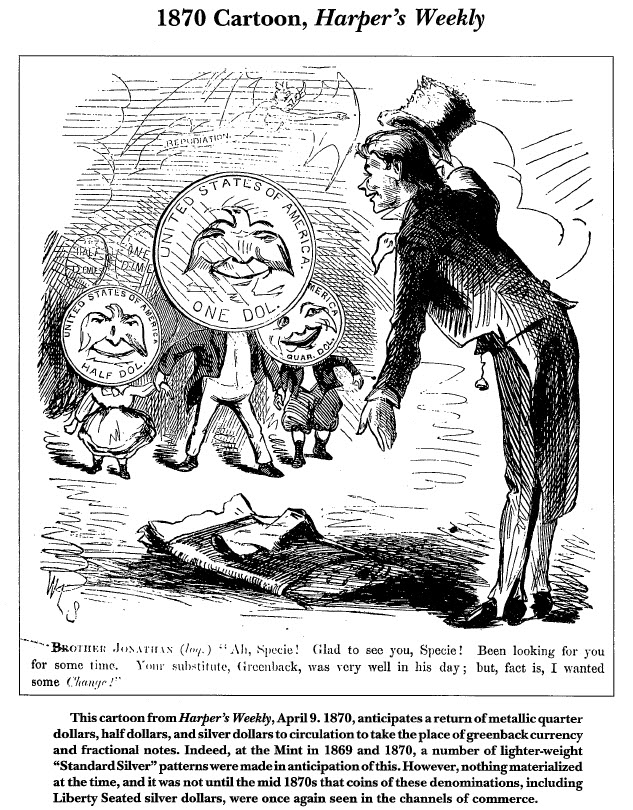
"Emerging from a tremendous Civil War which shook every social interest to the very foundation, it is no wonder that our currency continues in an abnormal condition. Most of our people rarely get the sight of a gold or silver coin. (Most small transactions were accomplished by using paper Fractional Currency notes, often dirty and tattered, disdainfully called "stamps" by the public. This name was derived from the original Postage Currency issue of 1862, which depicted postage stamps and occasionally came with perforated edges like those of actual stamps. These in turn had replaced postage stamps of 1861 as small change.) They know, by the state of the money market, the relation between the precious metals and current paper notes, and they must be kept advised of this to understand what is the real value of those notes; but the gold by which the measure is made, is almost as much out of sight as the sacred pound troy, or kilo-gram, carefully guarded as the final resort. (This is a reference to the standard weight, obtained from England, used to calibrate scales and other units of measure at the Mint. The standard weight is now (1992) at the National Bureau of Standards, Bethesda, Maryland. Also see item from Evans, quoted below.)