Silver Dollars & Trade Dollars of the United States - A Complete Encyclopedia
Q. David Bowers
1841 Liberty Seated Dollar
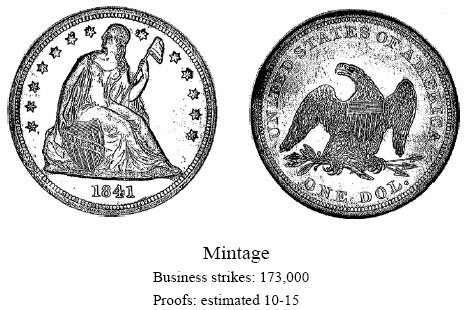
Coinage Context
Silver bullion a problem: As noted under 1840, the United States had but a small domestic supply of silver bullion. This continuing problem was the focus of a commentary in the 1841 Annual Report of the Director of the Mint:
The principal mint and its branches have all been in good condition throughout the year, there has been no unusual interruption in their operation; but, in consequence of the small supply of bullion, they have been only partially employed, so that the amount of work done by them has fallen far below what they are able to execute. The whole coinage of all the mints was less than two and a quarter million; while the Philadelphia Mint alone is capable of coining 12 million, and in 1836 did actually coin more than seven and three-quarters.
The same report showed the main sources of silver:
Bullion from North Carolina worth $4,198 Foreign bullion $210,546
Mexican dollars $272,320
Dollars of South America $14,292 European coins $55,692
Silver plate (Tableware and other wrought items, often dented or otherwise damaged.) $5,398
The above figures totaled $562,446, in comparison to a total silver coinage (of all denominations from the half dime to the dollar) for the year of $577,750. However, the total supply of bullion had little to do with silver dollar coinage. The number struck depended solely on the bullion deposited by those specifically asking for dollars. (Of course, had there been more bullion, proportionally more dollars would have been struck.) Others deposited silver bullion for dimes, half dollars, etc. This changed after the Act of February 21, 1853, when minor silver coins could no longer be requested for bullion.
A potential North Carolina source: In this year for the first time deposits of silver were received at the Philadelphia Mint from native mines ill the United States, coming in this instance from argentiferous carbonate of lead found in Davidson County, North Carolina. The proprietors of the mine informed Robert M. Patterson, director of the Mint the future silver output would be "largely productive." The amount of silver produced must have been small, for later Mint reports did not mention silver from this source.
Numismatic Information
Circulated grades: The mintage of 1841 was fairly high, but the availability of circulated specimens belies this. In general, fewer circulated 1841 dollars appear on the market than do those dated 1840, although nearly three times as many 1841s were struck. The explanation for this is not known. Such mysteries are intriguing to contemplate; they contribute much to the mystique of the Liberty Seated silver dollar series. How much more interesting this is than if everything were known! While R.W. Julian, Walter H. Breen, and others have examined many Mint and other government records, there are still many nineteenth century publications and documents that await the careful scrutiny of the scholar. More research has been done on Liberty Seated silver dollars in the past 25 years than in the preceding century. The enthusiasm of numismatists today augurs well for the future, and, undoubtedly, many more discoveries remain. (However, see the note under 1848, Coinage Context, concerning exportation of dollars.)
Mint State grades: In Mint State the 1841 is very rare because virtually all coins were placed into circulation (or perhaps there is another explanation; ah, sweet mystery of numismatics!). There is no record that any were saved by the Mint or Treasury.
The 1841 dollar in Mint State is an excellent example of a condition rarity. 1841 dollars are common in worn grades but are rarities if Uncirculated. Until certification arrived (with PCGS in 1986), pieces described in auction catalogues and fixed price lists as Mint State or Uncirculated were often apt to be EF or AU, sometimes even cleaned and polished. Even dollars which the American Numismatic Association Certification Service officially graded as MS-60 in the years before 1986 were found in some instances of later regrading by tightened interpretations to be in the AU range. (This unreliability of old catalogue data was mentioned earlier under Proof dollars of 1840.) "This is very underrated in Mint State. Even those I have seen slabbed were not that nice," reported Chris Napolitano in 1992. (Letter to the author, June 26, 1992.)
Proofs: Very few Proof 1841 Liberty Seated dollars were made, and this is reflected by the paucity of surviving specimens. One exists in a complete original Proof set in the National Numismatic Collection (nee Mint Cabinet) in the Smithsonian Institution, and another was dispersed circa 1942-1943 from the estate of Col. E.H.R. Green.
(Green, the son of millionairess Hetty Green ("the Witch of Wall Street;" her biography is given in the book, The Day They Shook the Plum Tree), was an avid and somewhat indiscriminate buyer of coins, including major rarities, in the 1920s and 1930s. He is best remembered today for once owning all five known 1913 Liberty Head nickels and, in the field of philately, the entire supply (one 100-subject sheet) of 24¢ inverted 'Jenny" airmail stamps.)
The 1841 Proof dollar is viewed today as one of the great Proof rarities in the series, although worn business strikes of the same date are plentiful. Typically, a decade or more may elapse between auction offerings of authentic Proofs. No commercial grading service had certified a single Proof example as of December 1991.
Proofs have the Reverse of 1840-1850 (distinguished by two minute points on the right slanting edge of the final A in AMERICA). Walter H. Breen describes an 1841 "Small Stars" obverse, from a die "drastically repolished," shortening and narrowing the stars, similar to the 1838 "small stars" half dimes. I have not examined this variety, and Walter H. Breen does not have complete information, stating "none examined recently enough for certainty."
Varieties
Business strikes:
1-2. Normal Date: Breen-5426. Obverse: Business strikes occur with at least two minor variations in date position, indicating at least two obverse dies must have been employed. As is true of the entire Liberty Seated dollar series, no exhaustive study of die variations has ever been published (exhaustive in the sense of what Leroy C. Van Allen and A. George Mallis have done for the Morgan and Peace dollar series).
Proofs:
1. Proof issue: Breen-5426. Regular obverse. Reverse of 1840-1850 (described under 1840).
2. Proof issue. Small Stars: Breen-5427. Obverse: "Small Stars" variety. Stars slightly smaller than usual, due to polishing of the die, a process which removed some of the lower-relief or edge features of the stars, giving them a smaller appearance. Reverse of 1840-1850. (See above text.) I have not seen one.