Silver Dollars & Trade Dollars of the United States - A Complete Encyclopedia
Q. David Bowers
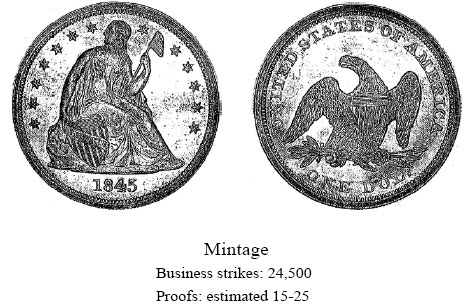
1845 Liberty Seated Dollar
Coinage Context
Repeat performance: For silver dollars, the year 1845 was a replay of 1844. Only a few thousand more were made. The lack of silver bullion continued to be a problem. Only two deliveries of silver dollars were made during the year. Indeed, United States silver coins of all denominations were relatively scarce on the American scene, despite generous mintages of lower denomination coins since the 1830s. When encountered, the typical silver piece was apt to be a Spanish-American (particularly Mexican) coin. An accounting of the coins possessed by the Massachusetts Bank in Boston in 1845 showed "that there was very little silver in the hands of the cashier and teller and that the gold was largely English, with French and American trailing far behind." (The Massachusetts First National Bank of Boston, 1784-1934, by N.S.B. Gras, p. 118.)
During the era, vast quantities of American silver coins were exported (see under Additional Information below). Although the exportation of Liberty Seated dollars is not specifically mentioned in Treasury reports, it seems logical that this, the largest silver denomination, would have been an ideal candidate for such use.
Numismatic Information
Circulated grades: Like the 1844, the enticingly low mintage of the 1845, just 24,500 pieces, may have been a reason more were saved than the low production figure would seem to indicate. Examples in circulated grades have always been on the numismatic market and are somewhat more available than those dated 1844.
Mint State grades: In Mint State the 1845 is the rarest of all Liberty Seated dollars of the 1840s and may well be the rarest Philadelphia Mint Liberty Seated dollar, period (this comment includes the famous 1851 and 1852). Mint State 1845 dollars are so elusive that most advanced collectors have never seen an example, let alone owned one. I graded the remarkable Norweb Collection coin as MS-63 (later graded MS-64 by NGC).
In 1982, Bruce Amspacher stated that he had been told of a "virtual gem" coin, but "I've never seen a coin that I thought was close.: (Article, "Liberty Seated Dollars," in the Monthly Summary, Coin Dealer Newsletter, July-August, 1982.)
However, in John Kroon's study, "Availability of Liberty Seated Dollars by Grade," published in The Gobrecht Journal in 1984, for which Mr. Kroon studied fixed price lists and mail bid sales in Coin World for a one-year period July 14, 1982 to July 6, 1983, is the remarkable total of 15 listings for Mint State 1845 dollars (compared to 16 of 1859-O, 35 of 1860-O, etc.). Either a mini-hoard of 1845 Mint State dollars came on the market during that period, and/or some listings represented coins that were not Mint State (this was before the encapsulation of coins and the implementation of stricter grading interpretations), and/or some listings were repetitions of the same coin(s) listed earlier. The report is clearly anomalous, for obviously Mint State 1845 dollars are not nearly as common as Mint State 1859-O dollars nor only half as common as 1860-O dollars. (I do not take these 15 coins into consideration in my estimate of rarity under Summary of Characteristics below.)
Proofs: In my experience, Proof 1845 Liberty Seated dollars are exceedingly rare and are on a par with those dated 1843, if not with those dated 1841, and are less available than Proof dollars of 1844 or 1846. Walter H. Breen in his Proof coin Encyclopedia takes a slightly more liberal view. The same writer also suggests that the National Coin Collection coin, now in the Smithsonian Institution, has a different reverse from the usual Reverse of 1840-1850, but this awaits detailed study and description.
Varieties
Business strikes:
1-3. Normal Date: Breen-5433. Obverse: At least three obverse varieties of business strikes are known, one of which shows repunching on the third digit.
Proofs:
1. Proof issue: Obverse: With 84 in date heavily repunched. Date slants down. Reverse of 1840-1850 (described under 1840). The usual variety seen. Walter H. Breen suggests that as many as 10 are known to him, a figure which may include duplication.
2. Proof issue: Breen-5434. Obverse as above. Reverse: From a different die than that of 1840-1850, but not yet described by specialists. Cf. (per Breen) National Coin Collection specimen in the Smithsonian Institution and the Davis-Graves (Stack's, 1954) coins. I have not seen one.