Silver Dollars & Trade Dollars of the United States - A Complete Encyclopedia
Q. David Bowers
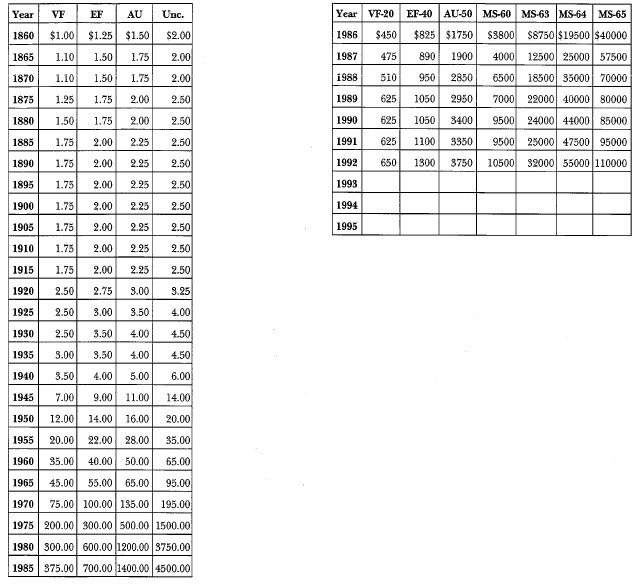
1850-O Liberty Seated: Market Values
1850-O Liberty Seated: Summary of Characteristics
Business Strikes:
Enabling legislation: Act of January 18, 1837 Designer of obverse: Robert Ball Hughes (after Gobrecht)
Designer of reverse: Robert Ball Hughes (after Reich)
Weight and composition: 412.5 grains; .900 silver, .100 copper
Melt-down (silver value) in year minted: $1.018 Dies prepared: Obverse: Unknown; Reverse: Unknown
Business strike mintage: 40,000; Delivery figures by month: July: 37,000; August: 3,000.
Estimated quantity melted: Unknown
Approximate population MS-65 or better: 0 or 1 (URS-O)
Approximate population MS-64: 1 to 3 (URS-1)
Approximate population MS-63: 1 to 3 (URS-1)
Approximate population MS-60 to 62: 6 to 10 (URS-4)
Approximate population VF-20 to AU-58: 800 to 1,200 (URS-11)
Characteristics of striking: Average strike for most; some have weakness on Miss Liberty's head and/ or on the eagle's head and claws.
Known hoards of Mint State coins: None
Proofs:
None
Commentary
This is a popular variety which has commanded the attention of a number of students of the Liberty Seated series over the years.
Additional Information
What Might Have Been (Part II)
Four obverse dies were shipped to New Orleans in 1851, and two in 1852, but apparently none was used (also see Additional Information under the 1846-O dollar).
Gold Coinage at New Orleans
"The Mint in this city is now in full operation, turning out double eagles with such rapidity, that they will soon work up the immense heap of 'the root of all evil,' which was so long locked up in its vaults, to the great inconvenience of many parties. As a small piece requires as much time to coin as a larger one, the plan adopted by the Mint is judicious, of applying their force to the double eagle, as it will enable them to work up the accumulated stock of gold in a very short period. Our California friends may continue to forward their gold to this city, as it can now be coined here with the greatest promptness." From the New Orleans Bulletin, June 1850.