Silver Dollars & Trade Dollars of the United States - A Complete Encyclopedia
Q. David Bowers
1850 Liberty Seated: Market Values
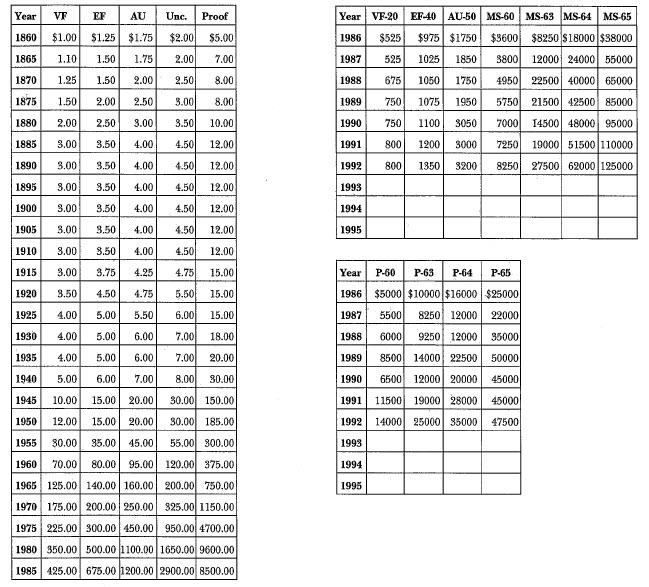
1850: Summary of Characteristics
Business Strikes:
Enabling legislation: Act of January 18, 1837 Designer of obverse: Robert Ball Hughes (after Gobrecht)
Designer of reverse: Robert Ball Hughes (after Reich)
Weight and composition: 412.5 grains; .900 silver, .100 copper
Melt-down (silver value) in year minted: $1.018
Dies prepared: Obverse: Unknown; Reverse: Unknown
Business strike mintage: 7,500; Delivery figures by month: June: 7,500.
Estimated quantity melted: Unknown
Approximate population MS-65 or better: 0 or 1 (URS-O)
Approximate population MS-64: 1 or 2 (URS-1)
Approximate population MS-63: 2 to 4 (URS-2)
Business Strikes:
Enabling legislation: Act of January 18, 1837 Designer of obverse: Robert Ball Hughes (after Gobrecht)
Designer of reverse: Robert Ball Hughes (after Reich)
Weight and composition: 412.5 grains; .900 silver, .100 copper
Melt-down (silver value) in year minted: $1.018
Dies prepared: Obverse: Unknown; Reverse: Unknown
Business strike mintage: 7,500; Delivery figures by month: June: 7,500.
Estimated quantity melted: Unknown
Approximate population MS-65 or better: 0 or 1 (URS-O)
Approximate population MS-64: 1 or 2 (URS-1)
Approximate population MS-63: 2 to 4 (URS-2)
Additional Information
The Year 1850 in History
The decennial federal census showed that 23,191,876 people lived in the United States, of which nearly a million had arrived from European countries since 1846 (including 370,000 from Ireland 1847-1849). Only two million citizens lived west of the Mississippi River. In Congress the Compromise of 1850, largely engineered by Henry Clay, permitted California to be admitted to the Union (on September 9th) as a free state but did not forbid slavery in other territorial areas acquired from Mexico (nor did it condone the practice). Indicative of the increasing interest in women's rights, a national convention was organized by Lucy Stone and others and was held in Worcester, Massachusetts.
Texas was given $10 million for the territory of New Mexico, and that territory's boundaries were reduced. Congress passed a new and stronger fugitive slave law as a sop to the South. Among its provisions, blacks were denied trial by jury; federal law rather than state law took precedence in the matter of runaway slaves. On July 9th, President Zachary Taylor died in office after a tenure of 16 months and was succeeded by his vice president, Millard Fillmore.
Total trackage of railroads was about 9,000 miles, about triple the length of tracks in place in 1840, while canal routes increased to about 3,600, up from about 3,300, during the same period. Caterpillars were a nuisance in New York, and the Brooklyn Institute sought to eliminate them by importing eight pairs of sparrows from England. The rest is history.
Nathaniel Hawthorne completed his Scarlet Letter story, featuring Hester Prynne and the red letter "A." De Camptown Races, by Stephen Collins Foster, was one of the more popular songs of the time. P.T. Barnum, by now America's best known impresario, signed Swedish singer 'Jenny" Lind, age 30, for a two-year tour in America which. would earn her $130,000, most of which she would give to charity. From the outset, Lind captured the fancy of Americans, and her opening concert at Castle Garden in New York brought $17,864.05 into the till.
Isaac M. Singer invented a sewing machine, which led to the worldwide distribution of the device. Before long, Singer sewing machines were familiar sights in remote African vil-lages. The American Express Company was formed by a merger of several different companies, and would go on to achieve great success in transportation, security, and, years later, international exchange.
England, which had suffered financial distress, recovered as trade barriers were dropped. Earlier an importer of food, England became a net exporter, while its manufactured goods continued to find a market in many other countries, including the United States. Charles Dickens, England's best known writer of novels, often with social themes, saw his David Copperfield published. It included this famous line, reflective of the human predicament: "Annual income 20 pounds, annual expenditure 19 pounds 6 [shillings], result happiness. Annual income 20, annual expenditure 20 pounds O [shillings] and 6 [pence], result misery."
Double eagles were made in large quantities for the first time. The Philadelphia Mint produced 1,170,261 coins, and the New Orleans Mint struck 141,000.
Silver dollars of the 1850s were rare by 1889, when William von Bergen issued his buying book, The Rare Coins of America, in which this Boston dealer offered to pay $3 for Fine grade 1850 dollars, $4 for Uncirculated, and the following prices for other silver dollars of this decade:
1851 Good $30, Fine $50, Uncirculated $75
1852 Good, $30, Fine, $50, Uncirculated $75
1853 Good $2, Fine $4, Uncirculated $5
1854 Good $3, Fine $5, Uncirculated $8
1855 Good $2, Fine $3, Uncirculated $6
1856 Good $2, Fine $3, Uncirculated $4
1857 Good $2, Fine $3, Uncirculated $4
1858, which was struck only in Proof finish, had the following buying prices: Good $30, Fine $40, and Uncirculated $50, apparently a typographical error for $50 was undoubtedly intended for Proof. Another error in the listing was the notation "Proofs only" for the year 1859.
Employees of banks and the Treasury Department, equipped with such a buying guide, could make a day's pay by finding a silver dollar of the 1850s among deposits, and many did so, providing the source for many such coins known today.
The Bankers' Magazine and Statistical Register commented on the rising price of silver On the London market (the center of silver trading at the time), noting that the metal was becoming scarce for three main reasons: (1) the influx of California gold, (2) the requirements for pay and maintenance to the German armies, and (3) the substitution of silver for gold in Holland. It was also noted that there was a demand for silver in California (a point that does not seem to have been raised by observers in America at the time).