Silver Dollars & Trade Dollars of the United States - A Complete Encyclopedia
Q. David Bowers
1843 Liberty Seated Dollar
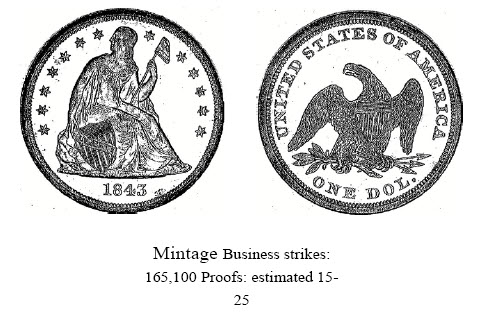
Coinage Context
Silver still a problem: Silver supplies remained a problem, and fewer 1843 Liberty Seated dollars were struck than could have been had domestic supplies been larger. As noted, dollars were only struck for those bullion depositors specifically requesting them. However, had there been more bullion, there would have been more deposits made. As it was, the production amounted to 165,100 business strikes, one of the more generous figures of the era.
Silver dollars not popular: The silver dollar remained secondary to the half dollar in terms of use and acceptance in the channels of commerce. In the same year, 1843, 3,844,000 half dollars were struck at the Philadelphia Mint and 2,268,000 at New Orleans, for a total face value amounting to $3,056,000, or over 18 times more value in half dollars than silver dollars. Even the total face value of quarter dollars amounted to more than the value of silver dollars.
Clearly, silver dollars were not popular as circulating coins, any more than in later decades. One reason for this is that a dollar was worth a day's payor more, and many transactions for merchandise and services could be handled more satisfactorily with half dimes, dimes, quarters, or half dollars. Even the lowly copper cent had significant purchasing value at the time.
Numismatic Information
Circulated grades: In circulated grades the 1843 is very plentiful. In fact, it may be the most common of the dates in the 1840s (which constitute a class of study into themselves, for coins of this decade were primarily struck for domestic circulation, rather than for export purposes). The 1842 and 1843 seem to run neck .and neck in terms of availability. In 1984 a study by John Kroon in The Gobrecht Journal found 1843 to be the most common dollar of this era, while a 1977 study by Ron Severa in the same publication picked 1842 for this distinction.
Mint State grades: In MS-64 or higher grade the 1843 dollar is an extreme rarity. This is somewhat curious, for in worn grades it is very common. As noted earlier, such situations contribute to the fascination of collecting Liberty Seated coins of this denomination.
In 1982, Bruce Amspacher stated that he knew of no specimen that could be called MS-65, a grade that today would be equal to MS-63 or so. (Article, "Liberty Seated Dollars," in the Monthly Summary, Coin Dealer Newsletter, July-August, 1982.) "But with a mintage of over 165,000 one has to exist somewhere, doesn't it?" he asked.
Proofs: Proofs of this date are very rare and, to this point in the chronology of Liberty Seated silver dollars since 1840, are the second rarest (after 1841) Proof date since the inception of the series. When one studies coins of such limited availability and mintage as early Proof Liberty Seated dollars, all such statements are conjectural and are apt to be distorted if even a small "hoard" of two or three coins were to come on the market. However, based upon experience, population reports of certification services, auction data, museum surveys, etc., some ballpark figures can be assembled.
1843 Proof sets: The intact copper and silver Proof set sold in the Richard B. Winsor Collection sale by the Chapman brothers, 1895, cost Winsor $100 in 1880 and was described as a gift from President John Tyler to a citizen. A marvelous complete set from the half cent to the $10 gold, in its original case of issue, appeared in an auction in Holland in 1930, was sent to the United States, and appeared as Lot No. 2292, for $1,250, in B. Max Mehl's mail bid sale of the Will W. Neil Collection, June 17, 1947. Neil, a pharmacist by profession, was an avid collector of silver dollars and made extensive notes on their rarity, including Morgan dollars available from circulation. The Neil set went to Amon Gamaliel
Carter, a Fort Worth, Texas businessman, then to Carter's son, then in Stack's auction of the Carter Family Collection, then to the American Rare Coin Fund L.P. (Hugh Sconyers). John Jay Pittman has another set, likewise in its original case, and there is a set in the Smithsonian Institution.
Varieties
Business strikes:
1. Heavy Date: Breen-5429. Repunching on 1 of date. At least three obverse dies were used to coin "Heavy Date" dollars, making the three varieties. Often seen with repunching on the third and/or first numerals. Often prooflike, sometimes with die striae from incomplete polishing.
2. Heavy Date: Breen-5429. Repunching on 1 and 4 of date.
3. Thin Numerals variety: Breen-5430, "Thin numerals," with the serifs appearing "hairlike" and with repunching on the 4. Reverse has heavy die file marks in the white shield stripes.
Proofs:
1. Proof issue: Obverse: Date slightly above center (slightly above the midway point between the border denticles and the rock base of Miss Liberty). Reverse of 1840-1850 (see description under 1840).