Silver Dollars & Trade Dollars of the United States - A Complete Encyclopedia
Q. David Bowers
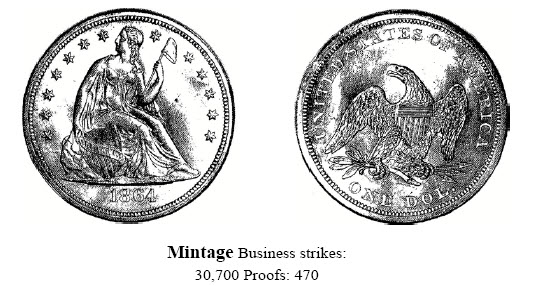
1864 Liberty Seated Dollar
Coinage Context
The silver situation. (Much of this silver information is from John M. Willern, The United States Trade Dollar.) From 1834 through 1844 the United States produced from its own mines and other deposits only an average of $25,000 a year in silver bullion. From 1845 to 1858 the average was just $51,000. In 1859 production increased to $105,000 a year with the Comstock Lode, $156,800 in 1860, $2,062,000 in 1861, nearly $5 million in 1862, and nearly $9 million in 1863. (Although such figures have a ring of exactness to them, estimates varied widely. Government reports furnished some numbers, data [rom express companies and banks (including Wells, Fargo & Co.) provided other information, and contemporary texts on gold and silver gave in some instances still other numbers.)
Hepburn in History of Currency in the United States, p.256, has a table which is titled "Silver Coin and Bullion imported into, and exported from, the United States," and shows export surpluses in seven years prior to 1860: 1845 export $5,551,070, import $3,251,392; 1848 export $4,770,419, import $2,951,529; 1849 export $3,432,415, import $2,582,593; 1850 export $2,962,367, import $2,852,086; 1851 export $6,635,839, import $1,884,413; 1852 export $2,600,150, import $1,846,985; 1853 export $2,044,017, import $1,774,026. Much of the silver probably was in the form of coins of other nations rather than domestic issues.
From 1841 to 1860, the United States imported about $147 million worth of silver while producing from its own mines only about 1 % of that amount. From the first time records were kept in America until 1860, this country yielded only about 928,500 ounces of silver. Thus, the United States was not in the position to make silver coins for export in quantity, as parties within the states had to import silver themselves or obtain it by melting down coins of other nations, particularly Mexico, which were abundant in domestic circulation. The Mint did not need to make a trade dollar or any other coin in order to find a market for American silver. Not until the mid-1860s was there a widespread desire on the part of silver producers to expand their markets to help consume the production.
Snowden's silver data: In 1884, Hon. Archibald Loudon Snowden, who had been superintendent of the Philadelphia Mint since 1879, and whose father, James Ross Snowden, was one of the most knowledgeable Mint directors ever, furnished James G. Blaine, long-time congressman, with estimates of the annual domestic production of silver from 1850 to 188l. (Blaine, Twenty Years of Congress, Vo!' II, pp. 610-611. The figure of $500,000 is given for 1858 in the Blaine text, but, presumably, this is an error and $50,000 was intended; I use the $50,000 figure here.)
Presumably, the Snowden figures are among the most accurate available, although they are not as precise-appearing as certain other estimates: 1850 through 1858, $50,000 domestic production annually; 1859, first year of the Comstock Lode, $100,000; 1860, $150,000; 1861, the first year of great exploitation of the Comstock, $2 million; 1862, $4.5 million; 1863, $8.5 million; 1864, $11 million; 1865,$11.25 million; 1866, $.10 million; 1867, $13.5 million; 1868, $12 million; 1869, $12 million; 1870, $16 million; 1871, $23 million; 1872, $28.75 million; 1873, last year of Liberty Seated dollar coinage, $35.75 million. From 1850 through 1873, production of silver elsewhere in the world, not including the United States, was estimated at about $40 million annually, with little change from year to year.
Use of silver dollars: Silver dollars of the 1864 year did not circulate domestically, and their rarity today is explained by the fact that most were exported.
Numismatic Information
Circulated grades: The story of low-mintage dollars of the earlier 1860s recurs here, and specimens of business strike 1864 dollars are very elusive. Take a low mintage to begin with, and export most of that, and survivors became numismatic rarities.
Mint State grades: Mint State 1864 dollars are very rare, but when they do appear they are apt to be in higher levels, an unusual situation. Perhaps some Assay Commission coins survived; if so, these would have been in higher grades. PCGS and NGC data may be distorted by the resubmission of coins. Walter H. Breen suggests that a few Mint State' coins could have come from original Proof sets," but I have never seen a Mint State coin in any original Proof set of this era, and I have handled quite a few.
High-grade coins typically have extensive die striae, as struck, on the obverse and reverse, making it appear to the uninitiated as if the coin had been cleaned or brushed. This characteristic is similar to that seen on dollars of 1862.
Proofs: Just 470 specimens were reported as being struck of the Proof 1864 silver dollar, and yet three different obverse dies were prepared for this small coinage. Equally interesting, this date has a survival rate higher than would be expected for such a low mintage, and of those extant today, more are in Proof-64 or better preservation than proportionately for other issues of the era. It could be that the mintage figure is incorrect; and more than 470 were made, perhaps as restrikes (as with 1863-1864 trimes and half dimes). A possible restrike candidate is 1864 Proof No.3 (described below). Another answer may be that original Proof 1864 dollars were more highly prized due to the difficulty in ordering them (see notes under 1862 Proofs).
All Proof dollars of this year were distributed with the silver Proof sets.
Varieties
Business strikes:
1.High Date: Breen-5470. Business strikes have date above center, with 6 and 4 of date not touching.
Proofs:
1. Proof issue: Breen-5470. Obverse: Large date (as all dies this year); same four-digit logotype as used On the 1864 $20. Date to the right of normal. Shield point far left of the 1 in date; right base of 4 nearly over right edge of denticle. Reverse: The same die used to coin 1863 Proof dollars (No.1 above). Less rare than the next two.
2. Proof issue: Breen-5470. Obverse: Date centered. Shield point over tip of 1; right base of 4 over left edge of denticle. Reverse: Same as 1863-4, No. 1. Apparently, Proofs from this die combination are very rare. This die reappears on 1865 Proofs.
3. Proof issue: Breen-5470. Obverse: Low date to left. Shield point slightly left of center of upright of 1 in date; right base of 4 slightly left of center of denticle. Reverse: Arrowheads well apart. Rare. If any 1864 Proof dollars are restrikes, this is a likely candidate. (Per Walter H. Breen, letter to the author, February 12, 1992.)
Note: Circa 1867-1868 a new 1864-dated obverse die was made and used to strike patterns in copper, aluminum, and silver with IN GOD WE TRUST on the reverse. The With-Motto reverse first appeared on regular Proof dollars of late 1866 and early 1867.