Silver Dollars & Trade Dollars of the United States - A Complete Encyclopedia
Q. David Bowers
Varieties
Proofs:
1.Proof restrike issue. Centered Date: Breen-5446 (not differentiated; it was not known that there were two die pairs). Newly (August 1992) described die pair; this and No.2 were lumped together in studies published elsewhere earlier. Obverse: With date centered between the rock base of Miss Liberty and the denticles. Die rust marks on 51, including a raised lune-shaped curl (resembling a miniature fingernail clipping) horizontally on the top surface of the last digit of the date, located slightly more than halfway down the shaft of the 1. Tiny, slightly curved horizontal raised line in Miss Liberty's leftmost (as seen by the observer) drapery fold, just below her right shoulder. Tiny raised lump in drapery area above shield point, about the same distance above the point as the distance from the point downward to the end of the vertical stripes.
Reverse: Leftmost vertical shield stripe elements (consisting of three closely spaced lines) taper downward in relief just before touching the bottom horizontal line. Flat areas within shield only partially polished (compare to No.2 described below). 189 reeds on edge.
Specimens from this die combination include a Sheldon Wirt inventory coin (as of August 1992) and a Proof-62 (PCGS) example in the Bowers and Merena auction of November 1992.
2. Proof restrike issue. Centered Date: Breen- 5446 (not differentiated; it was not known that there were two die pairs). Newly (August 1992) confirmed die pair different from the above.
Obverse: Without rust spots and lune-shaped raised area on 1. Light doubling on some stars, especially beginning with star 3. Very light doubling behind Miss Liberty's head, showing an extra outline. Unfinished area ("beard") below Miss Liberty's chin, giving a cobweblike effect (on Obverse 1, described above, there is a very slight unfinished area, not comparable in extent to that on Obverse 2). Date very slightly higher in field than on No. 1.
Reverse: Leftmost vertical shield stripe elements do not taper downward in relief just before touching the bottom horizontal line, and are of the same height from top to bottom. Flat areas within shield highly polished with full Proof surface in nearly all areas (except for parts of sixth and seventh areas; the sixth (counting from left to right) vertical flat area within the shield is not as highly polished at the bottom as the others, and the seventh vertical flat area is partially unpolished at the bottom and upper right. The leftmost vertical shield stripe of three elements shows Proof surface right at the top between the elements-two very tiny areas of Proof surface not visible among any of the other elements in the vertical stripes. Tiny area of die rust over T of UNITED, at denticle, just to the right of the center of the upright of T. This die was also used to coin 1852 Proof restrike dollars.
Specimens from this die combination include the Carter and Norweb coins.
Note: Impressions from centered date restrike dies were also struck in copper (Judd-132), probably to the extent of fewer than a dozen pieces. At least two pieces were later silver plated (suggesting that it is a good idea to weigh any coin offered). Die pair not known. A solitary nickel striking (Judd-133) is reported, ex Farouk Palace Collection:1744. Centered date. Die pair not known.
An "1851-O" dollar: A curious and interesting impression of the No. 1 1851 Proof restrike dies is overstruck on a previously-made New Orleans Mint dollar, probably an 1859-O or 1860-O, but of a mintmark position variety not otherwise seen. (Upon reading this comment, IT. Stanton commented: "The mintmark position may not necessarily match any known position as the struck coin may have been misaligned slightly with the dies, creating the differing position. Other design details may well have been hidden by the strike." Letter to the author, August 23, 1992.) The O mintmark is still visible below the eagle on the reverse, in the correct position. Examination of the piece by James C. Gray, Thomas K. DeLorey, the author, and several others, at the August 1992 ANA Convention, reveals that the New Orleans dollar was filed down on the edge (perhaps so it would fit in the collar of the restrike dies) and rim, accounting for its light weight of only 400.3 grains (as compared to the 412.5 grain standard). The O mintmark was flattened by striking. The coin, a Proof, is in the possession of a Western professional numismatist and is said to have come from a B. Max Mehl sale years ago, where the overstrike feature was not recognized.
1851 Proof Restrike Liberty Seated: Market Values
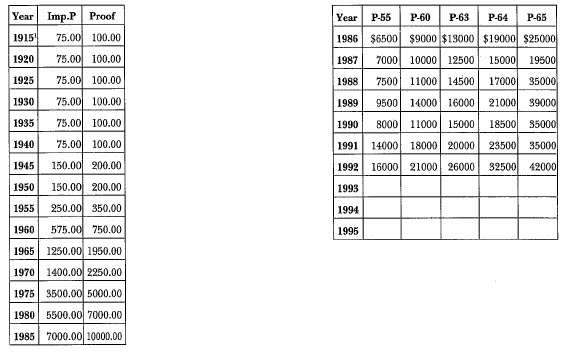
1. Prior to 1915, no distinction was generally made between original and restrike issues, with prices being the same.
1851 Proof Restrike: Summary of Characteristics
Proofs:
Enabling legislation: Act of January 18, 1837 Designer of obverse: Robert Ball Hughes (after Gobrecht)
Designer of reverse: Robert Ball Hughes (after Reich)
Weight and composition: 412.5 grains; .900 silver, .100 copper (however, this varies, as some are lightweight and/or overstruck on other dollars or different coins (Per letter from Walter H. Breen to the author, April 13, 1992.))
Melt-down (silver value) in year minted: Not relevant; coin struck in year(s) later than 1851
Business strike mintage: None
Dies prepared: Obverse: 2; Reverse: 2.
Proof mintage: 50 to 100 estimated
Approximate population Proof-64 or better: 5 to 10 (URS-4)
Approximate population Proof-60 to 63: 20 to 40 (URS-6)
Approximate population Impaired Proof: 5 to 10 (URS-4)
Commentary
This restrike may have been a delicacy made at the Mint circa 1858-1860 and possibly again 1867-1868 for private sale to dealers and collectors.