Silver Dollars & Trade Dollars of the United States - A Complete Encyclopedia
Q. David Bowers
1865 Liberty Seated Dollar
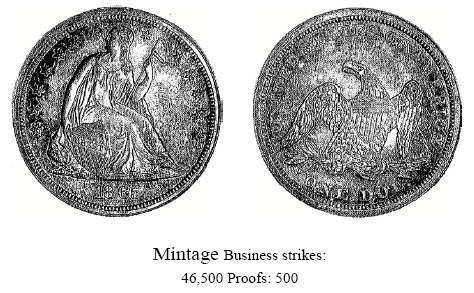
Coinage Context
Distribution: In 1865, the final year of the Civil War, specie payments remained in suspension, and the Treasury Department placed no 1865 silver coins of any denomination into circulation in the East. On the West Coast business was much as usual, and 1865-S silver and gold coins circulated in commerce.
Most of the mintage of the 1865 silver dollar is believed to have been exported to Central and South America.
Numismatic Information
Circulated grades: Here we go again: low mintage + many exported = rarity today. Circulated specimens are very scarce, possibly even scarcer than 1864 (although 1864 has a lower mintage).
Mint State grades: The 1865 dollar is a great rarity in Mint State and is a fit partner with others of its era in this regard. Some high-grade pieces show extensive die striae on the obverse, as struck. One reverse die shows breaks through the tops of TES, OF, and MERI, and the bottoms of E DOL; some unfinished areas in vertical shield stripe white spaces 2 and 3.
Proofs: Although only 500 Proof dollars were minted this year, most seem to have survived in varying states of preservation. All were distributed with the silver Proof sets.
As business strikes of the 1865 dollar are very rare, additional demand has developed for the Proofs, accounting for the spirited competition when examples of this and other dates, especially of the later no-motto years, 1861-1865, come up at auctions.
Varieties
Business strikes:
1. Low Date: Breen-5471. Obverse: Date low in field.
2. Normal Date: Breen-5471. Obverse: Date centered in field.
Proofs:
1. Proof issue: Breen-5471. Obverse: Date centered, "minutely slanting up," as Walter H. Breen describes it. Shield point minutely to the left of the tip of 1 in date. Reverse: No.1 of 1864, also used to coin Proofs in 1863; now in 1865 with ghostlike arc at the denticles over UNIT of UNITED.
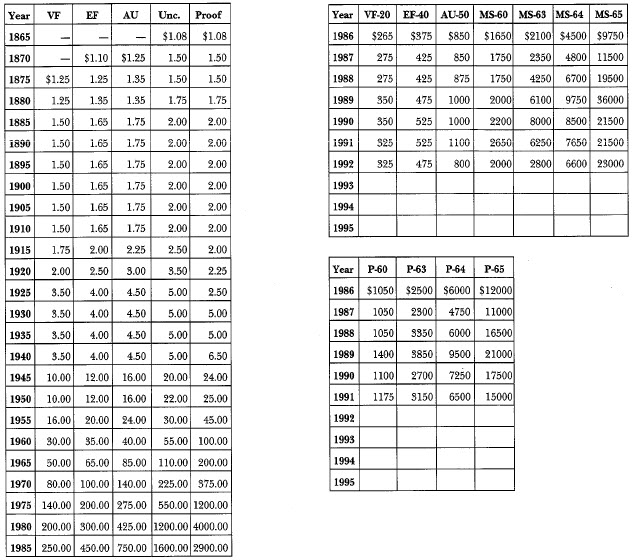
1865 Liberty Seated: Market Values
1865 Liberty Seated: Summary of Characteristics
Business Strikes:
Enabling legislation: Act of January 18, 1837
Designer of obverse: Robert Ball Hughes (after Gobrecht)
Designer of reverse: Robert Ball Hughes (after Reich)
Weight and composition: 412.5 grains; .900 silver, .100 copper
Melt-down (silver value) in year minted: $1.035
Dies prepared: Obverse: 3; Reverse: 3
Business strike mintage: 46,500; Delivery figures by day: March 3: 3,800; May 31: 14,000; September 8: 9,700; September 13: 7,000; September 27: 12,000.
Estimated quantity melted: Unknown
Approximate population MS-65 or better: 1 or 2 (URS-1)
Approximate population MS-64: 20 to 30
(Data distorted by resubmission of coins to grading services?) (URS-6)
Approximate population MS-63: 6 to 10 (URS-4)
Approximate population MS-60 to 62: 20 to 40 URS-6)
Approximate population VF-20 to AU-58: 260 to 400 (URS-10)
Characteristics of striking: Many show areas of light striking, often including the eagle's dexter leg.
Known hoards of Mint State coins: None
Proofs:
Dies prepared: Obverse: At least 1; Reverse: At least 1.
Proof mintage: 500; delivery dates: February 25: 100 delivered; March 10: 100; March 16: 100; March 20: 100; March 24: 100.
Approximate population Proof-65 or better: 48+/- (URS-7)
Approximate population Proof-64: 50+/- (URS-7)
Approximate population Proof-63: 70+/- (URS-8)
Approximate population Proof-60 to 62: 160+/- (URS-9)
Commentary
Most 1865 Liberty Seated dollars were exported.
The Year 1865 in History
The Civil War ended with a string of Union victories.
Northern troops occupied Columbia, South Carolina on February 17th; Charleston surrendered to the Union fleet on February 18th; and Petersburg, Virginia surrendered on April 3rd. General U.S. Grant took the Confederate capital of Rich-mond on April 3rd. On April 9th, General Robert E. Lee sur-rendered to Grant at Appomattox Court House, Virginia. Over a million men had been killed or injured in the conflict: America's bloodiest war.
President Abraham Lincoln was assassinated by actor John Wilkes Booth on April 14, 1865 while attending a performance of Our American Cousin at Ford's Theatre in Washington. The cousin in question was a supposedly wealthy American, who on the stage was romancing a lady who stated she would never marry for love. The lady and her mother learned that he had lost his wealth, and in disgust they left the stage, ending the scenario. The audience awaited the next scene, which never happened.
Vice President Andrew Johnson succeeded to the presidency. The Reconstruction era began in the post-war South, as so-called "carpetbaggers" arrived from the North to be-come involved in local and state governments and to help the former slaves in their new-found freedom. White Southerners who befriended blacks and aided them in their newfound independence were called "scalawags."
On April 27, 1,600 people were killed when the sidewheel steamer Sultana exploded on the Mississippi River. In 1865 the Ku Klux Klan was founded in Tennessee, and the Salvation Army was organized in England. Alice's Adventures in Wonderland, by Lewis Carroll, appeared in print in England. A newly published poem by William Ross Wallace contained the line, "The hand that rocks the cradle rules the world," a phrase would become popular and, for example, would play a prominent part in D.W. Griffith's 1916 epic motion picture, Intolerance.
On the London market in January, $100 in Confederate paper money was worth just $1.70 in gold, while $100 in legal tender Union bills was worth $46.
The Mint issued the first nickel three-cent pieces, to retire 3¢ fractional currency. The denomination would be continued through 1889,.although after the first several years its popularity declined sharply. At the time, silver and gold coins remained absent from circulation (except on the West Coast), but Indian cents, two-cent pieces, and nickel three-cent coins were abundant. However, most small change was made by using fractional currency notes.
In December 1865, W. Elliot Woodward sold the Bache, Bertsch, Colburn, et at. collections, which included a 1794 dollar described as Uncirculated.