Silver Dollars & Trade Dollars of the United States - A Complete Encyclopedia
Q. David Bowers
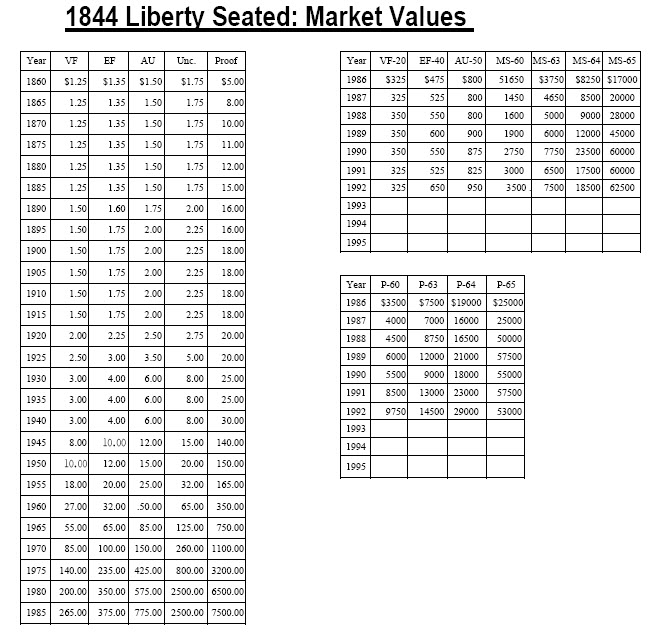
1844 Liberty Seated: Summary of Characteristics
Business Strikes:
Enabling legislation: Act of January 18, 1837 Designer of obverse: Robert Ball Hughes (after Gobrecht)
Designer of reverse: Robert Ball Hughes (after Reich)
Weight and composition: 412.5 grains; .900 silver, .100 copper
Melt-down (silver value)in year minted: $1.008 Dies prepared: Obverse: 1 or more; Reverse: I or more
Business strike mintage: 20,000; Delivery figures by day:(It was normal practice during this era to deliver coins on the last working day of the month. However, there were exceptions.) December 31: 20,000.
Estimated quantity melted: Unknown
Approximate population MS·65 or better: or 1 (URS-O)
Approximate population MS-64:.1 or 2 (URS-1)
Approximate population MS-63: 2 to 5 (URS-2)
Approximate population MS-60 to 62: 15 to 25 (URS-5)
Approximate population VF-20 to AU-58: 700 to 1,000 (URS-11)
Characteristics of striking: Usually well struck with smooth surfaces
Known hoards of Mint State coins: None
Proofs:
Dies prepared: Obverse: At least 1; Reverse: At least 1. Proof mintage: 20 to 30
Approximate population Proof-64 or better: 2 to 4 known (URS-2)
Approximate population Proof-60 to 63: 5 to 10 known (URS-4)
Commentary
The business strike dollars of this date are unique in the series in that each stripe in the obverse shield is composed of four tiny elements, "quad stripes," instead of the normal three.
Additional Information
Silver Coinage
Foreign silver and gold coins formed the bulk of circulating specie of these metals, and in some areas, especially in the southern part of the Mississippi Valley, United States coins were rarely seen, except, perhaps, for some few pieces from the New Orleans Mint. In Louisiana, most reckoning was still done in terms of Spanish (i.e., mostly Mexican) dollars and fractions.
In 1844 the government began in earnest recoining foreign coins acquired in government transactions. Many if not most of such pieces in the silver series were lighter in weight than the U.S. Mint coins that replaced them, a situation which caused a lessening of the total number of silver coins in circulation."
The earlier law was ambiguous on the legality of Spanish-American coins weighing less than 415 grains, and it is doubtful if fractions of the eight-real coins had legal tender status. However, the Mint took such pieces in at a loss to the American public, and recoined half dimes, dimes, quarter dollars, half dollars, and dollars from them. Carothers notes the following:
"The [Spanish-American] fractional coins were commonly accepted at values of 50, 25, 12-1/2, and 6-1/4 cents. In cities where the decimal system was making progress, the fractional remainders were often dropped, the real passing for 12 cents, the medio for 6 cents. The great depreciation in weight of the foreign coins and the losses on recoinage were beginning to cause disturbances. The general public was not concerned so long as the coins could be passed on to any storekeeper. The merchant in turn could adjust prices to the situation; he could deposit the coins in a bank. But the banks could not ignore the deficiency and they could not force them on customers who asked for United States coins. They had to take the old coins to the Treasury for recoinage.
"As early as 1832 banks in Philadelphia protested the deposit of 'large amounts of [Mexican] silver dollars by tale' [i.e., by count at $1 each]. No settled policy was adopted until 1843, in which year the New York Bank established a scale of values. The double real, real, and media were not to be taken at values higher than 23, 10, and 5 cents respectively. The post office had adopted the same valuations, despite public protest. By 1848 the New York ratings had been adopted by banks and post offices the country over. The ratings permitted the banks to recoin most of the foreign receipts without loss and enable the Treasury to carry out an extensive recoinage. But this also gave rise to a peculiar situation in which general currency was received at one value in ordinary transactions and at another in dealings with the Post Office ....
"The circulation of two types of silver coins-United States as well as foreign issues-was beginning to cause annoyance in business. Eventually special ratings for Spanish coins were five cents, 10 cents, and 20 cents, but in some transactions smaller pieces were valued at 12-1/2 cents and 6-1/2 cents and 12 and 6 cents. Making change was a matter that involved calculation. In the South and West the careless monetary habits of the people made copper coins superfluous. The purchaser of a half bit's worth of tobacco paid for it with a bit and should have received a half bit or 6-1/4 cents in change in the West, but he accepted a half dime if the storekeeper offered it. Throughout the South and the West the dime and half dime were commonly accepted as the change equivalence of the real and medio. In fact the dime was what was widely known as the "short bit." The storekeeper who paid out 10 dimes when he should have given out 10 reals made a profit of 25 cents. The people were systematically victimized. The practice became so firmly entrenched that Congress was trying to stop it as late as 1875 .... (However, Senator John P.Jones's proposed solution in 1875, the 20¢ piece, was a failure, being too close to the quarter in design and size. Jones's real aim was to create an additional market for mine owners in an era when silver ruled the politics of the American West.)
"In 1844 the legal ratio turned the tide of silver movements against the country. By now the devaluation of silver caught up with the system, and from this year on the exports to England exceeded the imports from Mexico. [Large shipments of gold from England to the United States had serious negative effects on the British gold reserves.]"