Silver Dollars & Trade Dollars of the United States - A Complete Encyclopedia
Q. David Bowers
1870-S Liberty Seated
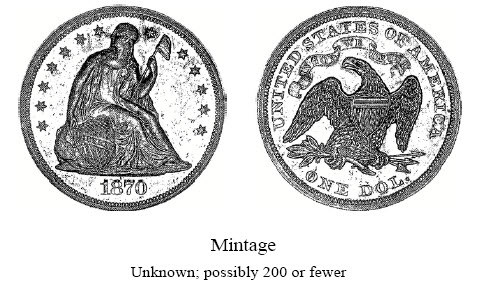
Coinage Context
The San Francisco Mint: In 1870 the cornerstone was laid for a new San Francisco Mint building, a structure that would be occupied from 1874 until the present Duboce Street facility was constructed in 1937. Later known as "the Granite Lady," the 1870 building is now the Mint Museum, at 5th and Mint streets, near Mission Street. Numismatic tradition has it that certain coins are believed to have been struck for inclusion in the cornerstone, including an 1870-S $3 gold piece and possibly an 1870-S silver dollar. (In Thomas L. Elder's March 1911 sale of the William H. Woodin Collection (which included an 1870·S $3), a paper from Coiner J.B. Harmstead was included, which identified the $3 as a duplicate of one in the cornerstone; nothing was said about a silver dollar.)
The records concerning 1870-S coinage are incomplete, and no pieces are listed as having been struck for the half dime and dollar denominations, and yet at least one authentic 1870-S half dime exists as do at least nine 1870-S Liberty Seated dollars.
Numismatic Information
The story of the issue: The 1870-S dollar is a mystery in the Liberty Seated series and is the single rarest issue of its design type (not including the nonexistent 1873-S $1). Just nine specimens are confirmed to exist, and a 10th has been reported but has not undergone detailed examination.
Not included in the Mint report for the year, the 1870-S dollar must have been produced in very limited numbers. The original coinage was probably on the order of a couple hundred pieces, if indeed that many. R.W.Julian estimates 50 or so. (Letter to the author, March 20, 1992.)
Walter H. Breen relates that there is no record of the shipment of dies from Philadelphia 1869 for use in 1870, but notwithstanding this omission, Coiner J.B. Harmstead returned two dollar reverses (gold? silver?) without a mintmark to Philadelphia and received two replacement dies on May 28, 1870. The Philadelphia Mint was very careless in its shipments, and an 1870-S gold dollar die was shipped to San Francisco lacking the S, as was an 1870 $3 die. The mintmarks on the 1870-S silver dollar and $3 (although not on the gold dollar, half dime, or other denominations) were anomalously engraved rather than punched. That on the $3 (and probably also the silver dollar) was cut into the dies by Harmstead. (Per Walter H. Breen, letter to the author, February 12, 1992.)
Only one pair of dies was apparently used, as all survivors have the same characteristics. Either examples were struck for circulation, or recipients at the cornerstone ceremony kept them as pocket pieces or spent them, as all known examples show signs of wear.
Circulated grades: Just nine specimens are confirmed to exist. All are in circulated grades from Very Fine to About Uncirculated. A roster of the known examples appears below.
Mint State grades: I have never seen a Mint State coin, nor is the existence of any confirmed in the literature. However, during the preparation of this book, a San Francisco dealer reported that he saw and had in his possession for a short time a Mint State 1870-S owned by a military officer assigned locally, who had an ancestor who worked at the San Francisco Mint in 1870. If this specimen is ever made available for detailed checking and authentication, and is found to be authentic, it will rank as one of the most important discoveries of our time. As of this writing, there is no indication that the coin is anything other than genuine. It is just that it has not been the subject of testing.
Registry of 1870-S Dollars
The following roster is adapted and expanded from the listing in Stack's March 1987 sale; Dr. John W. McCloskey's study, "Known Examples of the 1870-S Liberty Seated Dollar" in The Gobrecht Journal; March 1989; Bowers and Merena Galleries' Norweb Collection, November 1988; and Stack's January 1989 sale of the L.R. French, Jr. Family Collection. Additional notes are by Q. David Bowers; original research by Carl W.A. Carlson, Walter H. Breen, P. Scott Rubin, James C. Gray, and Bowers.
1. Granberg Specimen. AU
• Henry O. Granberg, of Oshkosh, Wisconsin. Illustrated in the catalogue prepared for the Exhibition of United States Coinage held by the American Numismatic Society in 1914. This grand event, unprecedented in numismatic history, brought together multiple examples of great rarities from important cabinets of the time, all of which were described in a handsome book issued for the occasion.
• Waldo C. Newcomer, the prominent Baltimore numismatist, who exhibited it at the 1916 ANA Convention. One of two owned by Newcomer; see No.7.
• William H. Woodin (leading American industrialist; co-author with Edgar H. Adams of the standard work on pattern coins, 1913; later secretary of the Treasury under Franklin D. Roosevelt).
• Col. Edward H.R. Green (wealthy heir and collector of many things; son of eccentric Wall Street millionairess Hetty Green).
• Col. Green Estate.
•Burdette G. Johnson (owner of the St. Louis Stamp & Coin Co.; Johnson worked with the Brand and Green estates, two of the largest in American numismatic history). Sale took place c. 1944.
• Anderson-Dupont Collection, Stack's, 1954. "Uncirculated." Lot 2551, $4,000.
• Arthur M. Ragin, who purchased it on behalf of the following.
• Ambassador and Mrs. R. Henry Norweb.
•Norweb III sale by Bowers and Merena, Inc., 1988. Described as About Uncirculated. This is the finest known specimen of the 1870-S. Lot 3825, $126,500. Sold into the following:
• Nebraska private collection. In a conversation with the author, May 11, 1992, the owner stated this: "Since buying the coin in your Norweb Collection auction I have had several people contact me about it and want to offer me a profit, but for the time being I enjoy owning it."
2. James A. Stack Specimen. VF
• Col. Edward H.R. Green(?)
•James Aloysius Stack (a New York collector, no kin to the rare coin firm of the same name) in 1944, possibly from the Col. E.H.R. Green estate. In the James A. Stack estate (1993).