Silver Dollars & Trade Dollars of the United States - A Complete Encyclopedia
Q. David Bowers
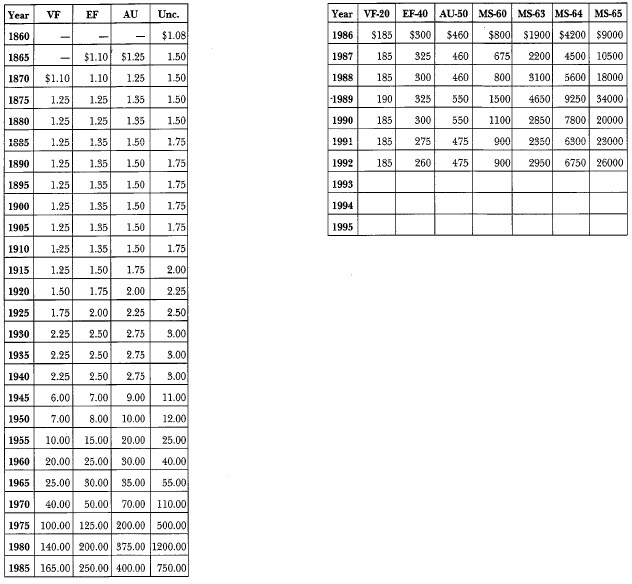
1861 Liberty Seated Dollar: Market Values
1861 Liberty Seated: Summary of Characteristics
Business Strikes:
Enabling legislation: Act of January 18, 1837
Designer of obverse: Robert Ball Hughes (after Gobrecht)
Designer of reverse: Robert Ball Hughes (after Reich)
Weight and composition: 412.5 grains; .900 silver, .100 copper
Melt-down (silver value) in year minted: $1.031
Dies prepared: Obverse: 7; Reverse: 8
Business strike mintage: 77,500; Delivery figures by day: January 24: 21,000; January 28: 12,000; February 26: 17,000; March 8: 6,000; March 12: 7,000; March 19: 9,000; June 25: 5,500.
Estimated quantity melted: Unknown Approximate population MS-65 or better: 4 to 8 (URS-3)
Approximate population MS-64: 15 to 25 (URS-5)
Approximate population MS-63: 15 to 25 (URS-5)
Approximate population MS-60 to 62: 15 to 25 (URS-5)
Approximate population VF-20 to AU-58: 200 to 300 (URS-9)
Characteristics of striking: Many have areas of weak striking, but well struck pieces exist.
Known hoards of Mint State coins: None
Proofs:
Dies prepared: Obverse: At least 1; Reverse: At least 1. Proof mintage: 1,000; all delivered April 15, 1860; about 350 actually distributed
Number melted: Over 600, estimated
Approximate population Proof-65 or better: 8+/- (URS-4)
Approximate population Proof-64: 18+/- (URS-6)
Approximate population Proof-63: 40+/- (URS-7)
Approximate population Proof-60 to 62: 135+/- (URS-9)
Commentary
A new reverse die with claws and arrowheads more delicate than earlier years was first employed in 1861; however, the differences between the old and new dies are very subtle.
Additional Information
The Status of the Silver Dollar
In the Annual Report of the Director of the Mint for 1861 the director, ex-Governor of Pennsylvania James Pollock, made the following observations in reference to the status of gold dollars and silver dollars:
"The gold dollar of the United States, conforming in standard value and decimal character to all the gold and silver coinage of the country, except the silver dollar, has been properly selected and should be retained as the standard of value for all coins used or employed in commercial or governmental transactions with other nations. The silver dollar of the United States, differing as it does in commercial and decimal value from the other silver coins of the country, cannot, without disturbing our decimal system and producing confusion in the relative value of our gold dollar is 412-1/2 grains; or two half-dollars, or other component fractions of the dollar, 384 grains-a difference of 28-1/2 grains.
"The silver dollar as it now is has actually three values:
"1st. It is by law a dollar simply, or 100 units or cents.
"2nd. By the Mint-price of silver it is 103.98 cents, which is its true commercial value, as compared with gold.
"3d. It has an interior or Mint-value, which is determined by its relation to the silver contained in the half-dollar, which makes it 107-26/64 cents; for which reason single pieces are paid out at the Mint at the even price of 108 cents. (A very significant comment which states that the government would not payout its own silver dollars at face value. Nor had it done so since spring 1853. For this reason, the denomination did not circulate. This and the first two valuations follow his predecessor's policy.)
"As the dollar, which is the unit of our money, is represented in gold coin, it would seem desirable not to have another dollar in another metal; but if this is inadmissible, and the silver dollar should be retained, then it should be reduced to eight-tenths of an ounce, to be in true relation to our other silver coins.
"Two reasons seem to have influenced Congress in retaining the silver dollar at its present anomalous terms: First, that it preserves the old dollar, known from the beginning of our coinage, and often exactly stipulated for in deeds of rent charge, mortgage, and other moneyed securities. To this it may be successfully replied that such payments are now always made in gold, because it is the legal and usual tender for all sums exceeding five dollars, and because silver dollars are no longer to be had, or are very rare. (Another very significant comment. The director of the Mint called recent silver dollars very rare or unavailable despite melting at least 40,000 in this same year.) In the second place, it was supposed to be needed for our China and East India trade. But our consular advices are to the effect that our silver dollars are very reluctantly taken at the ports, and not at all in the interior of China. (Liberty Seated dollars were shipped in quantity to China, where they were indeed used in certain port cities. They were accepted by weight and soon melted. However, the quantity of American dollars was small in comparison to the vast numbers of Mexican dollars sent to the Orient.)
They are believed by the Chinese to be of less value than they really are. The reasons for its retention having ceased, either we should cease to coin the silver dollar or it should be made to conform in weight and value to our lesser silver coins."
What Might Have Been (Part III)
Dies were shipped to New Orleans for an 1861-O coinage of silver dollars, but they never went into use, so far as anyone knows.
The American Journal of Numismatics, July 1876, page 11, printed a submission by William Sumner Appleton, who quoted William E. DuBois, curator of the Mint Collection at Philadelphia, on the subject of which varieties of dollars had been struck at New Orleans. DuBois stated that dollars had been coined in 1846,1850,1859,1860, and 1861. As no 1861-O dollars are known, it is presumed that none of this date was made; however, it is possible that certain 1860-O dies were used in the 1861 calendar year. It is also possible that the aforementioned 1861-O dies were used, but if so, DuBois died with the knowledge of where remaining specimens were located. Apropos of the following, extant 1861-O records by both Union and rebel authorities, though they specify extensive coinages of half dollars and double eagles, say nothing about silver dollars.