Silver Dollars & Trade Dollars of the United States - A Complete Encyclopedia
Q. David Bowers
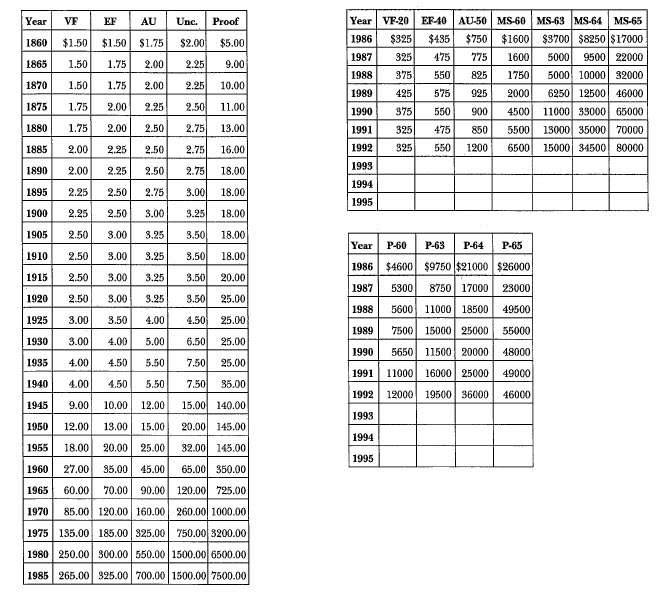
1845 Liberty Seated: Market Values
1845 Liberty Seated: Summary of Characteristics
Business Strikes:
Enabling legislation: Act of January 18, 1837 Designer of obverse: Robert Ball Hughes (after Gobrecht)
Designer of reverse: Robert Ball Hughes (after Reich)
Weight and composition: 412.5 grains; .900 silver, .100 copper
Melt-down (silver value) in year minted: $1.004 Dies prepared: Obverse: Unknown; Reverse: Unknown
Business strike mintage: 24,500; Delivery figures by month: May: 1,000; August: 23,500.
Estimated quantity melted: Unknown
Approximate population MS-65 or better: 0 or 1 (URS-O)
Approximate population MS-64: 1 or 2 (URS-1)
Approximate population MS-63: 2 to 4 (URS-2)
Approximate population MS-60 to 62: 2 to 4 (URS-2)
Approximate population VF-20 to AU-58: 900 to 1,400 (URS-11)
Characteristics of striking: Usually well struck, but there are exceptions.
Known hoards of Mint State coins: None
Proofs:
Dies prepared: Obverse: 1; Reverse: 2 (including one prepared in 1840)
Proof mintage: 15 to 25 estimated
Approximate population Proof-64 or better: 2 or 3 (URS-2)
Approximate population Proof-60 to 63: 3 to 6 (URS-3)
Commentary:
The 1845 is exceedingly rare in Mint State.
Additional Information
Coins as a Commodity
The Annual Report of the United States Treasury, 1845, stated that in 1845 coins of the United States amounting to $844,446 were exported as were foreign coins to the amount of $7,762,049. Imported coins amounted to $3,962,864.
Further: "Specie is, in a commercial sense, an article of merchandise, bought and sold at every commercial point, and entering largely into the channels of foreign trade. It is almost as much an article of trade as a barrel of port: with this difference, the former has a value approaching a fixed value while the latter has a variable value. Specie may be considered in Europe and America as an article of merchandise, forming one of the items of an ordinary price current: ever variable in value, commercially and legally, its value ascertained by the same standard as a barrel of flour, viz. Its weight-worth more at one point than another, but finally, it is a basis of wealth, the measure of value of all property, its exportation lessening our real wealth; and its importation (and it can be imported only upon two grounds, 1st, as the adjusting weight in the balance of trade or 2dly, as capital, for investment), adding to our actual national wealth."
The Year 1845 in History
In 1845, Florida joined the Union on March 3rd as the 27th state, and on December 29th the erstwhile Republic of Texas (established in 1836) became the 28th. The border dispute with England over the definition of the line between Oregon and the British lands continued to make the news. Oregon belonged to the United States "by right of our manifest destiny to overspread the continent allotted by Providence for the free development of our yearly multiplying millions," editor John L. O'Sullivan proclaimed in the July August issue of United States Magazine and Democratic Review. In his annual message to Congress, President James Knox Polk decreed that we had the proper claim to the border at 54 degrees, 40 minutes and that this right was beyond question, giving rise to the cry, "Fifty-four forty or fight!" The city of Portland was established in Oregon Territory and was named after a city in Maine when two people from New England flipped a large cent to choose between Portland and Boston. To the south, relations with Mexico worsened, but there was no intention of going to war about it.
Famine spread throughout Europe, and an estimated 2,500,000 people died from starvation. Particularly hard hit was Ireland, whose potato crop failed, a situation which prompted many Irish to emigrate to the United States. Trade with China, opened to Western commerce in 1842, continued to expand. In New York City the "extreme" (a term for the new, high-speed design) clipper ship Rainbow was launched. Such vessels would proliferate during the next 20 years, despite competition from an ever-growing worldwide fleet of steam-powered iron ships. In Annapolis, the United States Naval Academy was opened.
Nautilus Insurance Company, founded in 1845, would change its name to the New York Life Insurance Company in 1849. Among the claims paid out in the 1840s were those to relatives of victims of cholera, yellow fever, and Indian attacks. In New Jersey the Mutual Benefit Life Insurance Company was established in 1845 and would be a pillar of strength until running into trouble over a century later, in the early 1990s.
In Dresden, Germany the opera Tannhauser was performed for the first time. With music and libretto by Richard Wagner, the opera told of the legendary adventures of a medieval" German knight who had spent time at the underground pagan court of the goddess Venus.
Following reports of the director of the Mint, Augustus G. Heaton said in Mint Marks (1893) that no 1845-O quarter eagles were made. In the early 1900s a specimen turned up, then another. For years after, collectors considered this one of the greatest rarities. Only in 1951 did Walter Breen find in the National Archives a record that 4,000 were struck from 1845-dated dies in January 1846.
Although large copper cents were commonly seen in circulation in the northeastern United States(and were hardly ever seen west of Michigan or south of about Virginia), half cents had all but disappeared from commerce. Faced with little call for this, the lowest denomination, the Mint had not made significant numbers since 1835. Each year in the 1840s a few Proofs were made for inclusion in sets.