Silver Dollars & Trade Dollars of the United States - A Complete Encyclopedia
Q. David Bowers
1848 Liberty Seated: Market Values
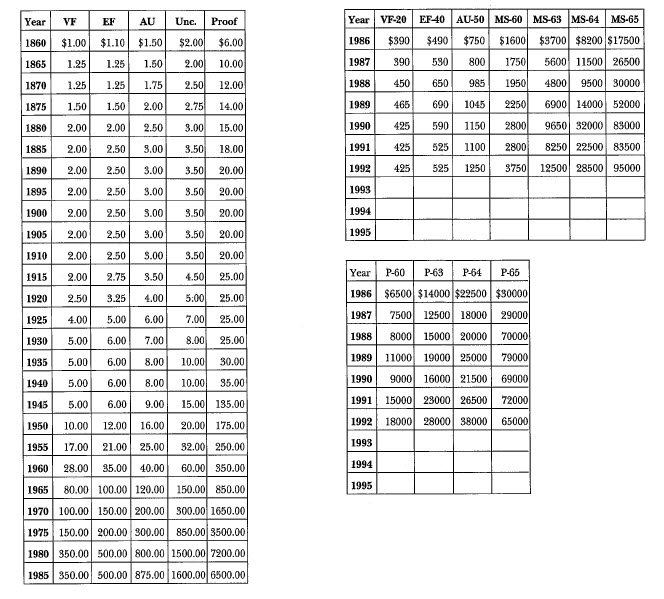
1848 Liberty Seated: Summary of Characteristics
Business Strikes:
Enabling legislation: Act of January 18, 1837
Designer of obverse: Robert Ball Hughes (after Gobrecht)
Designer of reverse: Robert Ball Hughes (after Reich)
Weight and composition: 412.5 grains; .900 silver, .100 copper
Melt-down (silver value) in year minted: $1.008
Dies prepared: Obverse: Unknown; Reverse: Unknown
Business strike mintage: 15,000; Delivery figures by month: December: 15,000.
Estimated quantity melted: Unknown
Approximate population MS-65 or better: 1 or 2 (URS-1)
Approximate population MS-64: 2 or 3 (URS-2)
Approximate population MS-63: 4 to 8 (URS-3)
Approximate population MS-60 to 62: 15 to 25 (URS-5)
Approximate population VF-20 to AU-58: 600 to 1,000 (URS-11)
Characteristics of striking: Usually well struck.
Known hoards of Mint State coins: None
Proofs:
Dies prepared: Obverse: At least 1; Reverse: At least 1.
Proof mintage: 25 to 35
Approximate population Proof-64 or better: 3 to 5 known (URS-3)
Approximate population Proof-60 to 63: 6 to 12 known (URS-4)
Commentary
The 1848, with a very low mintage of 15,000 business strikes, has always been one of the most popular issues of its era with numismatists.
Additional Information
The Year 1848 in History
In 1848, Harvard president Edward Everett made this statement concerning complaints over the admission of a black to that venerable institution: "If this boy passes the examination he will be admitted; and if the white students choose to withdraw, all the income of the college will be devoted to his education." Elsewhere on the human rights front, the first convention of women's rights activists was held in Seneca Falls, N cw York, under the direction of Lucretia Coffin Mott and Elizabeth Cady Stanton, with 260 women and 40 men in attendance.
The prohibition of slavery in new territories of the United States was the platform of the newly-organized Free Soil Party, which advertised its election hopes by counters tamping United States copper one-cent pieces with the petition: VOTE THE LAND FREE. Free Soil presidential candidate Martin Van Buren snatched away enough votes from the Democrats that their candidate, Lewis Cass (born in Exeter, New Hampshire; well-known as a resident and political leader in Michigan), lost to the carrier of the Whig banner, war hero General Zachary Taylor, who had won the nomination instead of those familiar Whig political war horses, Daniel Webster and Henry Clay.
Under the treaty of Guadalupe Hidalgo, signed February 2, 1848, the Mexican War came to an official end, and much of northern Mexico was ceded to the United States. The agreement provided for payment by the United States of $35 million and the assumption by the U.S. government of claims against Mexico. The consuls present at the ceremony had no idea that the month before, John Marshall had found flecks of gold in the race of the mill he was building for Sutter on the banks of the American River, in a territory belonging to Mexico at the time.
Though Marshall's fellow Mormon Sam Brannan rode horseback through city streets shouting "Gold! Gold! Gold on the American River," inducing thousands to quit their jobs and head inland to the bonanza site, the news of the gold strike would be slow in spreading to the East, and it was not until August 19th that tales of the bonanza mesmerized readers of the New York Herald. By year's end, between 5,000 and 10,000 fortune seekers were camped on the American River and its environs, and many of them had struck it rich. In San Francisco, ships lay deserted in the harbor and stores were closed for lack of clerks, as the able-bodied joined the "Gold Rush."
In December, a casket of native California gold reached the Philadelphia Mint, an event which was said to prove that gold really existed in "them thar hills." However, to most of America proof wasn't needed. The coming year would see the Forty-Niners, with their long lines of wagons stretching into the western sunset, en route to El Dorado. Among the most popular songs with the travelers was Oh. Susanna, by Stephen Collins Foster (who would be memorialized on the Cincinnati commemorative half dollar 88 years later).
Those who didn't go overland to California by one of several major routes took the easy (but longer) way aboard a clipper ship around Cape Horn, a voyage which lasted the best part of 100 days. Adventurers in a hurry could take a steamer to the Isthmus of Panama, cross land by caravan (later, by train), and then pick up another steamer, perhaps one owned by the newly-formed Pacific Mail Steamship Company, on the western side, and continue to San Francisco.
Wisconsin, which had adopted a territorial government in 1836, joined the Union as the 30th state in 1848. On March 28, 1848, John Jacob Astor died at the age of 84, having amassed a fortune estimated at $20 million in the fur trade (Astoria, Oregon and Astoria, New York are named for him, as are Astor Place and the Waldorf-Astoria Hotel in New York City). He was an early advocate of buying corner properties, as he felt that their location, facing on two streets, would be doubly good for commercial purposes.
The developing science-art of economics got a boost with the publication of Principles of Political Economy, by British economist-philosopher and former child prodigy John Stuart Mill. In the Black Forest of Germany, young Michael Welte completed his first orchestrion, an automatically operated device with hundreds of organ pipes which imitated a human orchestra. In an era in which the phonograph, radio, and other music-reproducing devices were unknown, the orchestrion could playa waltz or symphony with equal facility. By the end of the century, orchestrions made by Welte and others were de rigueur in the mansions of the "Upper 400" in American society.
In the eastern and midwestern United States, a new rash of copper tokens reminiscent of the Hard Times era pieces appeared. Advertising on these ranged from promotions of daguerreotype parlors to hatters to stove manufacturers. Many tokens were made in Waterbury, Connecticut by Scovill and were of the size of the contemporary United States large cent. Among large cents, regular ones that is, was the curious "Small Date," dated 1848 but of unknown time of manufacture, possibly a contemporary counterfeit made in New York City circa 1848-1849, but who knows?
The Philadelphia Mint issued its first commemorative coins, 1,389 1848 $2.50 gold quarter eagles (the smallest gold denomination of the time) stamped CAL. on the back, made from the aforementioned shipment of gold sent to the Mint to verity the discovery.