Silver Dollars & Trade Dollars of the United States - A Complete Encyclopedia
Q. David Bowers
1858 Liberty Seated Dollar
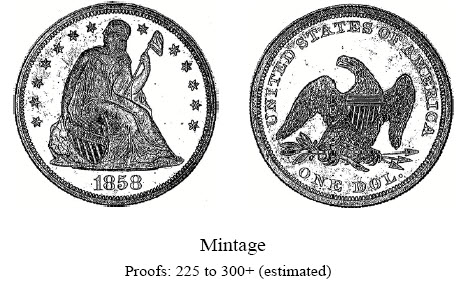
Coinage Context
No business strike coinage: The year 1858 saw no business strike coinage of dollars. Apparently, there was no call for coins of this denomination. However, the Mint made large quantities of lower denomination silver coins throughout the year for circulation.
Numismatic Information
Fame: The 1858, the solitary Proof-only issue among 34 dates of Liberty Seated silver dollars, for decades has been a numismatic Brocken specter-a coin larger than reality, an object of collecting desire, a badge of accomplishment, a game prize sought by some coin buyers who don't even collect Liberty Seated dollars but, somehow, want the distinction that comes with owning a dollar of this date. This is the Liberty Seated series' counterpart to the Proof-only 1895 dollar in the Morgan series.
Proof sets advertised: The year 1858 is remembered in the annals of numismatics as the first time that the Mint advertised Proof sets for sale to the general public. In earlier years, the few collectors wanting Proof sets had no problem. The Mint was always glad to comply with requests for them. However, knowledge of their availability was not wide-spread.
How many 1858 dollars were made? This, one of the most famous dates in the Liberty Seated series, is known only with Proof finish. For over a century, dealers and collectors repeated the Chapman brothers' estimate of only 80 coins (see below), virtually ignoring S.K. Harzfeld's figure of 75 or fewer (also see below). Other old-time estimates have ranged as high as 200, with the suggestion that restrikes were made, possibly in the 1860s. In modern times, estimates have tended to be higher.
Donald Vettel's article, "Some Thoughts on Liberty Seated Dollars: A Scarcity and Price Analysis," published in The Gobrecht Journal, July 1982, estimated that 600 or more Proofs exist today, and claimed the issue is very overrated. In the same Journal, November 1990, Weimar W. White, a student of the Liberty Seated dollar series, suggested that based on auction appearances, the mintage of Proof 1858 dollars was somewhere between 318 and 478 pieces, with 382 being an average. (An updating and revision of this article appeared as "Proof Mintages for 1858 Coins" in The Rare Coin Review No. 87, p. 48, 1992.) White's study and the follow-up revision were widely read and taken seriously, and after that time, fewer references to the traditional 80 mintage figure appeared in numismatic publications. (The same study suggested the following average mintages for certain other Proof silver coins of 1858: half dollar (374), quarter (282), dime (284), and half dime (354).)
Douglas Winter suggested that between 60 and 100 or so Proofs exist today. (Letter to the author, March 16, 1992, also including estimates of the populations of Mint State Liberty Seated dollars of various dates.)
No business strikes were made of the 1858 Proof dollar, and when this became known, probably after about mid-1859 (although Mint officials knew it in 1858), a demand arose for specimens of this date. One obverse die and at least two reverse dies were used to strike Proof 1858 dollars. I believe that specimens were made in 1858 and again in 1859-1860, when the rarity of the date was realized by numismatists. Additional pieces could well have been produced through at least 1876, if not even later, as the second reverse die (described under No.2 in the Proof listing below) was extant at the Mint at that time. (Judd, U.S. Pattern, Experimental, and Trial Pieces, p. 164 states that the reverse used to coin certain pattern dollars this year (J-1470 and 1471) was "the regular die of 1857-8-9 Proofs, without the motto.")
The mintage quantity of 1858 dollars is one of the most intriguing numismatic puzzles of the past 150 years. Mint records are silent on the subject. The Annual Report of the Director of the Mint does not list any production at all (nor did it list the production of other Proofs during this early period).
Apparently, it was the Chapman brothers, S. Hudson and Henry, precocious rare coin dealers of Philadelphia, who stated that sources within the Mint, possibly Patterson DuBois, gave the figure as 80 coins. However, expecting Mint officials to give factual information on the subject, especially if the same officials had been party to restriking additional pieces, was a hope of the most naive nature. Nevertheless, the 80 figure was used in many auction catalogues, price lists, and reference books until relatively recent times.
In his auction catalogue of November 26-27, 1880, S.K. Harzfeld commented as follows under the description of a Proof 1858 silver dollar: "I would here remark, upon the authority of Mr. J. Colvin Randall, that there were not over 75 of these dollars coined, and of this number, some undoubtedly must have been melted during the late war [Civil War]. As there are hundreds of collectors of dollars in the United States, the rarity of these pieces must be apparent to every collector."
If we discard the estimates of 75 or less, 80, and other figures, we can start with a blank sheet of paper and make some estimates based on logic and statistics more than guesswork. As of April 1992, the PCGS and NGC grading services combined had examined 41 specimens of 1858 dollars, undoubtedly including some duplicate submissions of the same coins. However, much can be learned from the numbers. Using population data and comparing surviving percentages of other nearby dates with known distribution figures, in the introduction to the Liberty Seated section I suggested a mintage of 265+/pieces.
How many 1858 Proof dollars were struck? The answer is still uncertain, but a reasonable conjecture seems to be at least 225 and perhaps possibly as many as 300, if not slightly more. Of course, my conclusions are based upon a number of premises, and someone else using different premises can come up with different answers. In its recent editions the Guide Book estimates 300+ as the mintage, a figure suggested by Liberty Seated dollar specialist Weimar W. White.
Varieties
Proofs:
1. Proof issue: Breen-5456. Obverse: With date in prominent figures. Only one die was used this year. Reverse of 1857 No.2 described above. The ANS specimen shows die rust on L in DOL. and on the rim below that letter; same die state as the ANS 1857.
2. Proof issue: Breen-5456. Obverse: As preceding, from the same die. Reverse of 1859 with traces of inner circle at denticles above UNI. Often seen with a depression or pit, probably from foreign matter on the die, in the field near the eagle's beak, above the top of the eagle's dexter wing. Apparently, about 60% to 70% of the known 1858 dollars have this pit. (Per Chris Napolitano, conversation with the author, May 1, 1992, who suggested 70%, and the author's observations involving about 20 coins.)(On the specimen in the Somerset Collection sale, Bowers and Merena, May 1992, Lot 1356, these additional characteristics were noted: In the field below the D of UNITED, about one-third of the distance to the eagle's wing, is another tiny depressed area; at the upper left of the D of DOL is a tiny raised area or lump; other irregularities appear at the lower left of the upright of LA.) Stuart Mosher said he saw specimens with "high unnatural wire edges" and considered them to be restrikes, a status not confirmed by Breen, who has not seen such coins. (Walter Breen s Encyclopedia if U.S, and Colonial Proof Coins, 1722-1989, p. 263. Mosher at one time or another was editor of The Numismatist, private consultant to Texas numismatist O.K. Rumbel, and curator of the National Coin Collection at the Smithsonian Institution.)This die was kept in the Mint at least through 1876, in which year, during the tenure of Mint Director Dr. Henry Richard Linderman, it was used to coin Proof pattern silver dollars. By this time the die showed rust spots. Earlier in the 1870s it had been muled with other pattern dies as well. If any 1858 dollars are indeed restrikes, most certainly those from this die are prime candidates for this status.