Silver Dollars & Trade Dollars of the United States - A Complete Encyclopedia
Q. David Bowers
1873 Liberty Seated: Market Values
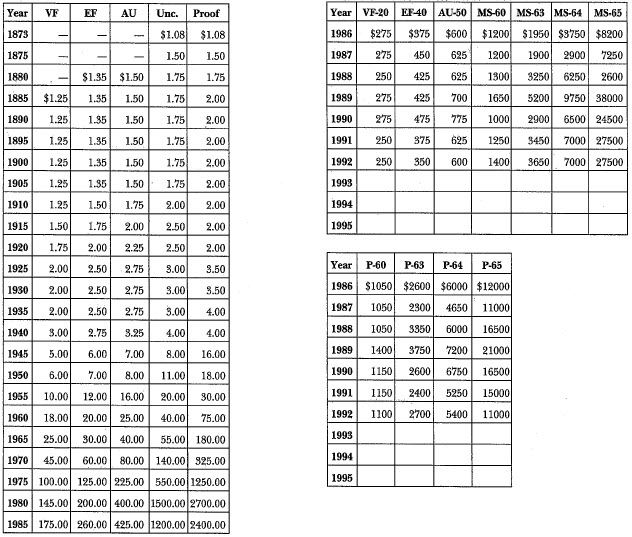
1873 Liberty Seated: Summary of Characteristics
Business Strikes:
Enabling legislation: Act of January 18, 1837 (weight and fineness); Act of March 3, 1865 (motto)
Designer of obverse: Robert Ball Hughes (after Gobrecht)
Designer of reverse: J.B. Longacre (after Hughes and Reich)
Weight and composition: 412.5 grains; .900 silver, .100 copper
Melt-down (silver value) in year minted: $1.00368 (Statistics for the average bullion value of the silver dollar (years 1837 to 1935) are taken from the Report of the Director of the Mint, 1938, p. 88. Bullion values for the next several years after 1873, when silver dollars were not coined, were: 1874 $0.98909, 1875 $0.96086, 1876 $0.90039, and 1877 $0.92958.)
Dies prepared: Obverse: Unknown; Reverse: Unknown
Business strike mintage: 293,000; Delivery figures by day: January 7: 9,000;January 16: 21,500; February 17: 21,000; February 18: 4,000; February 25: 21,000; March 3: 20,000; March 4: 7,000; March 6: 12,000; March 8: 11,000; March 10: 11,000; March 11: 10,000; March 14: 18,000; March 15: 13,000; March 17: 11,000; March 1: 14,000; March 19: 10,000; March 20: 15,000; March 24: 17,000; March 26: 20,000; March 27: 16,000; March 29: 11,500.
Estimated quantity melted: Many were melted at the Mint after July 10, 1873.
Approximate population MS-65 or better: 1 or 2 (URS-1)
Approximate population MS-64: 30 to 50 (URS-6)
Approximate population MS-63: 20 to 40 (URS-6)
Approximate population MS-60 to 62: 50 to 100 (URS-7)
Approximate population VF-20 to AU-58: 260 to 500 (URS-10)
Characteristics of striking: Varies; some with lightly struck details on Miss Liberty's head and light strike on stars, especially 8 through 10. Some
Mint State coins have satiny surfaces. Others are partially prooflike.
Known hoards of Mint State coins: None
Proofs:
Dies prepared: Obverse: 1; Reverse: 2 (one left over from 1872; the other the doubled die used in 1871 and 1872).
Proof mintage: 600; delivery dates: January 18: 100 delivered; February 18: 100; February 28: 200; March 12: 200.
Approximate population Proof-65 or better: 24+/- (URS-6)
Approximate population Proof-64: 102+/- (URS-8)
Approximate population Proof-63: 97+/- (URS-8)
Approximate population Proof-60 to 62: 190+/- (URS-9)
Commentary
Many specimens were melted of this, the last Liberty Seated silver dollar issue.
Additional Information
The Act of February 12, 1873
As finally passed, the Act of February 12, 1873 stated the following, among other provisions:
"SEC. 15. That the silver coins of the United States shall be a trade-dollar, a half-dollar, or fifty-cent piece; a quarter dollar or twenty-five cent piece; a dime, or ten-cent piece; and the weight of the half-dollar shall be twelve grams (grammes) and one-half of a gram (gramme); the quarter-dollar and the dime shall be respectively, one-half and one-fifth of the weight of said half-dollar; and said coins shall be a legal tender at their nominal value for any amount not exceeding five dollars in anyone payment. ...
"SEC. 28. That silver coins other than the trade-dollar shall be paid out at the several mints, and at the assay office in New York City, in exchange for gold coins at par, in sums not less than one hundred dollars, and it shall be lawful, also, to transmit parcels of the same, from time to time, to the assistant treasurers, depositories, and other officers of the United States, under general regulations proposed by the director of the Mint, and approved by the secretary of the Treasury; but nothing herein contracted shall prevent the payment of silver coins, at their nominal value, for silver parted from gold, as provided in this act, or for change less than one dollar in settlement for gold deposits: Provided, That for two years after the passage of this act, silver coins shall be paid at the Mint in Philadelphia and the assay-office in New York City, for silver bullion purchased for coinage, under such regulations as may be prescribed by the director of the Mint, and approved by the secretary of the Treasury ....
"SEC. 66. That the different mints and assay offices authorized by this act shall be known as 'the Mint of the United States at Philadelphia,' 'the Mint of the United States at San Francisco,' 'the Mint of the United States at Carson,' 'the Mint of the United States at Denver, (Although the federal government made provision for a mint at Denver as early as 1862, when the facilities of Clark, Gruber & Co., bankers and assayers of that city, were acquired, the Denver Mint did not strike coins until 1906, by which time it was set up in a new building. Before that time, it functioned only as an assay office, making bars of gold, silver, or unparted mixtures.) the United States assay-office at New York,' 'the United States assay-office at Boise City, Idaho,' 'the United States assay-office at Charlotte, North Carolina;' and all unexpended appropriations heretofore authorized by law for the use of the Mint of the United States at Philadelphia, the branch Mint of the United States in California, the branch mint of the United States at Denver, the United States assay-office in New York, the United States assay-office at Charlotte, North Carolina, and the United States assay-office at Boise City, Idaho, are hereby authorized to be transferred for the account and use of the institutions established and located respectively at the places designated by this act. ... "