Silver Dollars & Trade Dollars of the United States - A Complete Encyclopedia
Q. David Bowers
1850 Liberty Seated Dollar
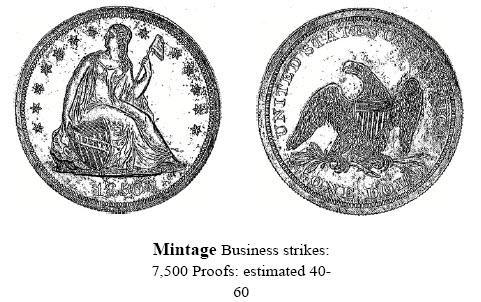
Coinage Context
Limited production: The production of Liberty Seated silver dollars at the Philadelphia Mint hit an all-time low in 1850. The reason for this is not clear in government records, but I believe the explanations are simple. To expand on the commentary given under 1849, the following seems to be a likely scenario:
The gold dollar, introduced in 1849, was popular in government circles and at the Mint, and saw extensive use by the public. At the same time, the silver dollar was not popular and was widely criticized. The year 1850 saw a tremendous production of gold dollars, amounting to 481,953 at the Philadelphia Mint alone, a quantity far greater than had been made of any Liberty Seated silver dollar. It seems to me that the Treasury was trying to promote the new gold dollar as the coin of choice of this denomination, and to minimize the silver dollar. This would also account, in part, for the very low silver dollar mintages of 1851 and 1852 (although the rising price of silver was an integral part of the equation). The exportation of dollars undoubtedly was a factor as well (see citation under Coinage Context, 1848). However, it is to be remembered that the quantity of silver dollars coined was equal to the amount of bullion specifically deposited in request for them.
In a specific contribution to this book, Dr. Harry Salyards points out that Coinage Laws of the United States, gives interesting information concerning silver imports and exports. 1850 was the only year in its immediate time frame in which exports and imports were very nearly equal. Specific figures follow. Exports: 1847: $869,103; 1848: $4,770,419; 1849: $3,432,415; 1850: $2,962,367; 1851: $6,635,839; 1852: $2,600,156; 1853: $2,044,017; 1854: $727,040. Imports: 1847: $2,546,358; 1848: $2,951,529; 1849: $2,582,593; 1850: $2,852,086; 1851: $1,884,413; 1852: $1,846,985; 1853: $1,774,026; 1854: $3,726,623. (Coinage Laws of the United States, 4th Edition, Washington, Government Printing Office, 1894, p. 256. Carothers, Fractional Money, p. 108 gave incorrect information. )
Numismatic Information
Circulated grades: The 1850 dollar begins a decade of rare Liberty Seated dollar issues. Examples in circulated grades are scarce, as the production figure of 7,500 suggests. However, dealer specialists can usually supply examples in VF and EF grades. AU specimens are scarce but not to the extent that the low mintage might imply; often, such pieces are highly publicized when they are offered for sale.
Mint State grades: Mint State coins, when seen, are apt to be nearly fully prooflike and are often mistaken for Proofs. Indeed, they were struck from dies also used to coin Proofs. Such coins are rare at all Mint State grade levels but are extremely so in MS-63 or better. In 1982, Bruce Amspacher stated that he knew of no gems in existence at that time and was aware of just two coins that could be called Mint State. (Article, "Liberty Seated Dollars," in the Monthly Summary, Coin Dealer Newsletter, July-August, 1982. 2 Die description from James C. Gray, letter to the author, October 5, 1992.) High-grade pieces often show diagonal die finish lines on obverse and reverse; these appear as hairlines or brush marks but, unlike these, the finish lines are microscopically raised on the coin surface.
Proof dollars: Although 1850 Proof sets of copper and silver coins are of extreme rarity, and although as Proofs of all denominations are also very rare, the 1850 dollar is most often seen. Apparently, additional coins were struck apart from those issued with sets. The reason for this may rest with the low business strike mintage of just 7,500 coins, third only to the 1851 and 1852 within the 1840-1857 era. Possibly, insiders at the Mint, knowing that business strike dollars had such a low mintage, produced restrikes in a larger than average quantity in view of an anticipated market for them. Whether restrikes were made, or whether all are originals, awaits further study of extant specimens. As it is, hitherto published information is often ambiguous.
Examples of the Proof 1850 Liberty Seated dollar were occasionally seen in dealers' hands in the 1950s, but by now they have been widely dispersed. The appearance of such a coin on the present market would raise many eyebrows.
Varieties
Business strikes:
1. Closed 5: Breen-5442. Obverse: With the knob on 5 touching the cusp above, a rare and seldom seen issue. Proofs were also coined from these dies (same as Proof No.1 described below). Most if not all business strikes have a die crack which angles through the bottom portion of the 0 in ONE and then into the denticles below the N of ONE. In addition, another die crack begins at the denticles below UNITED, crosses the tops of all six letters of UNITED and angles back into the denticles above the ST in STATES. Also, this die has the diagonal defect in the horizontal stripes, which is clearly shown in John Kroon's article on the 1851 dollars which appeared in Collective Volume III of The Gobrechtjournal. This identical die was used to strike all original 1851 dollars."
2. Open 5: Breen-5443. Obverse: With the knob separate from the cusp, and with repunching at the base of the zero. Prominent die file marks extend slightly upward and to the left from the denticles below 50 in the date. Proofs of the Open 5 variety were coined from this obverse. Possible restrikes (see under Proofs below) have a heavy crack through the base of the date and are exceedingly rare. Proof dies were later used to make business strikes, accounting for the prooflike characteristic of circulating pieces.
Proofs:
1. Proof issue; Closed 5: Breen-5442. Obverse: Closed 5 in date, without repunching at the base of o in 1850. Reverse: With die file marks filling most of the shield interstices except the upper left section of the white stripes. A tiny line slants down to the right through the azure of the shield, ending at the lower right corner. Two arrows are joined. Faint die cracks are seen through ON of ONE and TED of UNITED, but not necessarily on all specimens. Struck early, before business strikes were made from these same dies (business strikes, as all 1850 dollars, have prooflike surfaces; see above). The Byron Reed Collection (owned by the city of Omaha, Nebraska) Proof is of this variety. Rarer than the following. Business strikes were also coined from these dies.
2. Proof issue; Open 5: Breen-5443. Obverse: Open 5 in date, with base of 0 in 1850 date double punched. Die file marks are seen below 50. Perfect die (without cracks). Reverse of 1840-1850 (described under 1840). Business strikes were coined from this obverse die. Specimens include the Garrett Collection coin (now in the American Numismatic Society Collection) and the Floyd T. Starr Collection coin (sold by Stack's, October 1992).
2a. Proof issue; Open 5: Breen-5443. Obverse: As preceding, but later issue (restrike?) with heavy crack through the base of date. Apparently, the dies were repolished after having served to produce business strikes. Walter H. Breen suggests that some of these are originals made in 1850, and others, particularly those with high knife-rims, are restrikes. (Walter Breen's Encyclopedia of u.s. and Colonial Proof Coins, 1722·1989, P: 262.) More study is needed.