Silver Dollars & Trade Dollars of the United States - A Complete Encyclopedia
Q. David Bowers
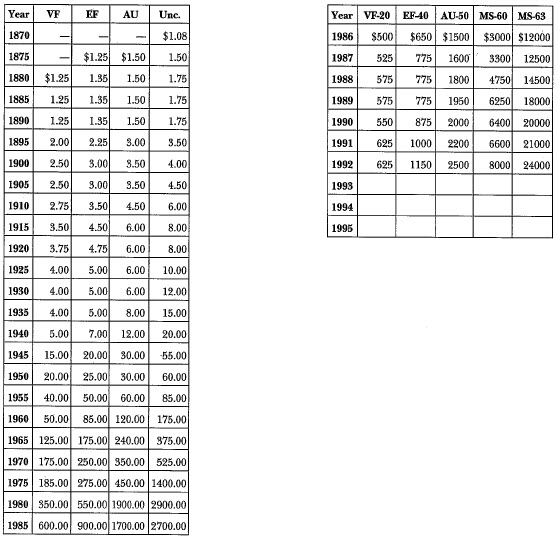
1870-CC Liberty Seated: Market Values
1870-CC liberty Seated: Summary of Characteristics
Business Strikes:
Enabling legislation: Act of January 18, 1837 (weight and fineness); Act of March 3, 1865 (motto)
Designer of obverse: Robert Ball Hughes (after Gobrecht)
Designer of reverse: J.B. Longacre (after Hughes and Reich)
Weight and composition: 412.5 grains; .900 silver, .100 copper
Melt-down (silver value) in year minted: $1.027 Dies prepared: Obverse: 2; Reverse: 5
Business strike mintage: 11,758; Delivery figures by day. ("Die Shipments and Coinage Delivery Dates for the Carson City Branch Mint in the Year 1870." Article by Randall E. Wiley in The Gobrecht journal; July 1988. A Guide Book of United States Coins, 1992, edition, gives 12,462 as the mintage figure.)
February 10: 2,303; February 24: 1,444; March 5: 1,116; March 22: 1,175; March 24: 500; March 30: 1,300; April 7: 500; May 20: 600; June 11: 870;June 14: 550;June 30: 1,400.
Estimated quantity melted: Unknown
Approximate population MS-65 or better: 0 or 1 (URS-O)
Approximate population MS-64: 2 to 4 (URS-2)
Approximate population MS-63: 6 to 10 (URS-4)
Approximate population MS-60 to 62: 10 to 20 (URS-5)
Approximate population VF-20 to AU-58: 260 to 350 (URS-10)
Approximate population AG-3 to F-15:
(Estimates of the population of Carson City Liberty Seated dollars in grades AG-3 to F-15 are from John Kroon, letter to the author April 30, 1992. Estimates of other grades are the author's.) 150-250 (URS-9)
Characteristics of striking: Usually well struck, a general characteristic of most varieties of Carson City dollars over the years; this is especially true of the reverse. However, as is the case with other CC Mint Liberty Seated dollars, the word LIBERTY on the shield is not as prominent as on Philadelphia coins, and tended to wear away especially quickly once the coins saw circulation. Most if not all were struck with prooflike surfaces. The most spectacularly prooflike coins, including one astonishing DMPL in the Weimar W. White Collection, are from dies 1-D, thought to have been the first of eight varieties struck. Some 1870-CC dollars have weakness on Miss Liberty's head and chest.
Known hoards of Mint State coins: None
Proofs:
None
Commentary
The 1870-CC is the first Carson City silver dollar issue. Many were saved as the first of their kind, largely retrieved from circulation. Close to 5% survive.
Additional Information
The City and the Mint
In the late 1850s the western section of Nevada had few inhabitants and consisted of little except sparsely vegetated high prairie and mountain landscapes. Abraham Curry, who came from New York State, went to Nevada and purchased a tract of land on which he established Carson City in 1858. In local parlance, and also in numerous entries in the Annual Report of the Director of the Mint, the town was known simply as Carson.
In 1859 a band of travelers located gold-and silver-bearing black sand about 15 miles away from Carson City. Henry Comstock aggressively sought and gained control of the beginning operation, and soon directed a very valuable property which eventually became known as the Comstock Lode. Although the district was primarily known for its silver, vast amounts of gold were also found there. Word of the bonanza spread westward to California, where many gold-seekers had found the yellow metal elusive and had been reduced to employment on farms, in stores, and other less adventurous pursuits. The Comstock Lode beckoned, and by 1860-1862 the district, centered in Virginia City, was teeming with miners, nearly all of whom worked as laborers in large mining operations. Unlike in the early days of the Gold Rush in California,
Estimates of the population of Carson City Liberty Seated dollars in grades AG-3 to F-15 are from John Kroon, letter to the author April 30, 1992. Estimates of other grades are the author's. in Nevada there was little opportunity for the one-man mine. Largest of all Virginia City operations was the sprawling Gould & Curry facility.
Prosperity was the theme of the day, and fortunes were made not only in mining but in railroading, gambling, and other related ventures. On March 2, 1861 Nevada was granted territorial status, and on October 31, 1864 it became a state.
From 1859 through the early 1860s, most gold and silver from Virginia City was shipped by rail to San Francisco, the leading financial center of the West Coast. The San Francisco Mint converted much of the metal to coins.
The bonanza of riches from the earth spawned a number of very powerful political figures in Nevada, and repeated calls were made to establish a mint in the state. This would give Nevada a status of its own and was envisioned as a giant step in the establishment of the state as an important financial center in its own right, as opposed to being a feeder to San Francisco. In Washington, Treasury Secretary Salmon P. Chase favored a mint in Nevada, while Mint Director James Pollock felt that with existing mints at Philadelphia, New Orleans (inactive since 1861, when Civil War exigencies forced its closing), and San Francisco, a new mint would be redundant. It would make much more sense, he felt, to enlarge the San Francisco facilities, which at the time were cramped and poorly ventilated.
A Nevada mint was to be, and the Act of March 3, 1863 set forth the necessary details for a beginning, including salaries for those employed there. One of the most powerful figures in Nevada was Abram (also spelled Abraham) Curry, an owner of the Gould & Curry mine and the man who founded Carson City. He sold the government a tract of land in Carson in 1865. Following an authorization on July 18, 1866, construction began of a sandstone building 60 by 90 feet in floor plan, two and one-half stories high, estimated to cost $150,000. When the project was finished in autumn 1868, costs had mounted to $426,000. By December 1869 nearly everything was ready, and it was anticipated that coins bearing a distinctive mintmark, CC, would be struck for the first time. The use of a single letter, C, was considered, but was abandoned as that letter had been the mark of the Charlotte Mint from 1838 until it closed in 1861.