Silver Dollars & Trade Dollars of the United States - A Complete Encyclopedia
Q. David Bowers
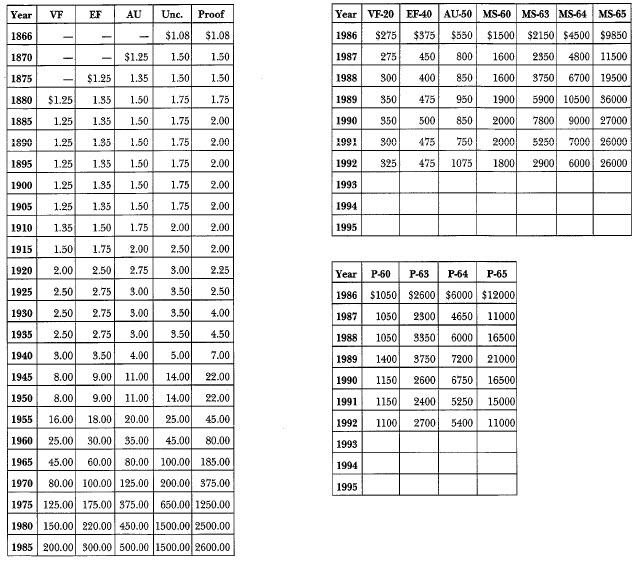
1866 With Motto: Market Values
1866 With Motto: Summary of Characteristics
Business Strikes:
Enabling legislation: Act of January 18, 1837 (weight and fineness); Act of March 3, 1865 (motto)
Designer of obverse: Robert Ball Hughes (after Gobrecht)
Designer of reverse: James Barton Longacre (after Hughes and Reich)
Weight and composition: 412.5 grains; .900 silver, .100 copper
Melt-down (silver value) in year minted: $1.036
Dies prepared: Obverse: Unknown; Reverse: Unknown
Business strike mintage: 48,900; Delivery figures by day: January 30: 6,700; May 8: 15,900; June 21: 6,600; July 30: 13,900; August 24: 5,800.
Estimated quantity melted: Unknown
Approximate population MS-65 or better: 10 to 15 (URS-5)
Approximate population MS-64: 15 to 25 (URS-5)
Approximate population MS-63: 20 to 40 (URS-6)
Approximate population MS-60 to 62: 20 to 40 (URS-6)
Approximate population VF-20 to AU-58: 275 to 400 (URS-10)
Characteristics of striking: Many are weakly struck, especially at stars 8 and 9.
Known hoards of Mint State coins: None
Proofs:
Dies prepared: Obverse: 3; Reverse: 2.
Proof mintage: 725; delivery dates: January 17: 100 delivered; January 23: 100; January 29: 100; February 9: 200; March 5: 100; June 11: 50; July 25: 50; September 17: 25.
Approximate population Proof-65 or better: 34+/- (URS-7)
Approximate population Proof-64: 110+/- (URS-8)
Approximate population Proof-63: 112+/- (URS-8)
Approximate population Proof-60 to 62: 200+/- (URS-9)
Commentary
This is the first year that the motto IN GOD WE TRUST appeared on the Liberty Seated silver dollar.
Additional Information
The Motto IN GOD WE TRUST
James Pollock's Annual Report of the Director of the Mint, 1866, contains the following paragraph: "Morro COINS:
The motto, 'In God We Trust,' authorized by Act of Congress of March 3, 1865, has been placed upon all the gold and silver coins of the United States susceptible of such addition since the commencement of the current year. 'Happy is the nation whose God is the Lord."
The motto IN GOD WE TRUST on circulating coinage first appeared in 1864 on the two-cent piece. The Act of March 3, 1865 provided that it would be lawful for the director of the Mint, with the approval of the secretary of the Treasury, to place IN GOD WE TRUST on silver and gold coins.
The motto had its origin in a letter from M.R. Watkinson, minister of the gospel, in Ridleyville, Pennsylvania, who wrote on November 13, 1861 to Secretary of the Treasury Salmon P. Chase:
"One fact touching our currency has hitherto been seriously overlooked. I mean the recognition of the Almighty God in some form in our coins.
"You are probably a Christian. What if our Republic were now shattered beyond reconstruction? Would not the antiquaries of succeeding centuries rightly reason from our past that we were a heathen nation? What I propose is that instead of the goddess of Liberty we shall have next inside the 13 stars a ring inscribed with the words 'perpetual union;' within this ring the all-seeing eye, crowned with a halo; beneath this eye the American flag, bearing in its field stars equal to the number of the States united; in the folds of the bars the words 'God, liberty, law.'
"This would make a beautiful coin, to which no possible citizens could object. This would relieve us from the ignominy of heathenism. From my heart I have felt our national shame in disowning God as not the least of our present national disasters.
"To you first I address a subject that must be agitated. "M.R. WATKINSON,
"Minister of the Gospel. "
Chase responded by sending the following letter to the director of the Mint on November 20, 1861:
"DEAR SIR: No nation can be strong except in the strength of God, or safe except in His defense. The trust of our people in God should be declared on our national coins.
"You will cause a device to be prepared without unnecessary delay with a motto expressing in the fewest and tersest words possible this national recognition.
"Yours, truly,
"S.P; CHASE.
"[To] JAMES POLLOCK, Esq., "Director of the Mint, Philadelphia, Pa. "
Mint Director Pollock found that the Act of January 18, 1837 prescribed the mottoes and devices on coinage, and nothing could be added without specific legislation. In December 1863, Pollock submitted bronze pattern cents, two cent, and three-cent pieces, the two-cent piece in two versions, Washington's bust with GOD AND OUR COUNTRY, and a shield design with GOD OUR TRUST. Secretary Chase wrote to the director of the Mint on December 1863, as follows:
"I approve your mottoes, only suggesting that on that with the Washington obverse [the pattern two-cent piece is referred to here] the motto should begin with the word 'Our,' so as to read: 'Our God and our country.' And on that with the shield, it should be changed to read: 'In God we trust."
Secretary Chase preferred the adopted wording IN GOD WE TRUST as nearest to the motto of his alma mater, Brown University, IN DEO SPERAMUS (In God we hope).
Following Chase's recommendations, the bill which became the Act of April 22, 1864 authorized the bronze cent and two-cent coins, the latter bearing the new motto. It did not reach the silver (25¢ to $1) and gold denominations ($5 to $20) until 1866, conforming to the Act of March 3, 1865. Quarter eagles first showed the motto in 1908, cents in 1909, and dimes in 1916.