Silver Dollars & Trade Dollars of the United States - A Complete Encyclopedia
Q. David Bowers
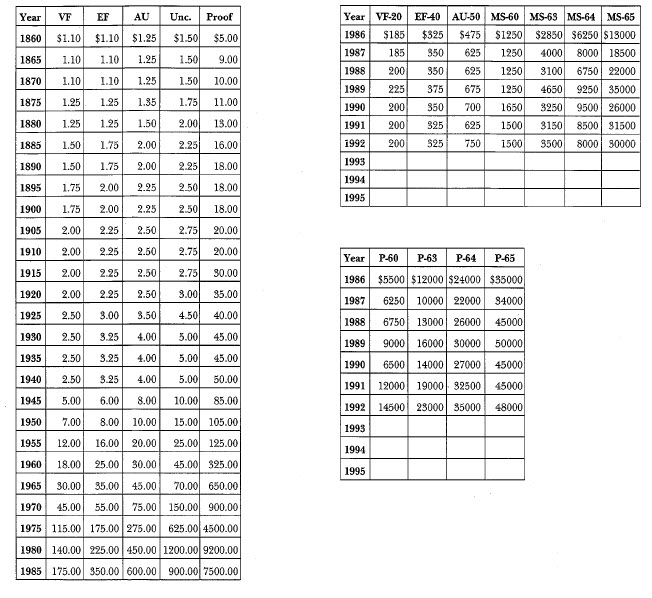
1846 Liberty Seated: Market Values
1846 Liberty Seated: Summary of Characteristics
Business Strikes:
Enabling legislation: Act of January 18, 1837 Designer of obverse: Robert Ball Hughes (after Gobrecht)
Designer of reverse: Robert Ball Hughes (after Reich)
Weight and composition: 412.5 grains; .900 silver, .100 copper
Melt-down (silver value) in year minted: $1.005 Dies prepared: Obverse: Unknown; Reverse: Unknown
Business strike mintage: 110,600; Delivery figures by month: June: 73,000; July: 28,000; November: 9,600.
Estimated quantity melted: Unknown
Approximate population MS-65 or better: 0 or 1 (URS-O)
Approximate population MS-64: 2 to 4 (URS-2)
Approximate population MS-63: 8 to 12 (URS-4)
Approximate population MS-60 to 62: 25 to 50 (URS-6)
Approximate population VF-20 to AU-58: 2,000+ to 4,000 (URS-13)
Characteristics of striking: Usually very well struck and very pleasing in appearance.
Known hoards of Mint State coins: None
Proofs:
Dies prepared: Obverse: 2; Reverse: 1. Proof mintage: 40 to 60
Approximate population Proof-64 or better: 8 to 12 (URS-4)
Approximate population Proof-60 to 63: 20 to 30 (URS-6)
Commentary:
The 1846 dollar, plentiful in worn grades, is seldom seen in Mint State.
Additional Information
The Year 1846 in History
International events were especially important in 1846. The Walter Tariff Act enacted the year before, on July 30, 1845, helped the United States come close to free trade. During the next decade exports would double to $306 million and imports would triple to $361 million. Many imports consisted of manufactured goods from Europe, most particularly from England, while food was a major export item.
The United States' war with Mexico began on January 13, 1846, following President James Knox Polk's unsuccessful attempt to purchase the New Mexico Territory from Mexico. Provoking the situation, Polk ordered General Zachary Taylor to advance to the Rio Grande River, and on April 25th the first clash with the enemy occurred. On May 8, 1846 the Battle of Palo Alto, at a watering place in southern Texas, saw Taylor's force of 2,000, equipped with modern artillery, vanquish 6,000 Mexicans. On May 11 th, Polk declared to Congress that Mexico "has invaded our territory and shed American blood upon American soil." On May 13th, Congress declared war, appropriated $10 million to wage it, and provided for the enlistment of 50,000 troops. Santa Anna, former dictator of Mexico, took command of the Mexican Army, and on September 24th in Monterrey his force of 10,000 succumbed to 6,600 under the command of General Taylor. On November 15th, Tampico yielded to American naval forces, and on November 16th, Saltillo fell to General Taylor's troops. The rather one-sided Mexican War would subsequently provide the reason for creating some of the largest and most beautiful medals ever produced by the Philadelphia Mint. Mexico was having trouble to the west as well. On June 14th in Sonoma, California, the so-called Black Bear Revolt began when settlers raised their own flag displaying a black bear and star.
The Oregon boundary dispute with Britain was resolved on June 15th when the United States accepted the territory below the 49th parallel, while Britain retained the northern side mainland and Vancouver Island. Trade with China expanded, and the Tudor Ice Company of Boston utilized 175 ships to transport 65,000 tons of New England pond ice to the Orient, where silk and other goods were acquired in exchange.
Ireland's famine continued as the potato crop failed again. Hundreds of thousands of people died. In Britain and America numerous private programs helped, but only in a small way. Emigration from Ireland to America continued.
In Washington, DC, Congress utilized a bequest of £100,000 from James Smithson (an Englishman who knew relatively little about America) to found the Smithsonian Institution "for the diffusion of knowledge." Later affectionately known as "the nation's attic," the Smithsonian eventually became a vast storehouse of treasures, ranging from the Hope Diamond to moon rocks, from early planes to spacecraft, from the only known 1849 $20 gold coin to the original Star Spangled Banner. The 1849 double eagle was, of course, a part of the Mint Collection, which was transferred there in the twentieth century.
On the commercial scene, the Pennsylvania Railroad received a charter on April 13, 1846, and went on to become one of America's leading rail lines. After the Pennsylvania Railroad faded in the late twentieth century with the advent of Conrail and Amtrak, it remained one of four railroads beloved to players of Parker Brothers' Monopoly game (along with Short Line, Reading Railroad, and the Baltimore & Ohio, the last-named being the means of financing the fabulous Garrett Collection of coins, which would be formed beginning in the 1860s and continuing through the 1930s). In New York City, Knoedler's Art Gallery opened its doors and started buying and selling paintings at tiny fractions of the values many would achieve a century later. In 1846 no one could have envisioned that certain paintings would sell for millions of dollars several generations later. On the contrary, there was a belief in some quarters that the spread and improvement of photography would render paintings worthless.
Richard Hoe patented his rotary "lightning press," which soon made obsolete the flat-bed presses used in print shops and newspaper offices everywhere. Hoe would amass a fortune, part of which he would spend on rare books.
Popular pastimes included singing Blue Tail Fly, published in 1846, and playing baseball, the rules of which (defined by Abner Doubleday in 1839) were revised in 1846 by Alexander Cartwright, of the Knickerbocker Baseball Club.
In 1846 the following estimate was given of the number of steamboats built the previous year at five places on the Ohio and Mississippi rivers: New Albany 11, Louisville 15, St. Louis 10, Cincinnati 20, and Pittsburgh 42. Including these, there were no fewer than 750 steamboats on these inland waters, amounting to about 160,000 tons, costing no less than 12 million dollars in their construction. (Data from The Bankers' Magazine, October 1846.) New Orleans was one of America's main ports, with exportations to Boston, New York, Great Britain, France, and elsewhere.
In Philadelphia, coinages of half dimes and dimes were smaller than usual. When numismatics became popular on a widespread basis about 15 years later, the 1846 half dime and dime would be recognized as being scarce.